


Prefrontal contributions to relational encoding in amnestic mild cognitive impairment
- PMID: 26937384
- PMCID: PMC4753805
- DOI: 10.1016/j.nicl.2016.01.008
Prefrontal contributions to relational encoding in amnestic mild cognitive impairment
Abstract
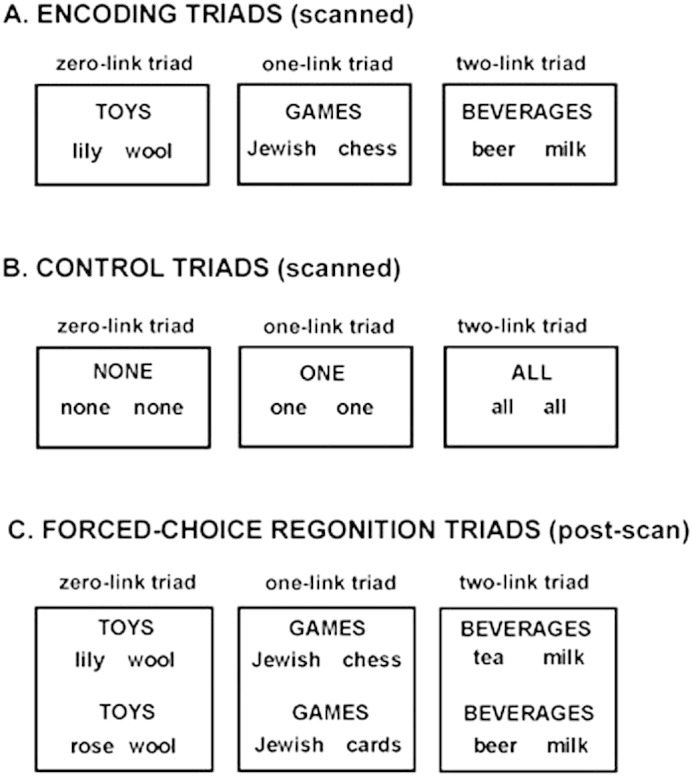
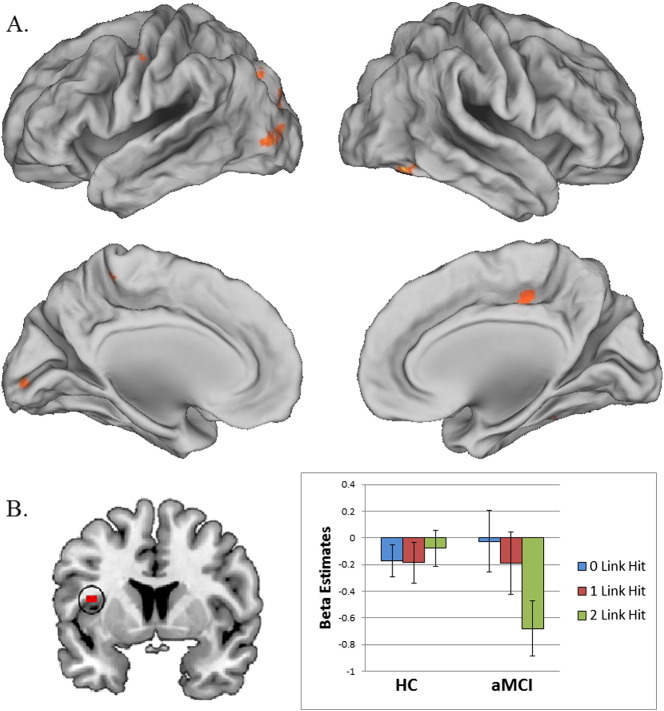
Relational memory declines are well documented as an early marker for amnestic mild cognitive impairment (aMCI). Episodic memory formation relies on relational processing supported by two mnemonic mechanisms, generation and binding. Neuroimaging studies using functional magnetic resonance imaging (fMRI) have primarily focused on binding deficits which are thought to be mediated by medial temporal lobe dysfunction. In this study, prefrontal contributions to relational encoding were also investigated using fMRI by parametrically manipulating generation demands during the encoding of word triads. Participants diagnosed with aMCI and healthy control subjects encoded word triads consisting of a category word with either, zero, one, or two semantically related exemplars. As the need to generate increased (i.e., two- to one- to zero-link triads), both groups recruited a core set of regions associated with the encoding of word triads including the parahippocampal gyrus, superior temporal gyrus, and superior parietal lobule. Participants diagnosed with aMCI also parametrically recruited several frontal regions including the inferior frontal gyrus and middle frontal gyrus as the need to generate increased, whereas the control participants did not show this modulation. While there is some functional overlap in regions recruited by generation demands between the groups, the recruitment of frontal regions in the aMCI participants coincides with worse memory performance, likely representing a form of neural inefficiency associated with Alzheimer's disease.
Keywords: Aging; Functional MRI; Mild cognitive impairment; Relational memory.
Figures
References
-
- Achim A.M., Lepage M. Neural correlates of memory for items and for associations: an event-related functional magnetic resonance imaging study. J. Cogn. Neurosci. 2005;17(4):652–667. - PubMed
-
- Addis D.R., McAndrews M.P. Prefrontal and hippocampal contributions to the generation and binding of semantic associations during successful encoding. NeuroImage. 2006;33(4):1194–1206. - PubMed
-
- Addis D.R., Schacter D.L. Constructive episodic simulation: temporal distance and detail of past and future events modulate hippocampal engagement. Hippocampus. 2008;18(2):227–237. - PubMed
-
- Albert M.S., DeKosky S.T., Dickson D., Dubois B., Feldman H.H., Fox N.C., Gamst A., Holtzman D.H., Jagust W.J., Petersen R.C., Snyder P.J., Carrillo M.C., Thies B., Phelps C.H. The diagnosis of mild cognitive impairment due to Alzheimer's disease: recommendations from the national institute on aging-Alzheimer's association workgroups on diagnostic guidelines for Alzheimer's disease. Alzheimers Dement. 2011;7(3):270–279. - PMC - PubMed
Publication types
MeSH terms
Grants and funding
LinkOut - more resources
Full Text Sources
Other Literature Sources
Medical
Research Materials
