


Effect of the US National HIV/AIDS Strategy targets for improved HIV care engagement: a modelling study
- PMID: 26939737
- PMCID: PMC4787987
- DOI: 10.1016/S2352-3018(16)00007-2
Effect of the US National HIV/AIDS Strategy targets for improved HIV care engagement: a modelling study
Abstract
Background: The recently updated White House National HIV/AIDS Strategy (NHAS) includes specific progress indicators to improve the HIV care continuum in the USA, but the economic and epidemiological effect of achieving those indicators remains unclear. We aimed to project the impact of achieving NHAS goals on HIV incidence, prevalence, mortality, and costs among adults in the USA over 10 years.
Methods: We constructed a dynamic transmission model of HIV progression and care engagement based on literature sources and the most recent published US Centers for Disease Control and Prevention data. We specifically considered achievement of the 2020 targets set forth in NHAS progress indicator 1 (90% awareness of serostatus), indicator 4 (85% linkage within 1 month), and indicator 5 (90% of diagnosed individuals in care).
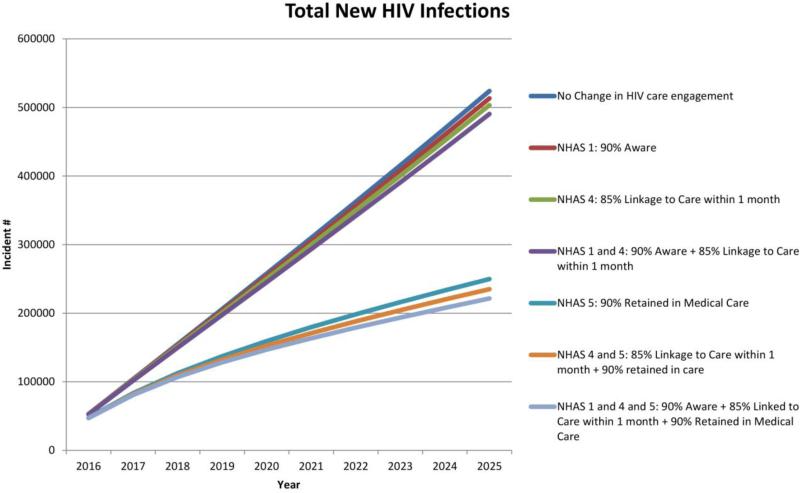
Findings: At current rates of engagement in the HIV care continuum, we project 524,000 (95% uncertainty range 442,000-712,000) new HIV infections and 375,000 deaths (364,000-578,000) between 2016 and 2025. Achievement of NHAS progress indicators 1 and 4 has modest epidemiological effect (new infections reduced by 2·0% and 3·9%, respectively). By contrast, increasing the proportion of diagnosed individuals in care (NHAS indicator 5) averts 52% (95% UR 47-56) of new infections. Achievement of all NHAS targets resulted in a 58% reduction (95% UR 52-61) in new infections and 128 000 lives saved (106,000-223,000) at an incremental health system cost of US$105 billion.
Interpretation: Achievement of NHAS progress indicators for screening, linkage, and particularly improving retention in care, can substantially reduce the burden of HIV in the USA, but continued and increased financial investment will be required.
Funding: The National Institutes of Health, the B Frank and Kathleen Polk Assistant Professorship in Epidemiology, Emory University CFAR, Johns Hopkins University CFAR, and CDC/NCHHSTP Epidemiological and Economic Modeling Agreement (5U38PS004646).
Copyright © 2016 Elsevier Ltd. All rights reserved.
Figures
Comment in
-
Let's treat everyone with HIV now: what happens next?Lancet HIV. 2016 Mar;3(3):e109-10. doi: 10.1016/S2352-3018(16)00017-5. Epub 2016 Feb 8. Lancet HIV. 2016. PMID: 26939733 No abstract available.
References
-
- Quinn TC, Wawer MJ, Sewankambo N, et al. Viral load and heterosexual transmission of human immunodeficiency virus type 1. New England Journal of Medicine. 2000;342(13):921–9. - PubMed
-
- Cohen M. Final results of the HPTN 052 randomized controlled trial: antiretroviral therapy prevents HIV transmission Program number MOAC0106LB, Track C. International AIDS Society; Vancouver; 2015. 2015.
-
- Centers for Disease Control and Prevention Monitoring selected national HIV prevention and care objectives by using HIV surveillance data-United States and 6 dependent areas--2013. [Sept 29 2015];HIV surveillance Supplemental Report. 2015 2015 http://www.cdc.gov/hiv/library/reports/surveillance/
-
- Skarbinski J, Rosenberg E, Paz-Bailey G, et al. Human immunodeficiency virus transmission at each step of the care continuum in the United States. JAMA internal medicine. 2015;175(4):588–96. - PubMed
Publication types
MeSH terms
Grants and funding
LinkOut - more resources
Full Text Sources
Other Literature Sources
Medical
