Review
. 2016;7(1):3-21.
doi: 10.1080/19490976.2015.1116673.

Systems-wide analyses of mucosal immune responses to Helicobacter pylori at the interface between pathogenicity and symbiosis

Affiliations
Review

Systems-wide analyses of mucosal immune responses to Helicobacter pylori at the interface between pathogenicity and symbiosis

Barbara Kronsteiner et al. Gut Microbes. 2016.

Abstract

Helicobacter pylori is the dominant member of the gastric microbiota in over half of the human population of which 5-15% develop gastritis or gastric malignancies. Immune responses to H. pylori are characterized by mixed T helper cell, cytotoxic T cell and NK cell responses. The presence of Tregs is essential for the control of gastritis and together with regulatory CX3CR1+ mononuclear phagocytes and immune-evasion strategies they enable life-long persistence of H. pylori. This H. pylori-induced regulatory environment might contribute to its cross-protective effect in inflammatory bowel disease and obesity. Here we review host-microbe interactions, the development of pro- and anti-inflammatory immune responses and how the latter contribute to H. pylori's role as beneficial member of the gut microbiota. Furthermore, we present the integration of existing and new data into a computational/mathematical model and its use for the investigation of immunological mechanisms underlying initiation, progression and outcomes of H. pylori infection.

Keywords: IFN-γ; bacterial pathogenesis, commensal; helicobacter pylori; host tolerance; immune evasion; information biology; treg.


Figures
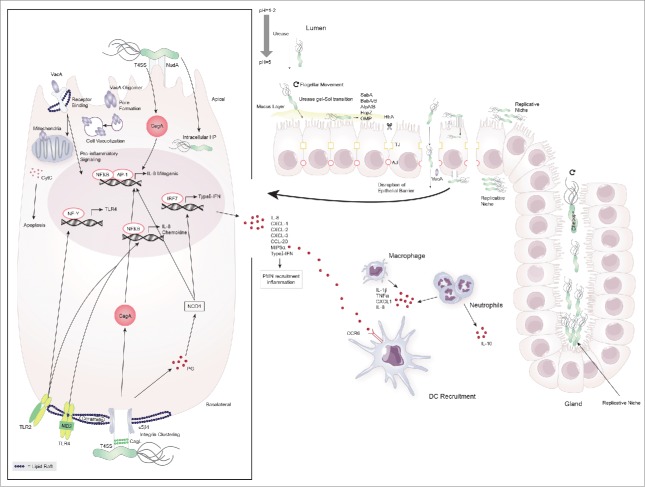
Figure 1.
Figure 1.
Colonization of the gastric niche and initiation of immune responses by H. pylori. H. pylori possesses a number of virluence factors that aid in its ability to colonize and exploit the gastric niche for survival and replication. It elevates the gastric pH by secretion of urease and traverses the mucus layer through flagellar movement and urease-induced gel-sol transition. Once in contact with the epithelial cell layer it binds to the apical cell surface using various adhesins (SabA, BabA/B, AlpA/B, HopZ, OMP) causing cell damage and facilitating the delivery of toxins. H. pylori disrupts the cell barrier by breaking up tight- and adherent junctions (TJ, AJ) through HtrA and enters the lamina propria to replicate at the basolateral cell surface. H. pylori further exploits gastric glands and the apical cell surface as replicative niche for which the proteins Chepep and the virulence factor CagA respectively are essential. At the basolateral cell surface H. pylori forms the type 4 secretion system (T4SS) encoded by the cag pathogenicity island and causes integrin clustering at lipid rafts to inject CagA into epithelial cells. Peptidoglycan (PG) leaks through the T4SS and is recognized by the pathogen recognition receptor (PRR) NOD1. These two virulence factors induce the transcription of host-cell genes including IL-8, chemokines and type-I interferons (type-I IFN) through NFκB/AP1 and IRF7, respectively. H. pylori further causes host cell remodeling and damage through VacA. This toxin either heterodimerizes and forms pores in the cell membrane or enters by receptor binding to cause cell-vacuolization, pro-inflammatory cytokine signaling and cytochrome C (CytC)- induced apoptosis. Epithelial cells at the mucosal barrier are involved in initiating the immune response to H. pylori by antigen-induced TLR-2 and -4 signaling through NFκB. This is further amplified by the induction of TLR-4 transcription via NF-Y-mediated TLR-2 signaling. The subsequent secretion of chemokines attracks peripheral mononuclear cells (PMN) including neutrophils and dendritic cells to the site of infection.
Figure 2.
Figure 2.
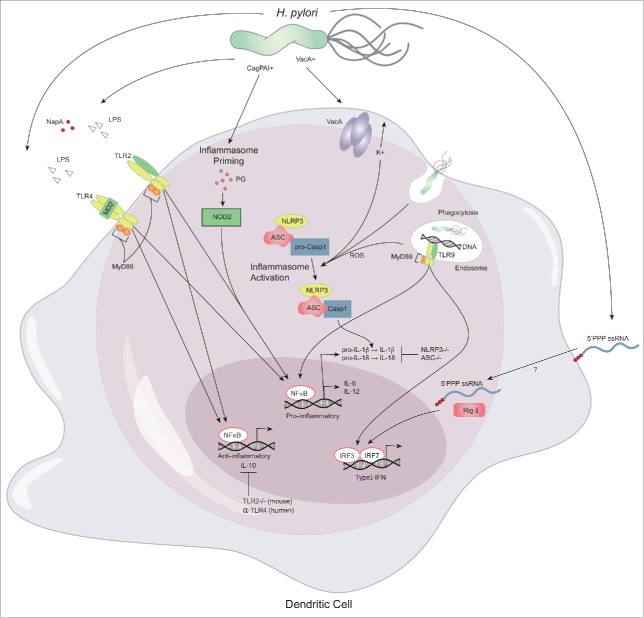
Innate immune sensing of H. pylori. The innate immune response to H. pylori is initiated by epithelial cells and tissue resident macrophages. Upon chemokine secretion dendritic cells are recruited to the gastric mucosa, where they encounter, recognize and process various known and unknown H. pylori antigens. Myd88-dependent TLR2 (LPS, NapA) and TLR4 (LPS) antigen binding results in both pro- and anti-inflammatory cytokine production which reflects the complexity of the immune response initiated by H. pylori. Following phagocytosis bacterial DNA is bound by TLR9 on endosomes and induces transcription of pro-inflammatory cytokines and type-I interferons (IFN) through NFkB and IRF7/IRF8, respectively. Bacterial RNA is recognized by RIG-I and elicits Myd88-independent signaling to induce transcription of type-I IFN. Furthermore, inflammasome priming is mediated by binding of peptidoglycan (PG) to NOD2 and subsequent activation of NFκB-mediated transcription of pro-IL-1β. Subsequently, the inflammasome complex NLRP3/ASC/pro-Casp1 is activated by potassium efflux and phagocytosis-induced ROS production, which results in Casp1-mediated cleavage of pro-IL-1β to IL-1β.
Figure 3.
Figure 3.
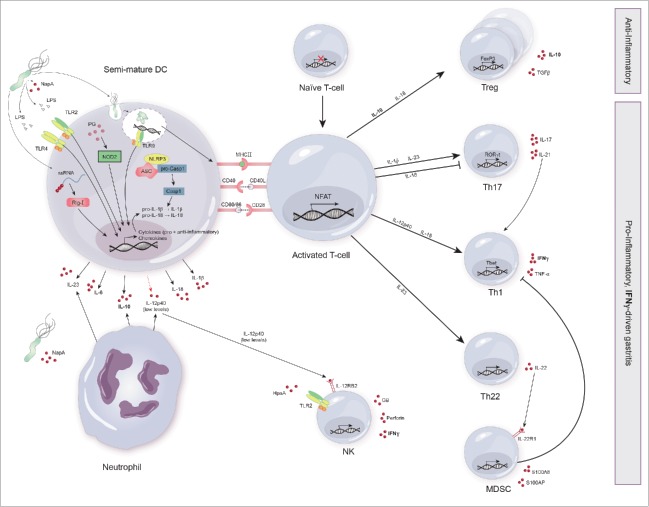
Shaping adaptive immune responses to H. pylori. Dendritic cells (DC) encountering H. pylori have been shown to possess a semi-mature phenotype. The adaptive immune response to H. pylori is characterized by a mixed anti- and pro-inflammatory response. Upon pathogen receptor recognition, DC and neutrophils secrete a number of cytokines including IL-1β, IL-6, IL-10, IL-18, IL-23 and low levels of IL-12p40. These cytokines and concomitant presentation of H. pylori antigens by semi-mature DC to naive T cells via MHC-II results in the expansion of H. pylori-specific Treg. Furthermore, T cells differentiate into Th17, Th1 and Th22. The secretion of IL-22 by Th22 induces the secretion of anti-bacterial proteins by MDSC (monocytic-myeloid derived suppressor cells). IL-21 secretion by Th17 supports Th1 differentiation and thus maintains the Th17/Th1 axis during gastritis. In contrast, MDSC exert an inhibitory effect on Th1 cells. Upon binding of HpaA to TLR2 and IL-12RB2 signaling, NK cells secrete granzyme B (GB), perforin and IFN-γ. Importantly, IFN-γ secreted by NK cells, Th1 cells and possibly other cell types (CD8+ T cells) has been identified as the main driver of gastritis.

References

    1. Ndip RN, MacKay WG, Farthing MJG, Weaver LT. Culturing Helicobacter pylori from clinical specimens: review of microbiologic methods. J Pediatr Gastroenterol Nutr 2003; 36:616-22; PMID:12717085; http://dx.doi.org/ 10.1097/00005176-200305000-00005 - DOI - PubMed
    1. McNulty SL, Mole BM, Dailidiene D, Segal I, Ally R, Mistry R, Secka O, Adegbola RA, Thomas JE, Lenarcic EM, et al.. Novel 180- and 480-base-pair insertions in African and African-American strains of Helicobacter pylori. J Clin Microbiol 2004; 42:5658-63; PMID:15583296; http://dx.doi.org/ 10.1128/JCM.42.12.5658-5663.2004 - DOI - PMC - PubMed
    1. Mane SP, Dominguez-Bello MG, Blaser MJ, Sobral BW, Hontecillas R, Skoneczka J, Mohapatra SK, Crasta OR, Evans C, Modise T, et al.. Host-interactive genes in Amerindian Helicobacter pylori diverge from their Old World homologs and mediate inflammatory responses. J Bacteriol 2010; 192:3078-92; PMID:20400544; http://dx.doi.org/ 10.1128/JB.00063-10 - DOI - PMC - PubMed
    1. Marshall BJ, Warren JR. Unidentified curved bacilli in the stomach of patients with gastritis and peptic ulceration. Lancet 1984; 1:1311-5; PMID:6145023; http://dx.doi.org/ 10.1016/S0140-6736(84)91816-6 - DOI - PubMed
    1. Danesh J. Helicobacter pylori infection and gastric cancer: systematic review of the epidemiological studies. Aliment Pharmacol Ther 1999; 13:851-6; PMID:10383517; http://dx.doi.org/ 10.1046/j.1365-2036.1999.00546.x - DOI - PubMed

Publication types

MeSH terms

LinkOut - more resources