


Probing the origin of excitonic states in monolayer WSe2
- PMID: 26940069
- PMCID: PMC4778068
- DOI: 10.1038/srep22414
Probing the origin of excitonic states in monolayer WSe2
Abstract
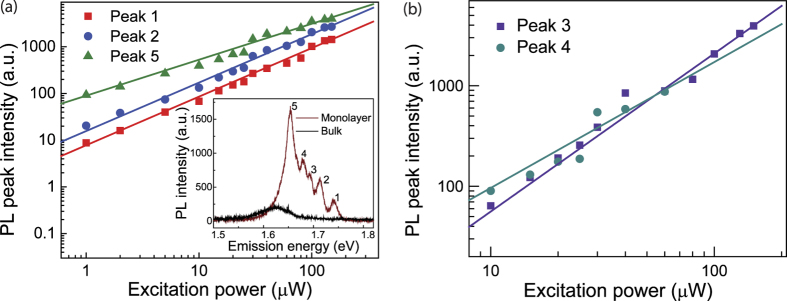
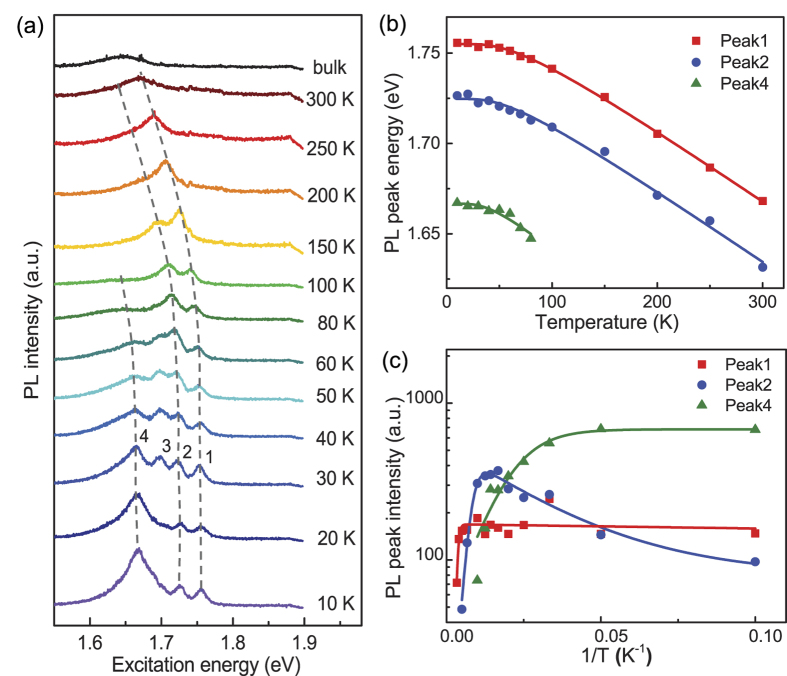
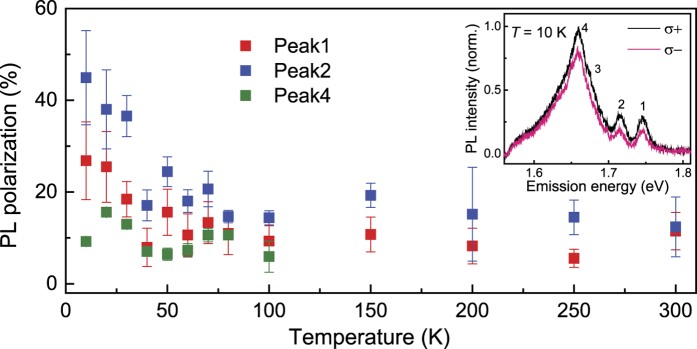
Two-dimensional transition metal dichalcogenides (TMDCs) have spurred excitement for potential applications in optoelectronic and valleytronic devices; however, the origin of the dynamics of excitons, trions, and other localized states in these low dimensional materials is not well-understood. Here, we experimentally probed the dynamics of excitonic states in monolayer WSe2 by investigating the temperature and polarization dependent photoluminescence (PL) spectra. Four pronounced PL peaks were identified below a temperature of 60 K at near-resonant excitation and assigned to exciton, trion and localized states from excitation power dependence measurements. We find that the localized states vanish above 65 K, while exciton and trion emission peaks remain up to room temperature. This can be explained by a multi-level model developed for conventional semiconductors and applied to monolayer TMDCs for the first time here. From this model, we estimated a lower bound of the exciton binding energy of 198 meV for monolayer WSe2 and explained the vanishing of the localized states. Additionally, we observed a rapid decrease in the degree of circular polarization of the PL at increasing temperatures indicating a relatively strong electron-phonon coupling and impurity-related scattering. Our results reveal further insight into the excitonic states in monolayer WSe2 which is critical for future practical applications.
Conflict of interest statement
The authors declare no competing financial interests.
Figures
References
-
- Xiao D., Liu G. B., Feng W. X., Xu X. D. & Yao W. Coupled Spin and Valley Physics in Monolayers of MoS2 and Other Group-VI Dichalcogenides. Phys. Rev. Lett. 108, 196802 (2012). - PubMed
-
- Xu X., Yao W., Xiao D. & Heinz T. F. Spin and pseudospins in layered transition metal dichalcogenides. Nat. Phys . 10, 343–350 (2014).
-
- Wang Q. H., Kalantar-Zadeh K., Kis A., Coleman J. N. & Strano M. S. Electronics and optoelectronics of two-dimensional transition metal dichalcogenides. Nat. Nanotechnol . 7, 699–712 (2012). - PubMed
-
- Mak K. F. et al.. Tightly bound trions in monolayer MoS2. Nat. Mater. 12, 207–211 (2013). - PubMed
-
- He K. et al.. Tightly Bound Excitons in Monolayer WSe2. Phys. Rev. Lett. 113, 026803 (2014). - PubMed
Publication types
LinkOut - more resources
Full Text Sources
Other Literature Sources
