


Health and population effects of rare gene knockouts in adult humans with related parents
- PMID: 26940866
- PMCID: PMC4985238
- DOI: 10.1126/science.aac8624
Health and population effects of rare gene knockouts in adult humans with related parents
Abstract
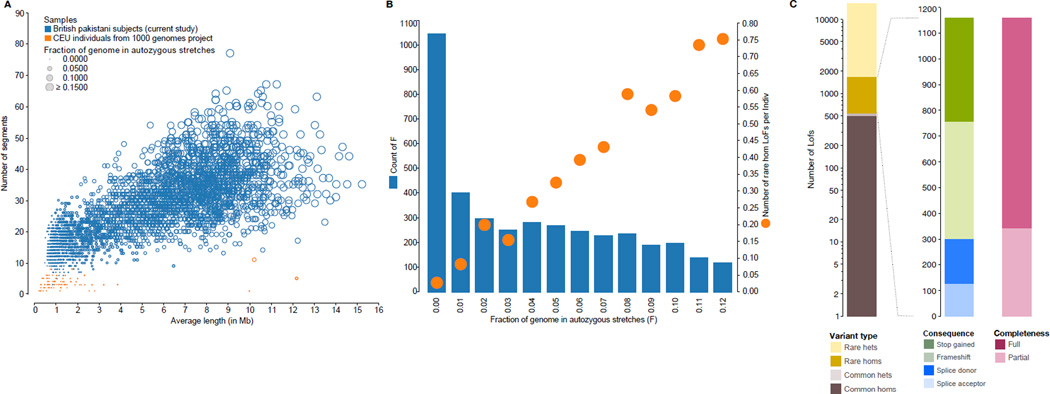
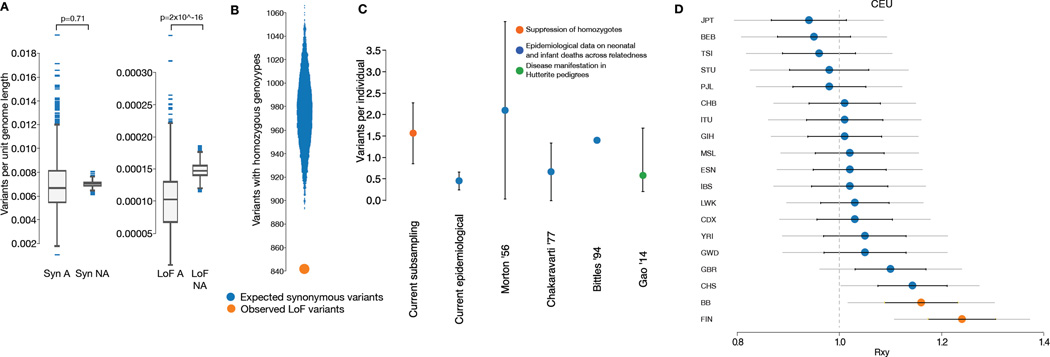
Examining complete gene knockouts within a viable organism can inform on gene function. We sequenced the exomes of 3222 British adults of Pakistani heritage with high parental relatedness, discovering 1111 rare-variant homozygous genotypes with predicted loss of function (knockouts) in 781 genes. We observed 13.7% fewer homozygous knockout genotypes than we expected, implying an average load of 1.6 recessive-lethal-equivalent loss-of-function (LOF) variants per adult. When genetic data were linked to the individuals' lifelong health records, we observed no significant relationship between gene knockouts and clinical consultation or prescription rate. In this data set, we identified a healthy PRDM9-knockout mother and performed phased genome sequencing on her, her child, and control individuals. Our results show that meiotic recombination sites are localized away from PRDM9-dependent hotspots. Thus, natural LOF variants inform on essential genetic loci and demonstrate PRDM9 redundancy in humans.
Copyright © 2016, American Association for the Advancement of Science.
Figures
Comment in
-
Human genetics: Loss-of-function variants--not always what they seem.Nat Rev Genet. 2016 May;17(5):251. doi: 10.1038/nrg.2016.33. Epub 2016 Mar 14. Nat Rev Genet. 2016. PMID: 26972591 No abstract available.
-
Detouring the roadblocks in gene expression.Nat Rev Mol Cell Biol. 2019 Apr;20(4):197. doi: 10.1038/s41580-019-0107-5. Nat Rev Mol Cell Biol. 2019. PMID: 30733603 No abstract available.
References
-
- Exome Aggregation Consortium et al. Analysis of protein-coding genetic variation in 60,706 humans. 2015 http://biorxiv.org/content/early/2015/10/30/030338. - PMC - PubMed
-
- Sulem P, et al. Identification of a large set of rare complete human knockouts. Nat. Genet. 2015;47:448–452. - PubMed
-
- Supplementary Materials.
Publication types
MeSH terms
Substances
Grants and funding
- BHF_/British Heart Foundation/United Kingdom
- MR/K006665/1/MRC_/Medical Research Council/United Kingdom
- MC_PC_13042/MRC_/Medical Research Council/United Kingdom
- GM 099640/GM/NIGMS NIH HHS/United States
- WT098051/WT_/Wellcome Trust/United Kingdom
- CRUK_/Cancer Research UK/United Kingdom
- MR/K006584/1/MRC_/Medical Research Council/United Kingdom
- R01 GM104371/GM/NIGMS NIH HHS/United States
- MR/M009017/1/MRC_/Medical Research Council/United Kingdom
- R01GM104371/GM/NIGMS NIH HHS/United States
- P01 GM099640/GM/NIGMS NIH HHS/United States
- WT102627/WT_/Wellcome Trust/United Kingdom
- WT099769/WT_/Wellcome Trust/United Kingdom
- WT101597/WT_/Wellcome Trust/United Kingdom
- DH_/Department of Health/United Kingdom
- ARC_/Arthritis Research UK/United Kingdom
- U54 DK105566/DK/NIDDK NIH HHS/United States
- WT_/Wellcome Trust/United Kingdom
- CSO_/Chief Scientist Office/United Kingdom
LinkOut - more resources
Full Text Sources
Other Literature Sources
Molecular Biology Databases
