


Gene-Specific Therapy With Mexiletine Reduces Arrhythmic Events in Patients With Long QT Syndrome Type 3
- PMID: 26940925
- PMCID: PMC4773513
- DOI: 10.1016/j.jacc.2015.12.033
Gene-Specific Therapy With Mexiletine Reduces Arrhythmic Events in Patients With Long QT Syndrome Type 3
Abstract
Background: Long QT syndrome type 3 (LQT3) is a lethal disease caused by gain-of-function mutations in the SCN5A gene, coding for the alpha-subunit of the sodium channel NaV1.5. Mexiletine is used to block late sodium current and to shorten QT interval in LQT3 patients.
Objectives: The aim of this study was to determine whether mexiletine prevents arrhythmic events (arrhythmic syncope, aborted cardiac arrest, or sudden cardiac death) in LQT3 patients.
Methods: The endpoint of this retrospective cohort study, which studied consecutive LQT3 patients who were referred to our center and treated with mexiletine, was to evaluate the antiarrhythmic efficacy of mexiletine by comparing the number of arrhythmic events per patient and the annual rate of arrhythmic events during observation periods of equal duration before and after the beginning of therapy with mexiletine.
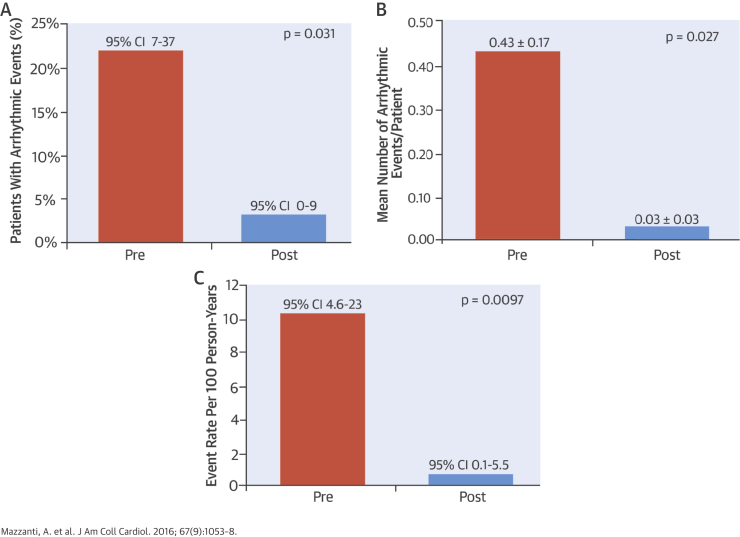
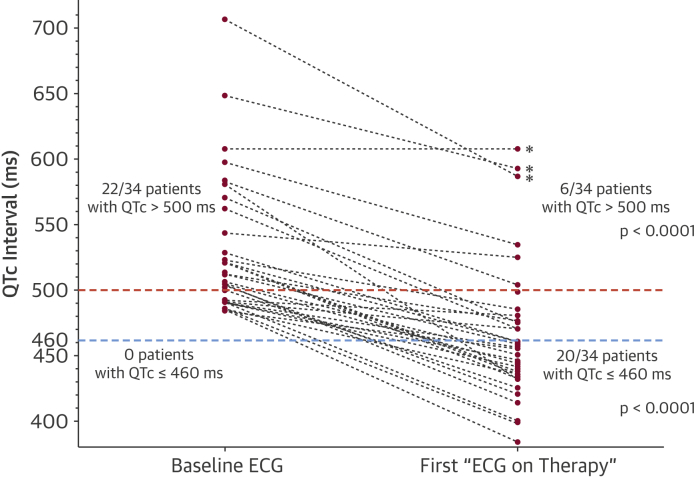
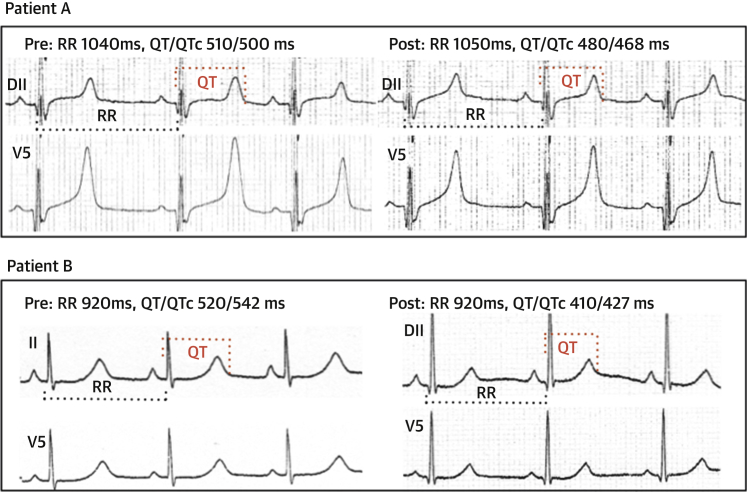
Results: The study population comprised 34 LQT3 patients, 19 (56%) of whom were male. The median age at beginning of treatment with mexiletine was 22 years, and median QTc interval before therapy 509 ms. The median duration of oral mexiletine therapy was 36 months, at an average daily dose of 8 ± 0.5 mg/kg. Mexiletine significantly shortened QTc (by 63 ± 6 ms; p < 0.0001) and reduced the percentage of patients with arrhythmic events (from 22% to 3%; p = 0.031), the mean number of arrhythmic events per patient (from 0.43 ± 0.17 to 0.03 ± 0.03; p = 0.027), and the annual rate of arrhythmic events (from 10.3% to 0.7%; p = 0.0097).
Conclusions: Besides shortening QTc interval, mexiletine caused a major reduction of life-threatening arrhythmic events in LQT3 patients, thus representing an efficacious therapeutic strategy.
Keywords: SCN5A; beta-blocker; mutation; sodium channel; sudden cardiac death.
Copyright © 2016 American College of Cardiology Foundation. Published by Elsevier Inc. All rights reserved.
Figures
Comment in
-
Gene-Specific Therapy for Congenital Long QT Syndrome: Are We There Yet?J Am Coll Cardiol. 2016 Mar 8;67(9):1059-1061. doi: 10.1016/j.jacc.2015.12.030. J Am Coll Cardiol. 2016. PMID: 26940926 No abstract available.
-
Reply: Did Mutation Type Affect the Efficacy of Mexiletine Observed in Patients With LQTS Type 3?J Am Coll Cardiol. 2017 Jan 17;69(2):248-249. doi: 10.1016/j.jacc.2016.09.981. J Am Coll Cardiol. 2017. PMID: 28081834 No abstract available.
-
Did Mutation Type Affect the Efficacy of Mexiletine Observed in Patients With LQTS Type 3?J Am Coll Cardiol. 2017 Jan 17;69(2):248. doi: 10.1016/j.jacc.2016.06.083. J Am Coll Cardiol. 2017. PMID: 28081835 No abstract available.
References
-
- Wang Q., Shen J., Splawski I. SCN5A mutations associated with an inherited cardiac arrhythmia, long QT syndrome. Cell. 1995;80:805–811. - PubMed
-
- Priori S.G., Schwartz P.J., Napolitano C. Risk stratification in the long-QT syndrome. N Engl J Med. 2003;348:1866–1874. - PubMed
-
- Blaufox A.D., Tristani-Firouzi M., Seslar S. Congenital long QT 3 in the pediatric population. Am J Cardiol. 2012;109:1459–1465. - PubMed
-
- Priori S.G., Napolitano C., Schwartz P.J. Association of long QT syndrome loci and cardiac events among patients treated with beta-blockers. JAMA. 2004;292:1341–1344. - PubMed
Publication types
MeSH terms
Substances
Supplementary concepts
LinkOut - more resources
Full Text Sources
Other Literature Sources
Medical
Miscellaneous
