


Concordance of folate receptor-α expression between biopsy, primary tumor and metastasis in breast cancer and lung cancer patients
- PMID: 26943581
- PMCID: PMC4951224
- DOI: 10.18632/oncotarget.7856
Concordance of folate receptor-α expression between biopsy, primary tumor and metastasis in breast cancer and lung cancer patients
Abstract
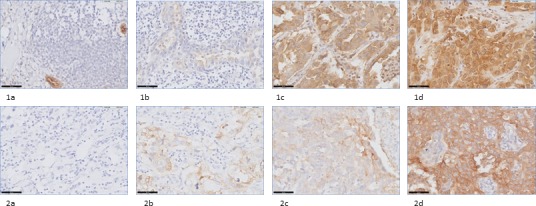
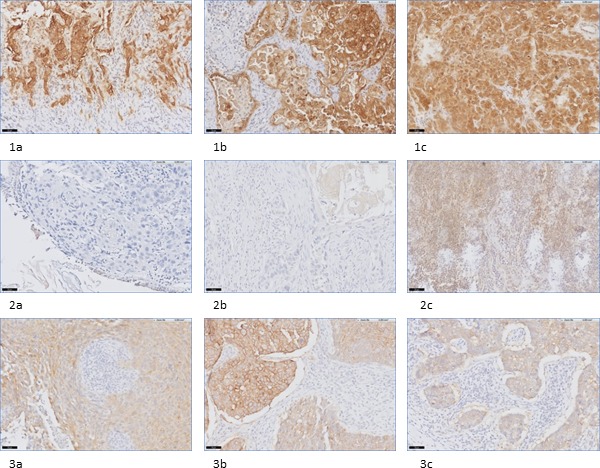
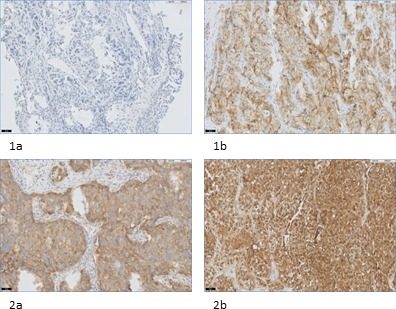
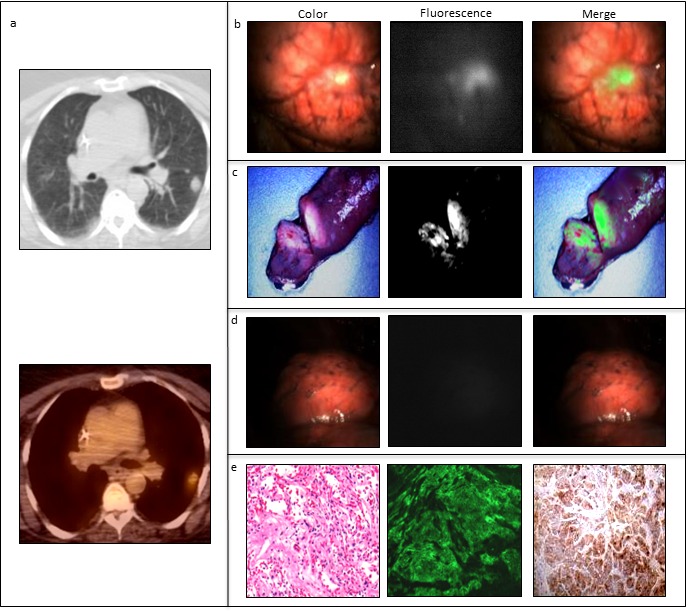
Folate receptor alpha (FRα) is known to be upregulated in a variety of cancers, including non-small cell lung cancer (NSCLC) and breast cancer. To ensure reliable implementation of diagnostic- and therapeutic agents, concordance of FRα expression between biopsy, primary tumor and metastases is important. Using immunohistochemistry (Mab 26B3.F2) these concordances were investigated in 60 NSCLC and 40 breast cancer patients. False positivity of FRα expression on breast and lung cancer biopsies was limited to less than 5%. In NSCLC, FRα expression was shown in 21/34 adenocarcinomas and 4/26 squamous cell carcinomas (SCC). Concordance of FRα expression between biopsy and primary tumor was achieved in respectively 83% and 91% of adenocarcinomas and SCCs. Approximately 80% of all local and distant metastases of NSCLC patients showed concordant FRα expression as their corresponding primary tumor. In breast cancer, FRα positivity was shown in 12/40 biopsies, 20/40 lumpectomies and 6/20 LN metastases, with concordance of 68% between biopsy and primary tumor and 60% between primary tumor and LN metastases. In conclusion, this study shows high concordance rates of FRα expression between biopsies and metastases compared to primary NSCLC and breast cancers, underscoring the applicability of FRα-targeted agents in these patients.
Keywords: Pathology Section; biomarker; diagnosis; oncology; personalized medicine; targeting.
Conflict of interest statement
None
Figures
References
-
- Kourea HP, Zolota V, Scopa CD. Targeted pathways in breast cancer: molecular and protein markers guiding therapeutic decisions. Curr Mol Pharmacol. 2014;7:4–21. - PubMed
-
- Roengvoraphoj M, Tsongalis GJ, Dragnev KH, Rigas JR. Epidermal growth factor receptor tyrosine kinase inhibitors as initial therapy for non-small cell lung cancer: focus on epidermal growth factor receptor mutation testing and mutation-positive patients. Cancer Treat Rev. 2013;39:839–850. - PubMed
-
- Coney LR, Tomassetti A, Carayannopoulos L, Frasca V, Kamen BA, Colnaghi MI, Zurawski VR., Jr Cloning of a tumor-associated antigen: MOv18 and MOv19 antibodies recognize a folate-binding protein. Cancer Res. 1991;51:6125–6132. - PubMed
-
- Ross JF, Chaudhuri PK, Ratnam M. Differential regulation of folate receptor isoforms in normal and malignant tissues in vivo and in established cell lines. Physiologic and clinical implications. Cancer. 1994;73:2432–2443. - PubMed
Publication types
MeSH terms
Substances
LinkOut - more resources
Full Text Sources
Other Literature Sources
Medical
Research Materials
Miscellaneous
