Glycemic Index, Glycemic Load, and Lung Cancer Risk in Non-Hispanic Whites
- PMID: 26944871
- PMCID: PMC4780226
- DOI: 10.1158/1055-9965.EPI-15-0765
Glycemic Index, Glycemic Load, and Lung Cancer Risk in Non-Hispanic Whites
Abstract
Background: Postprandial glucose (PPG) and insulin responses play a role in carcinogenesis. We evaluated the association between dietary glycemic index (GI) and glycemic load (GL), markers of carbohydrate intake and PPG, and lung cancer risk in non-Hispanic whites.
Methods: GL and GI were assessed among 1,905 newly diagnosed lung cancer cases recruited from the University of Texas MD Anderson Cancer Center (Houston, TX) and 2,413 healthy controls recruited at Kelsey-Seybold Clinics (Houston, TX). We assessed associations between quintiles of GI/GL and lung cancer risk and effect modification by various risk factors. ORs and 95% confidence intervals (CI) were estimated using multivariable logistic regression.
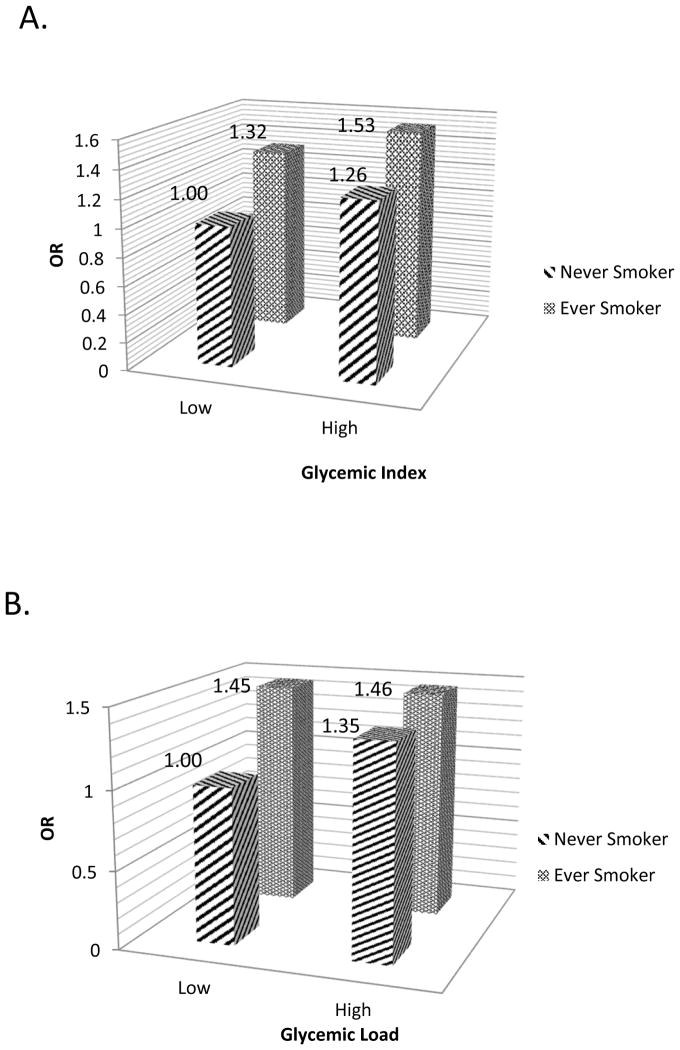
Results: We observed a significant association between GI [5th vs. 1st quintile (Q) OR = 1.49; 95% CI, 1.21-1.83; P(trend) <0.001] and lung cancer risk and GI(ac) (5th vs. 1st Q OR = 1.48; 95% CI, 1.20-1.81; P(trend) = 0.001) and lung cancer risk. We observed a more pronounced association between GI and lung cancer risk among never smokers (5th vs. 1st Q OR = 2.25; 95% CI, 1.42-3.57), squamous cell carcinomas (SCC; 5th vs. 1st Q OR = 1.92; 95% CI, 1.30-2.83), and those with less than 12 years of education (5th vs. 1st Q OR = 1.75; 95% CI, 1.19-2.58, P(interaction) = 0.02).
Conclusion: This study suggests that dietary GI and other lung cancer risk factors may jointly and independently influence lung cancer etiology.
Impact: Understanding the role of GI in lung cancer could inform prevention strategies and elucidate biologic pathways related to lung cancer risk.
©2016 American Association for Cancer Research.
Conflict of interest statement
No conflicts of interest to report
Figures
References
-
- American Cancer Society. Cancer Facts & Figures 2015. Atlanta, Ga: American CancerSociety; 2015.
-
- American Cancer Society. Global Cancer Facts & Figures. 2. Atlanta: American Cancer Society; 2011.
-
- Fedirko V, Lukanova A, Bamia C, Trichopolou A, Trepo E, Nothlings U, et al. Glycemic index, glycemic load, dietary carbohydrate, and dietary fiber intake and risk of liver and biliary tract cancers in Western Europeans. Annals of oncology: official journal of the European Society for Medical Oncology/ESMO. 2013;24:543–53. - PMC - PubMed
-
- Giovannucci E. Insulin, insulin-like growth factors and colon cancer: a review of the evidence. The Journal of nutrition. 2001;131:3109S–20S. - PubMed
Publication types
MeSH terms
Grants and funding
LinkOut - more resources
Full Text Sources
Other Literature Sources
Medical
Research Materials