. 2016 Mar 5:17:7.
doi: 10.1186/s12867-016-0059-7.

Gene expression profiling of the venom gland from the Venezuelan mapanare (Bothrops colombiensis) using expressed sequence tags (ESTs)

Affiliations

Gene expression profiling of the venom gland from the Venezuelan mapanare (Bothrops colombiensis) using expressed sequence tags (ESTs)

Montamas Suntravat et al. BMC Mol Biol. .

Erratum in

Abstract

Background: Bothrops colombiensis is a highly dangerous pit viper and responsible for over 70% of snakebites in Venezuela. Although the composition in B. colombiensis venom has been identified using a proteome analysis, the venom gland transcriptome is currently lacking.

Results: We constructed a cDNA library from the venom gland of B. colombiensis, and a set of 729 high quality expressed sequence tags (ESTs) was identified. A total number of 344 ESTs (47.2% of total ESTs) was related to toxins. The most abundant toxin transcripts were metalloproteinases (37.5%), phospholipases A2s (PLA2, 29.7%), and serine proteinases (11.9%). Minor toxin transcripts were linked to waprins (5.5%), C-type lectins (4.1%), ATPases (2.9%), cysteine-rich secretory proteins (CRISP, 2.3%), snake venom vascular endothelium growth factors (svVEGF, 2.3%), L-amino acid oxidases (2%), and other putative toxins (1.7%). While 160 ESTs (22% of total ESTs) coded for translation proteins, regulatory proteins, ribosomal proteins, elongation factors, release factors, metabolic proteins, and immune response proteins. Other proteins detected in the transcriptome (87 ESTs, 11.9% of total ESTs) were undescribed proteins with unknown functions. The remaining 138 (18.9%) cDNAs had no match with known GenBank accessions.

Conclusion: This study represents the analysis of transcript expressions and provides a physical resource of unique genes for further study of gene function and the development of novel molecules for medical applications.


Figures
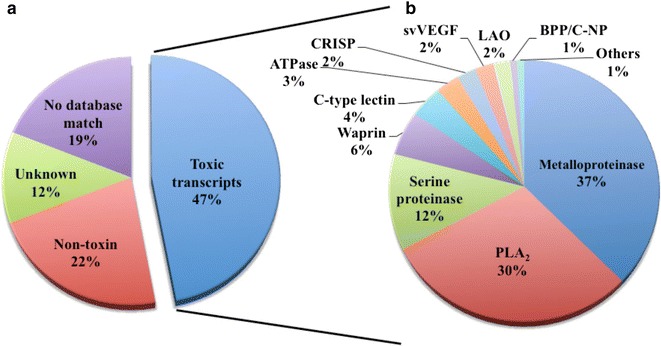
Fig. 1
Fig. 1
The EST toxin transcripts found in the venom gland of a B. colombiensis. The EST toxin transcripts found in the venom gland of a B. colombiensis. a The pie graph shows the relative abundance of all transcripts. Sequences that did not hit anything in the database are indicated as no database match. Unknowns are proteins with no functional attributes. b The percentage of the number of transcripts annotated by function terms based on significant BLASTX matches against NCBI GenBank. BLAST only against non-redundant protein sequences (nr) hits with protein. Others represent the minor components with less than three members including phospholipase B (2 ESTs) and phosphodiesterase (1 EST). Details of the individual proteins are shown in Tables 1, 2
Fig. 2
Fig. 2
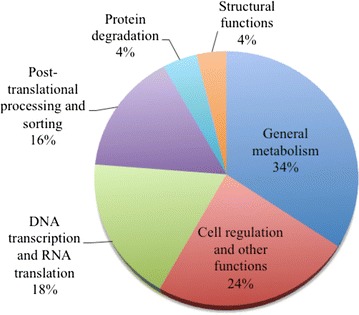
The putative cellular protein transcripts (non-toxins) from B. colombiensis according to their cellular functions
Fig. 3
Fig. 3
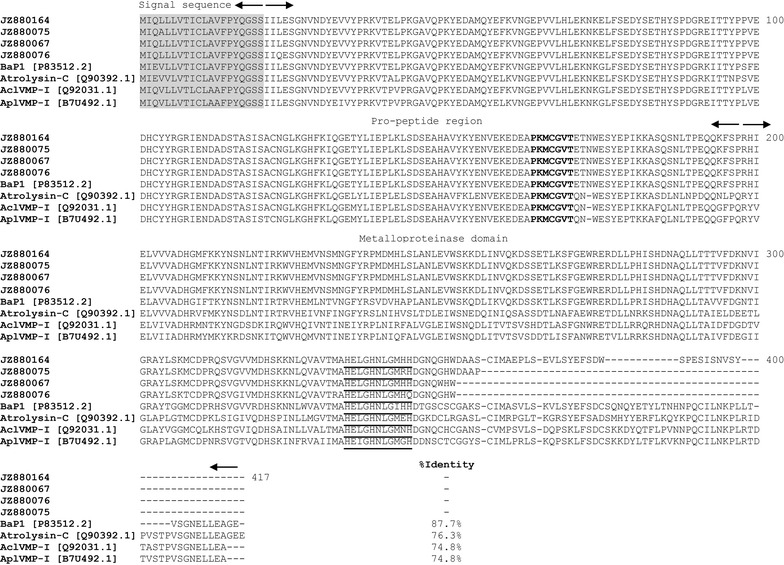
The partially deduced amino acid sequence of the representative clones [JZ880164, JZ880075, JZ880067, and JZ880076] from the most abundant PI-SVMP cluster BC01. Predicted amino acid sequences of transcripts coding for the signal peptide, pro-peptide region, and partial a metalloproteinase catalytic domain with a zinc-binding motif. The signal peptide is highlighted in grey color, and the cysteine-switch motif (PKMCGVT) is bolded. The zinc-binding site is underlined. Each domain is indicated by arrows. The major isoform of cluster BC01 is aligned with BaP1 [P83512.2] from B. asper, atrolysin-C [Q90392.1] from C. atrox, AclVMP-I [Q92031.1] from A. contortrix laticinctus, and AplVMP-I [B7U492.1] from A. piscivorus leucostoma. The  % identity is shown in the figure
Fig. 4
Fig. 4
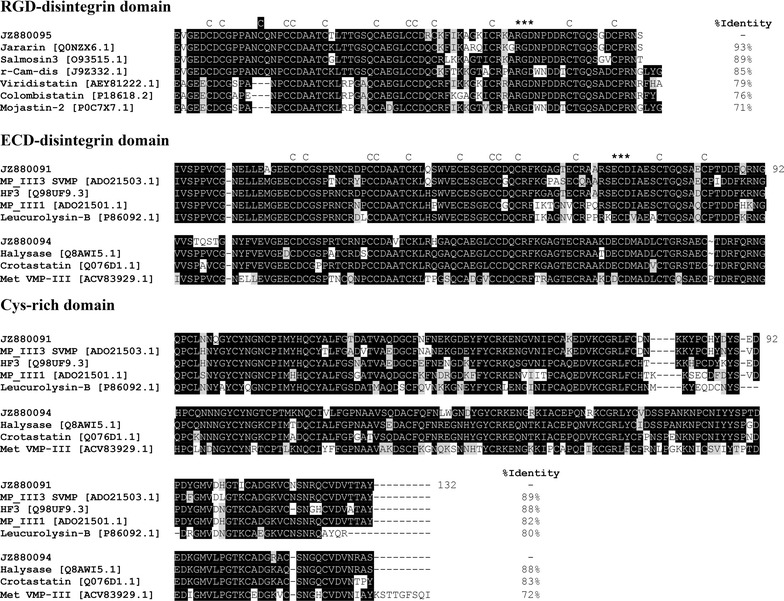
The multiple sequence alignments of the RGD-disintegrin domain (cluster BC03, a representative clone JZ880095), ECD-disintegrin and Cys-rich domains (cluster BC05, a representative clone JZ880091, and cluster BC06, a representative clone JZ880094) of metalloproteinases predicted from partially sequenced clones from B. colombiensis with other homologous venom proteins. The major isoforms from each group is aligned with closely related protein in the database, and the  % identities are shown in the figure. The alignment was generated with the ClustalW multiple sequence alignment program with manual adjustment and displayed with shaded boxes. The numbers in parenthesis are the NCBI accession numbers. The asterisk above the sequences represent the tripeptide binding motif in PII (RGD) and in PIII (ECD). All cysteine residues (letter “C” above the sequences) are conserved except for an extra cysteine residue (the letter “C” highlighted in black) in JZ880095, JZ8800100, jararin, salmosin 3, and r-Cam-dis. The source of sequences were as follows: Jararin [Q0NZX6.1] from B. jararaca, r-Cam-dis [J9Z332.1] from C. adamanteus, salmosin-3 [O93515.1] from G. brevicaudus, viridistatin [AEY81222.1] from C. viridis viridis, mojastin 2 isolated from the venom of C. scutulatus scutulatus, the native disintegrin colombistatin [P18618.2] from B. colombiensis, MP_III3 SVMP [ADO21503.1] from B. neuwiedi, HF3 from B. jararaca, MP_III1 [ADO21501.1] from B. neuwiedi, leucurolysin-B [P86092.1] from B. leucurus, Halysase [Q8AWI5.1] from Gloydius halys, Crotastatin [Q076D1.1] from C. durissus terrificus, and Met VMP-III [ACV83929.1] from A. contortrix laticinctus
Fig. 5
Fig. 5
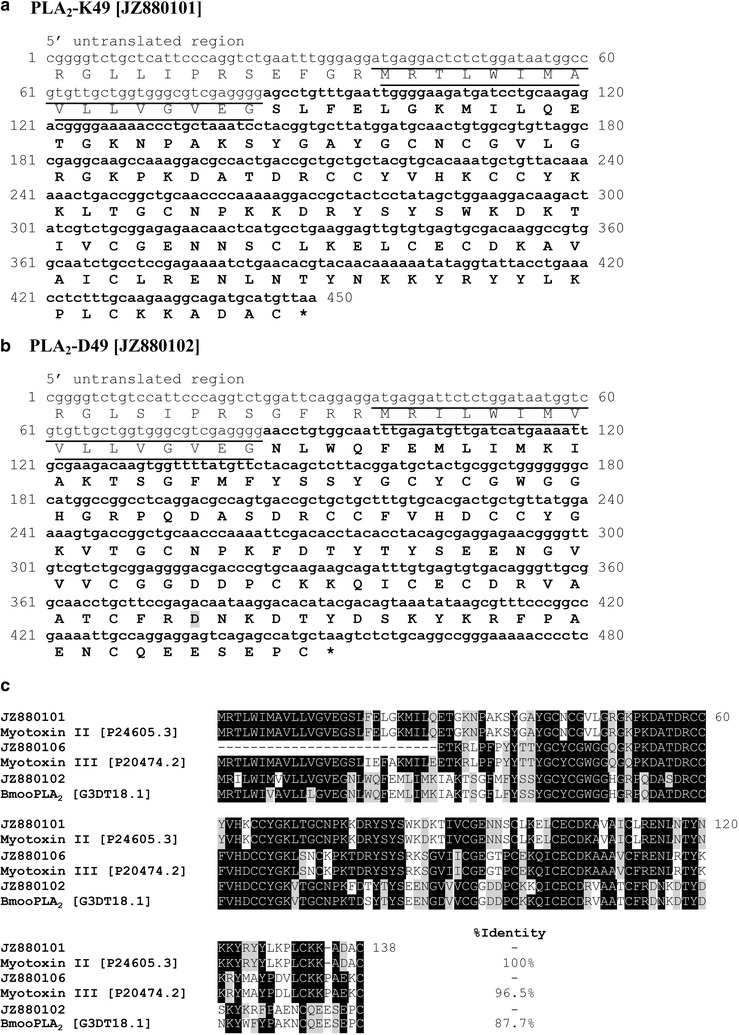
cDNA and deduced amino acid sequences of a representative clone PLA2-K49 from cluster BC11 [dbEST: JZ880101] (a) and a representative PLA2-D49 clone from cluster BC13 [dbEST: JZ880102] (b). The 16-residue signal peptide is underlined. The mature sequence is bolded. (c) Multiple alignments of predicted amino acid sequences of PLA2-K49, PLA2-D49, and basic D49-PLA2 with other homologous venom proteins. The alignment was generated with the ClustalW multiple sequence alignment program with manual adjustment and displayed with shaded boxes. PLA2-K49 [dbEST: JZ880101] is identical to basic the PLA2 homolog 2 (myotoxin II) from B. asper. Basic D49-PLA2 [dbEST: JZ880106] had 96.5 % identity to basic PLA2 myotoxin III [P20474.2] from B. asper. PLA2-D49 [dbEST: JZ880102] is closely homologous to BmooPLA2 from B. moojeni. The numbers in parenthesis are the NCBI accession numbers
Fig. 6
Fig. 6
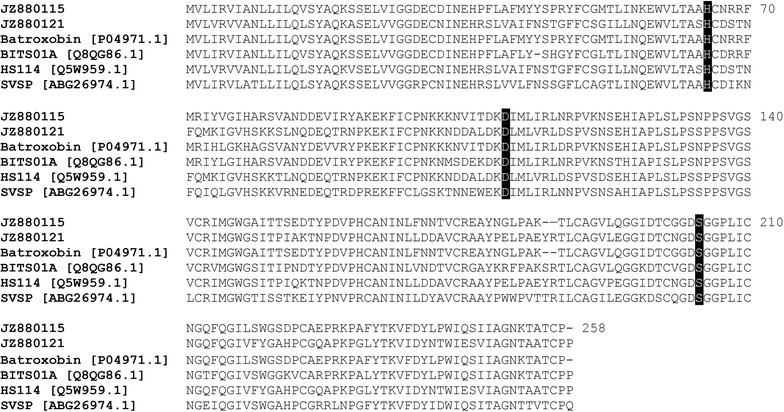
The multiple alignments of completed predicted amino acid sequences of the major isoforms of each cluster BC14 [JZ880115] and BC15 [JZ880121] with batroxobin [P04971.1] from B. atrox, BITS01A [Q8QG86.1] from B. insularis, HS114 [Q5W959.1], HS114 [Q5W959.1] from B. jararaca, and SVSP [ABG26974.1] from Sistrurus catenatus edwardsii. Residues forming the catalytic triad are highlighted with a dark background
Fig. 7
Fig. 7
Multiple alignments of the full-length coding sequences of major isoforms of waprin (cluster BC16, a representative clone JZ880126) from B. colombiensis with other homologous venom proteins. The alignment was generated with the ClustalW multiple sequence alignment program with manual adjustment and displayed with shaded boxes. The numbers in parenthesis are the NCBI accession numbers. Identical residues are marked in black. All cysteine residues (an asterisk above the sequences) are conserved. The bar (-) was introduced for optimal comparison. The inhibition loop is underlined. The sources of sequences are as follows: waprin [BAN89446.1] from Ovophis okinavensis, waprin-Phi1 [A7X4K1.1] from Philodryas olfersii, waprin-Rha1 [A7X4J4.1] from Rhabdophis tigrinus tigrinus, Nawaprin [P60589.1] from Naja nigricollis. The  % identities are shown in the figure
Fig. 8
Fig. 8
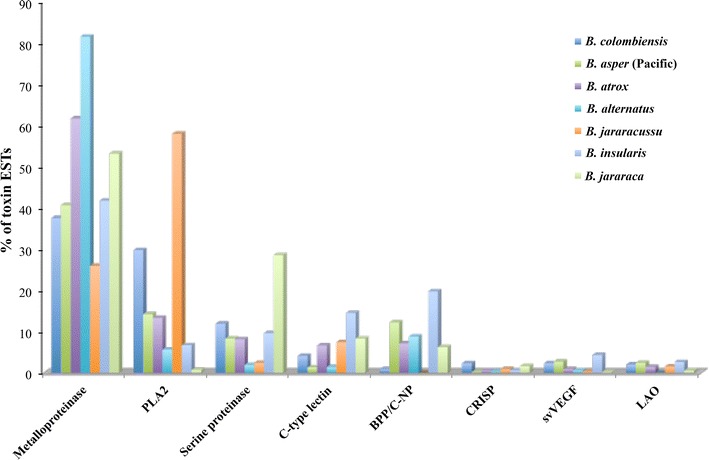
Relative abundance of the major toxin families in Bothrops venom gland transcriptomes. The abundance of transcripts is expressed as a percentage of the total toxin transcripts and was calculated by diving the number of ESTs of each toxin family by the total number of toxin ESTs reported in each study. The data sources other than B. colombiensis were as follows: B. asper (Pacific) [65], B. atrox [25], B. alternatus [24], B. jararacussu [64], B. insularis [27], and B. jararaca [27]. The percentage of each toxin transcript of individual Bothrops species is shown in the Additional file 3

References

    1. Giron ME, Guerrero B, Salazar AM, Sanchez EE, Alvarez M, Rodriguez-Acosta A. Functional characterization of fibrinolytic metalloproteinases (colombienases) isolated from Bothrops colombiensis venom. Toxicon. 2013;74:116–126. doi: 10.1016/j.toxicon.2013.07.025. - DOI - PubMed
    1. Giron ME, Rodriguez-Acosta A, Salazar AM, Sanchez EE, Galan J, Ibarra C, et al. Isolation and characterization of two new non-hemorrhagic metalloproteinases with fibrinogenolytic activity from the mapanare (Bothrops colombiensis) venom. Arch Toxicol. 2013;87(1):197–208. doi: 10.1007/s00204-012-0914-3. - DOI - PubMed
    1. Giron ME, Salazar AM, Aguilar I, Perez JC, Sanchez EE, Arocha-Pinango CL, et al. Hemorrhagic, coagulant and fibrino(geno)lytic activities of crude venom and fractions from mapanare (Bothrops colombiensis) snakes. Comp Biochem Physiol C: Toxicol Pharmacol. 2008;147(1):113–121. - PubMed
    1. Salazar AM, Rodriguez-Acosta A, Giron ME, Aguilar I, Guerrero B. A comparative analysis of the clotting and fibrinolytic activities of the snake venom (Bothrops atrox) from different geographical areas in Venezuela. Thromb Res. 2007;120(1):95–104. doi: 10.1016/j.thromres.2006.07.004. - DOI - PubMed
    1. de Selistre Araujo HS, de Souza DH, Ownby CL. Analysis of a cDNA sequence encoding a novel member of the snake venom metalloproteinase, disintegrin-like, cysteine-rich (MDC) protein family from Agkistrodon contortrix laticinctus. Biochim Biophys Acta. 1997;1342(2):109–115. doi: 10.1016/S0167-4838(97)00111-8. - DOI - PubMed

Publication types

LinkOut - more resources