


Randomized Trial of Peripheral Nerve Stimulation to Enhance Modified Constraint-Induced Therapy After Stroke
- PMID: 26945226
- PMCID: PMC4873453
- DOI: 10.1097/PHM.0000000000000476
Randomized Trial of Peripheral Nerve Stimulation to Enhance Modified Constraint-Induced Therapy After Stroke
Abstract
Background: Constraint-based therapy and peripheral nerve stimulation can significantly enhance movement function after stroke. No studies have investigated combining these interventions for cases of chronic, mild-to-moderate hemiparesis following stroke.
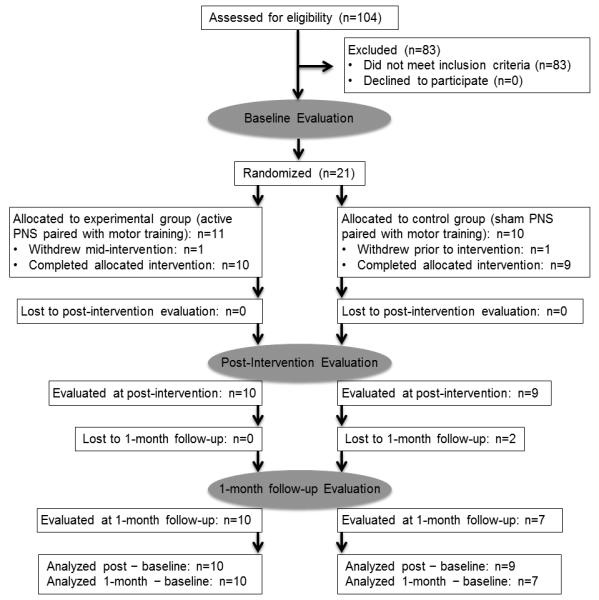
Objective: This study aims to determine the effects of peripheral nerve stimulation paired with a modified form of constraint-induced therapy on upper extremity movement function after stroke. Nineteen adult stroke survivors with mild-to-moderate hemiparesis more than 12 mo after stroke received 2 hours of either active (n = 10) or sham (n = 9) peripheral nerve stimulation preceding 4 hours of modified constraint-induced therapy (10 sessions).
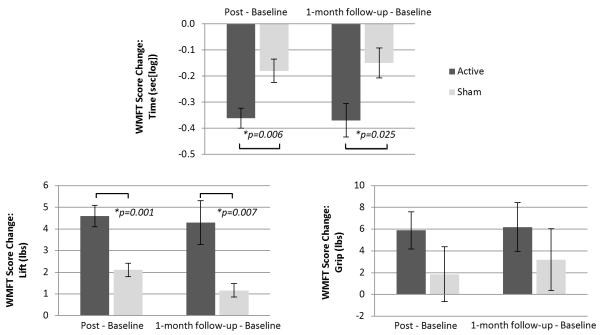
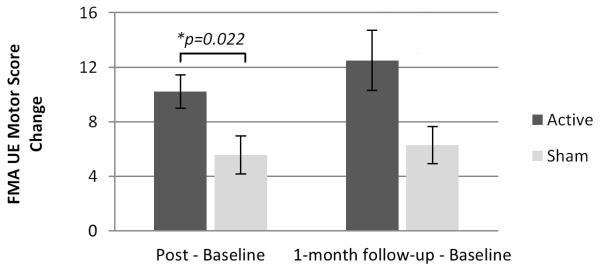
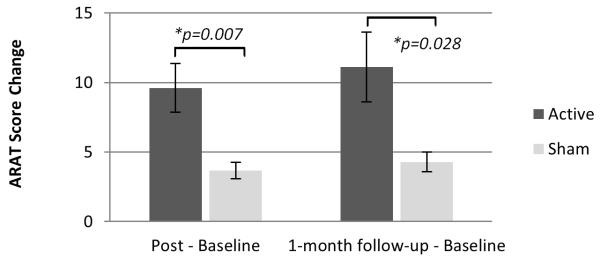
Results: Active peripheral nerve stimulation enhanced modified constraint-induced therapy more than sham peripheral nerve stimulation (significance at P < 0.05), both immediately after intervention (Wolf Motor Function Test: P = 0.006 (timed score); P = 0.001 (lift score); Fugl-Meyer Assessment: P = 0.022; Action Research Arm Test: P = 0.007) and at 1-mo follow-up (Wolf Motor Function Test: P = 0.025 (timed score); P = 0.007 (lift score); Fugl-Meyer Assessment: P = 0.056; Action Research Arm Test: P = 0.028).
Conclusion: Pairing peripheral nerve stimulation with modified constraint-induced therapy can lead to significantly more improvement in upper extremity movement function than modified constraint-induced therapy alone. Future research is recommended to help establish longitudinal effects of this paired intervention, particularly as it affects movement function and daily life participation.
To claim cme credits: Complete the self-assessment activity and evaluation online at http://www.physiatry.org/JournalCME CME OBJECTIVES:: Upon completion of this article, the reader should be able to: (1) Understand the role that afferent input plays with regard to movement function; (2) Understand general concepts of delivering modified constraint-based therapy in stroke rehabilitation research; and (3) Understand the rationale for applying an adjuvant intervention to optimize outcomes of constraint-based therapy following stroke.
Level: Advanced
Accreditation: : The Association of Academic Physiatrists is accredited by the Accreditation Council for Continuing Medical Education to provide continuing medical education for physicians. The Association of Academic Physiatrists designates this activity for a maximum of 1.5 AMA PRA Category 1 Credit(s). Physicians should only claim credit commensurate with the extent of their participation in the activity.
Trial registration: ClinicalTrials.gov NCT02587234.
Figures
References
-
- Wardlaw JM, Zoppo G, Yamaguchi T, Berge E. Thrombolysis for acute ischaemic stroke. Cochrane Database Syst Rev. 2003:CD000213. - PubMed
-
- Hallett M. Plasticity of the human motor cortex and recovery from stroke. Brain Res Brain Res Rev. 2001;36:169–174. - PubMed
-
- Nudo RJ. Adaptive plasticity in motor cortex: Implications for rehabilitation after brain injury. J Rehabil Med. 2003;41(Suppl):7–10. - PubMed
-
- Merzenich MM, Jenkins WM. Reorganization of cortical representations of the hand following alterations of skin inputs induced by nerve injury, skin island transfers, and experience. J Hand Ther. 1993;6:89–104. - PubMed
Publication types
MeSH terms
Associated data
Grants and funding
LinkOut - more resources
Full Text Sources
Other Literature Sources
Medical
Research Materials
