


A Comparison of Uremic Pruritus in Patients Receiving Peritoneal Dialysis and Hemodialysis
- PMID: 26945400
- PMCID: PMC4782884
- DOI: 10.1097/MD.0000000000002935
A Comparison of Uremic Pruritus in Patients Receiving Peritoneal Dialysis and Hemodialysis
Abstract
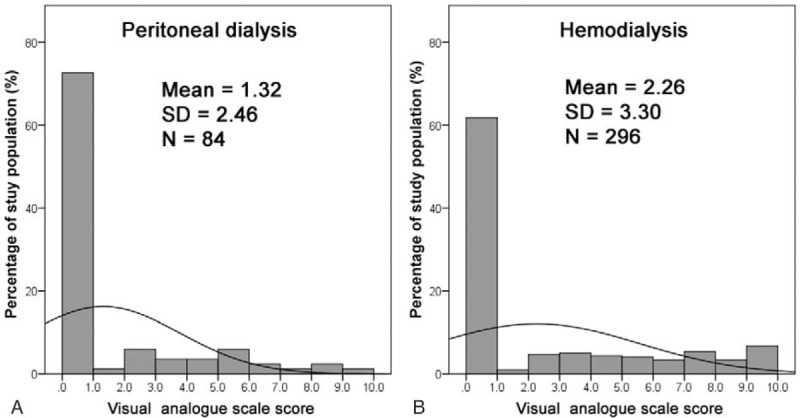
Uremic pruritus is common and bothersome in patients receiving either peritoneal dialysis (PD) or hemodialysis (HD). To date, the preferred dialysis modality regarding the alleviation of uremic pruritus remains controversial. We conducted this cross-sectional study to compare the prevalence, intensity, and characteristics of uremic pruritus between PD and HD patients. Patients receiving maintenance dialysis at a referral medical center in Taiwan were recruited. Dialysis modality, patient demographic, clinical characteristics, and laboratory data were recorded. The intensity of uremic pruritus was measured using visual analogue scale (VAS) scores. Multivariate linear regression analysis was conducted to compare the severity of uremic pruritus between PD and HD patients. Generalized additive models were applied to detect nonlinear effects between pruritus intensity and continuous covariates. A total of 380 patients completed this study, with a mean age of 60.3 years and 49.2% being female. Uremic pruritus was presented in 24 (28.6%) of the 84 PD patients and 113 (38.2%) of the 296 HD patients (P = .12). The VAS score of pruritus intensity was significantly lower among the PD patients than the HD patients (1.32 ± 2.46 vs 2.26 ± 3.30, P = .04). Multivariate linear regression analysis showed that PD was an independent predictor for lower VAS scores of pruritus intensity compared with HD (β-value -0.88, 95% confidence interval -1.62 to -0.13). The use of active vitamin D was also an independent predictor for a lower intensity of uremic pruritus, whereas hyperphosphatemia and higher serum levels of triglyceride and aspartate transaminase were significantly associated with higher pruritus intensity. There was a trend toward a less affected body surface area of uremic pruritus in the PD patients than in the HD patients, but the difference did not reach statistical significance (P = .13).In conclusion, the severity of uremic pruritus was lower among PD patients than HD patients, and PD may provide better alleviation of pruritus symptoms. The result provides a valuable reference for clinicians and patients when choosing a dialysis modality.
Conflict of interest statement
The authors have no conflicts of interest to disclose.
Figures
References
-
- Ko MJ, Yang JY, Wu HY, et al. Narrowband ultraviolet B phototherapy for patients with refractory uraemic pruritus: a randomized controlled trial. Br J Dermatol 2011; 165:633–639. - PubMed
-
- Yosipovitch G, Zucker I, Boner G, et al. A questionnaire for the assessment of pruritus: validation in uremic patients. Acta Derm Venereol 2001; 81:108–111. - PubMed
-
- Pisoni RL, Wikstrom B, Elder SJ, et al. Pruritus in haemodialysis patients: International results from the Dialysis Outcomes and Practice Patterns Study (DOPPS). Nephrol Dial Transplant 2006; 21:3495–3505. - PubMed
-
- Narita I, Alchi B, Omori K, et al. Etiology and prognostic significance of severe uremic pruritus in chronic hemodialysis patients. Kidney Int 2006; 69:1626–1632. - PubMed
Publication types
MeSH terms
Substances
LinkOut - more resources
Full Text Sources
Other Literature Sources
Medical
