. 2016 Aug 16;49(12):2358-65.
doi: 10.1016/j.jbiomech.2016.02.027. Epub 2016 Feb 24.

Arterial mechanics considering the structural and mechanical contributions of ECM constituents

Affiliations

Arterial mechanics considering the structural and mechanical contributions of ECM constituents

Yunjie Wang et al. J Biomech. .

Abstract

Considering the organization and engagement behavior of different extracellular matrix (ECM) constituents in the medial and adventitial layer of the arterial wall, in this study, we proposed a new constitutive model of ECM mechanics that considers the distinct structural and mechanical contributions of medial elastin, medial collagen, and adventitial collagen, to incorporate the constituent-specific fiber orientation and the sequential fiber engagement in arterial mechanics. Planar biaxial tensile testing method was used to characterize the orthotropic and hyperelastic behavior of porcine thoracic aorta. Fiber distribution functions of medial elastin, medial collagen, and adventitial collagen were incorporated into the constitutive model. Considering the sequential engagement of ECM constituents in arterial mechanics, a recruitment density function was incorporated into the model to capture the delayed engagement of adventitial collagen. A freely jointed chain model was used to capture the mechanical behavior of elastin and collagen at the fiber level. The tissue-level ECM mechanics was obtained by incorporating fiber distribution, engagement, and elastin and collagen content. The multi-scale constitutive model considering the structural and mechanical contributions of the three major ECM constituents allows us to directly incorporate information obtained from quantitative multi-photon imaging and analysis, and biochemical assay for the prediction of tissue-level mechanical response. Moreover, the model shows promises in fitting and predicting with a small set of material parameters, which has physical meanings and can be related to the structure of the ECM.

Keywords: Biaxial tensile testing; Collagen; Constitutive model; Elastin; Extracellular matrix; Fiber distribution function; Fiber engagement; Multi-photon imaging; Recruitment function.


Figures

Figure 1
Figure 1
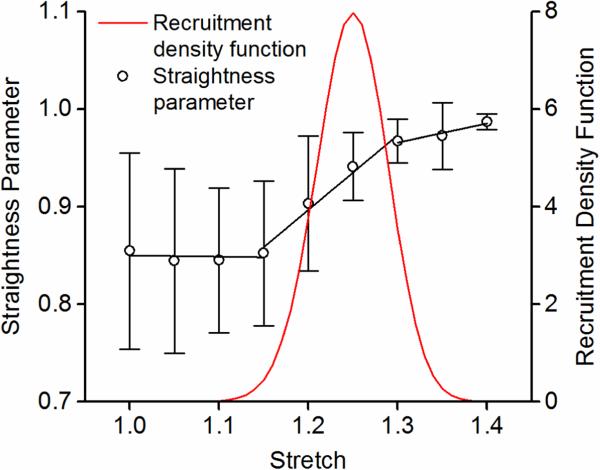
Straightness parameter of adventitial collagen fibers (from Chow et al., 2014), and the recruitment distribution density function that captures the delayed adventitial collagen engagement in response to mechanical loading.
Figure 2
Figure 2
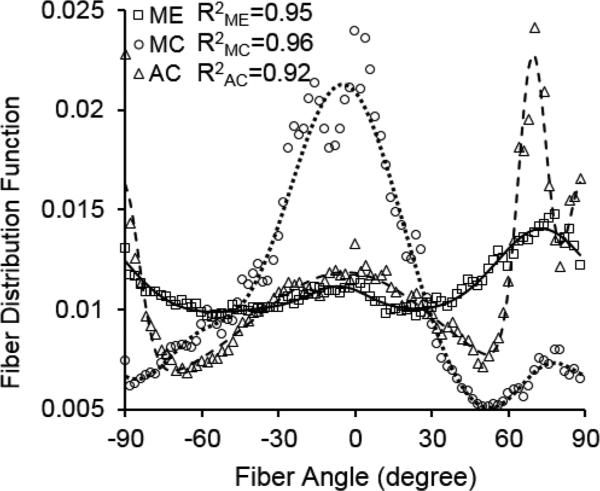
Fiber orientation distributions of medial elastin (ME), medial collagen (MC), and adventitial collagen (AC) in porcine thoracic aorta when subjected to an equi-biaxial stretch of 140% in both the longitudinal and circumferential directions. Symbols represent measured distribution (Chow et al., 2014) and lines represent the corresponding three-term von Mises distribution function fitting. The R2 values represent correlation coefficients between the measured and fitted fiber distributions.
Figure 3
Figure 3
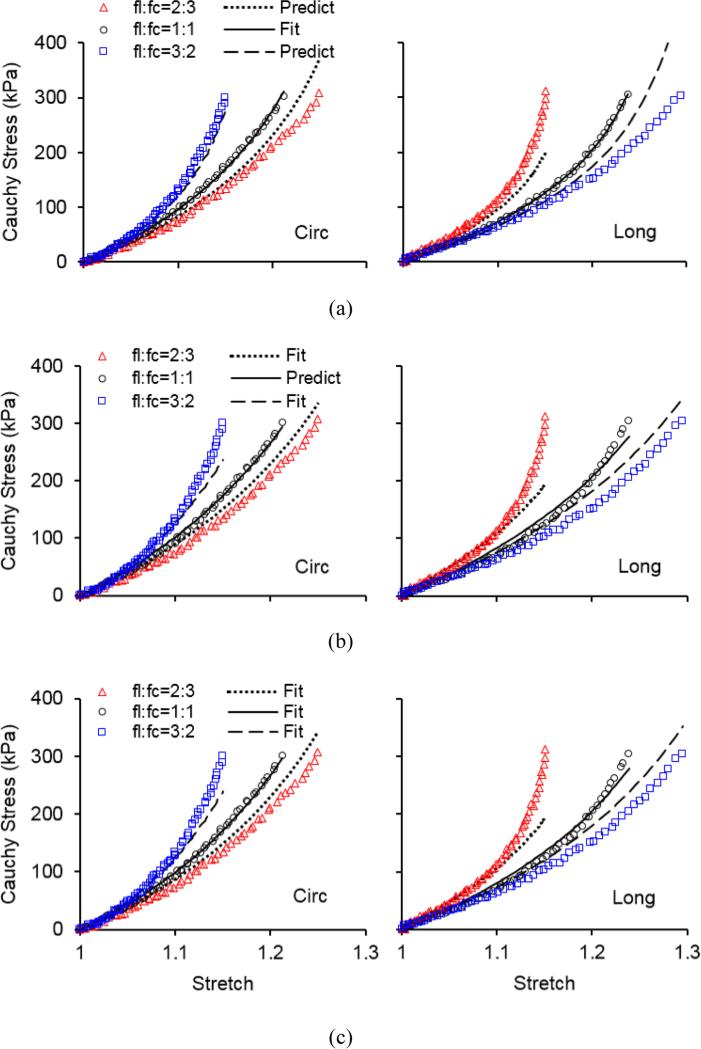
Representative Cauchy stress vs. stretch in the circumferential (Circ) and longitudinal (Long) directions of sample 1 in Table 1 when (a) fitting equi-biaxial testing data fl:fc = 1:1 and predicting nonequi-biaxial testing data fl:fc = 2:3 and 3:2; (b) fitting nonequi-biaxial testing data fl:fc = 2:3 and 3:2 and predicting equi-biaxial testing data fl:fc = 1:1; and (c) fitting all equi-biaxial and nonequi-biaxial testing data. Symbols represent experimental measurements and lines represent modeling results.
Figure 4
Figure 4
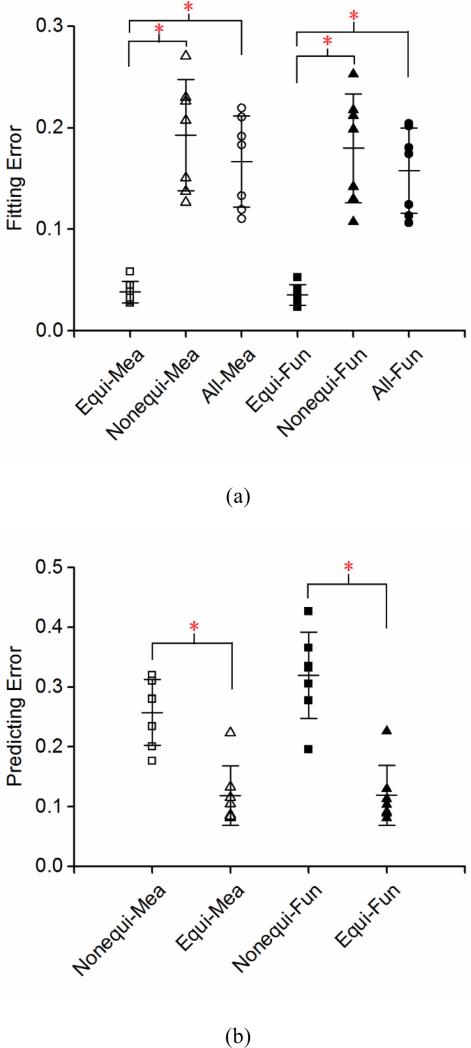
Quantification of (a) fitting and (b) predicting errors from the three fitting strategies in Figure 3 (Equi-, Nonequi-, All-) with the incorporation of directly measured orientation distribution functions (Mea) and the corresponding three-term von Mises distribution function (Fun) (n = 7). *p < 0.05.
Figure 5
Figure 5
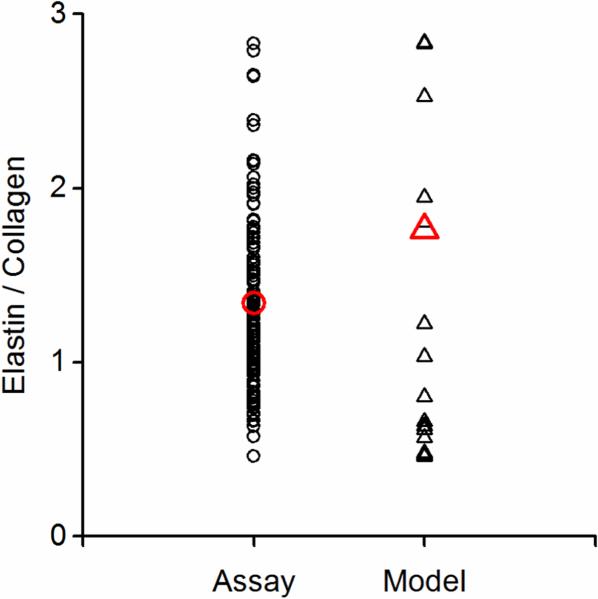
The ratio of elastin to total collagen content obtained from biochemical assays (n = 118) and constitutive modeling (n = 42 combining all results listed in Tables 1 and S1).
Figure 6
Figure 6
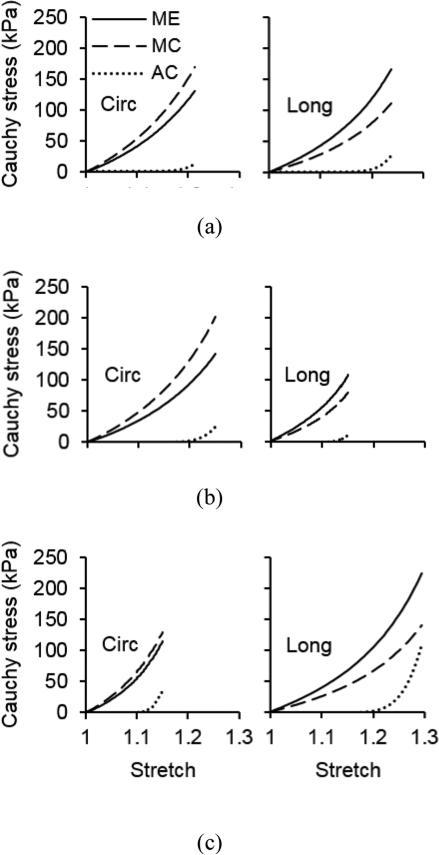
Cauchy stress vs. stretch in medial elastin, medial collagen, and adventitial collagen of sample 1 in Table 1 in the longitudinal and circumferential directions when the tissue sample is subjected to (a) equi-biaxial tension fl:fc = 1:1, (b) nonequi-biaxial tension fl:fc = 2:3, and (c) nonequi-biaxial tension fl:fc = 3:2. The modeling results were obtained from fitting experimental results from equi-biaxial tension.

References

    1. Brooke BS, Bayes-Genis A, Li DY. New insights into elastin and vascular disease. Trends in cardiovascular medicine. 2003;13(5):176–181. - PubMed
    1. Cacho F, Elbischger PJ, Rodríguez JF, Doblaré M, Holzapfel G. a. A constitutive model for fibrous tissues considering collagen fiber crimp. International Journal of Non-Linear Mechanics. 2007;42(2):391–402.
    1. Chow M-J, Choi M, Yun SH, Zhang Y. The effect of static stretch on elastin degradation in arteries. PloS one. 2013a;8(12):e81951. - PMC - PubMed
    1. Chow M-J, Mondonedo JR, Johnson VM, Zhang Y. Progressive structural and biomechanical changes in elastin degraded aorta. Biomechanics and modeling in mechanobiology. 2013b;12(2):361–372. - PMC - PubMed
    1. Chow M-J, Turcotte R, Lin CP, Zhang Y. Arterial extracellular matrix: a mechanobiological study of the contributions and interactions of elastin and collagen. Biophysical journal. 2014;106(12):2684–2692. - PMC - PubMed

LinkOut - more resources