Review
. 2016 Mar;137(3):667-79.
doi: 10.1016/j.jaci.2016.01.006.

Leveraging gene-environment interactions and endotypes for asthma gene discovery

Affiliations
Review

Leveraging gene-environment interactions and endotypes for asthma gene discovery

Klaus Bønnelykke et al. J Allergy Clin Immunol. 2016 Mar.

Abstract

Asthma is a heterogeneous clinical syndrome that includes subtypes of disease with different underlying causes and disease mechanisms. Asthma is caused by a complex interaction between genes and environmental exposures; early-life exposures in particular play an important role. Asthma is also heritable, and a number of susceptibility variants have been discovered in genome-wide association studies, although the known risk alleles explain only a small proportion of the heritability. In this review, we present evidence supporting the hypothesis that focusing on more specific asthma phenotypes, such as childhood asthma with severe exacerbations, and on relevant exposures that are involved in gene-environment interactions (GEIs), such as rhinovirus infections, will improve detection of asthma genes and our understanding of the underlying mechanisms. We will discuss the challenges of considering GEIs and the advantages of studying responses to asthma-associated exposures in clinical birth cohorts, as well as in cell models of GEIs, to dissect the context-specific nature of genotypic risks, to prioritize variants in genome-wide association studies, and to identify pathways involved in pathogenesis in subgroups of patients. We propose that such approaches, in spite of their many challenges, present great opportunities for better understanding of asthma pathogenesis and heterogeneity and, ultimately, for improving prevention and treatment of disease.

Keywords: 17q asthma locus; Asthma; CDHR3; gene-environment interactions; genome-wide association study; rhinovirus.


Conflict of interest statement

Disclosure of potential conflict of interestC. Ober has received grants from the National Institutes of Health. K. Bønnelykke declares that he has no relevant conflicts of interest.

Figures
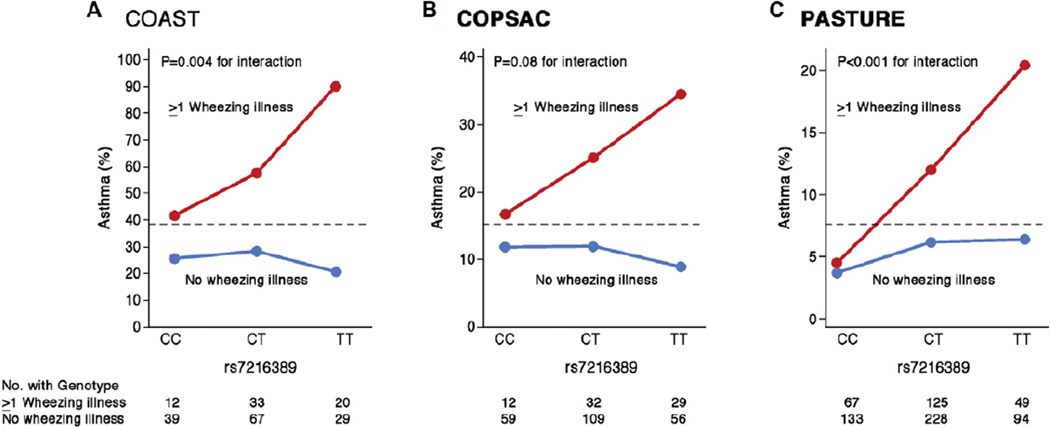
Figure 1
Figure 1. Interaction effects of the 17q genotype and wheezing on asthma risk in 3 birth cohorts
In all cohorts there is more asthma among children who wheezed in early life (red lines) compared with children who did not wheeze in early life (blue lines), and the associations with 17q genotype are only evident among the children who wheezed. In all cohorts the prevalence of asthma at age 6 years is more than 3-fold higher among TT children who wheezed compared with children who did not wheeze. The dashed line shows the overall prevalence of asthma in each population. Note the different y-axis scales in each panel. A and B, Stratified by rhinovirus-associated wheezing illness in the first 3 years of life. Modified from Caliskan et al. C, Stratified by wheezing illness in the first year of life. Modified from Loss et al.
Figure 2
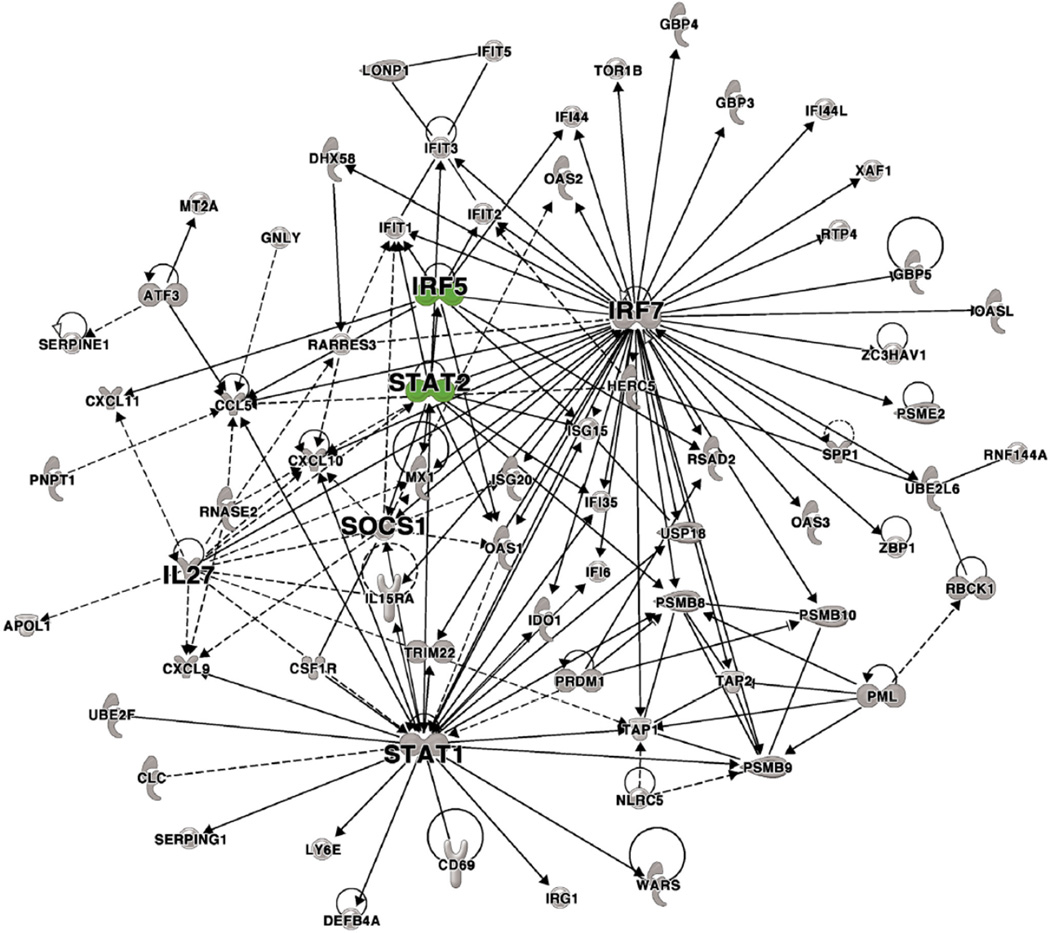
Figure 2. Coexpression network analysis of genes differentially expressed in nasal lavage fluid in children during an asthma exacerbation
This network includes 58 genes with eQTLs in rhinovirus-treated PBMCs, including STAT2 and IRF5 as hubs (shown as green symbols), supporting the hypothesis that genetic variation in response to rhinovirus might modulate response to this virus and to asthma severity more generally. Molecule shapes: oval = transcriptional regulator, diamond = enzyme, dashed line rectangle = channel, up triangle = phosphatase, down triangle = kinase, trapezoid = transporter, circle = other. Modified from Bosco et al.
Figure 3
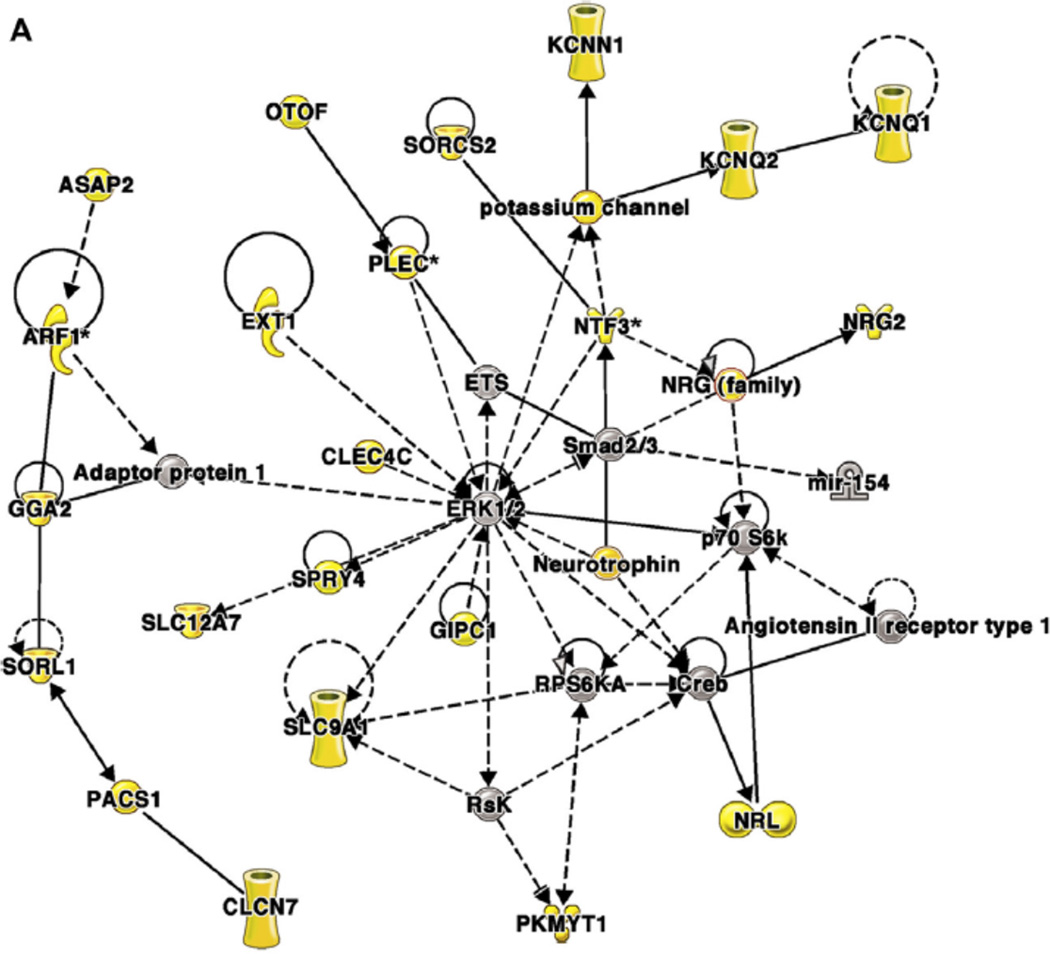
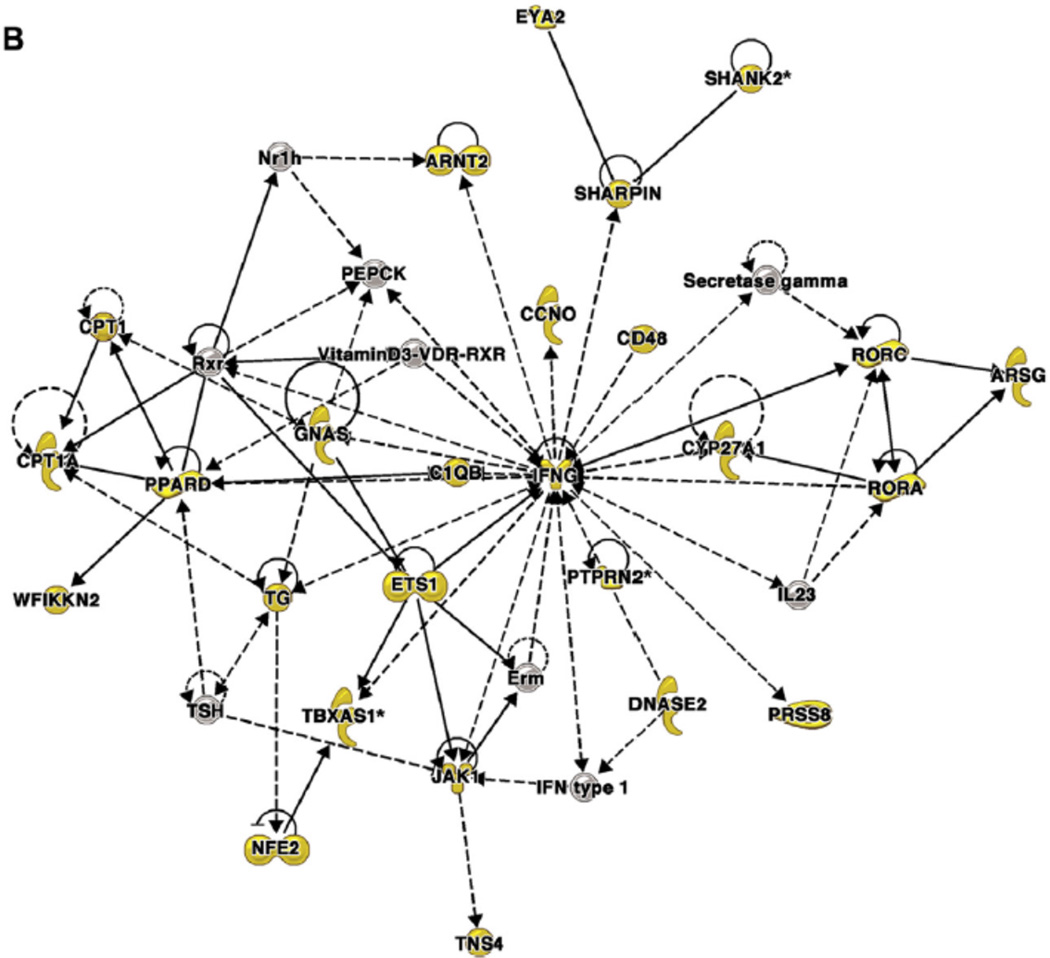
Figure 3. Coexpression network analysis of genes near differentially methylated CpG dinucleotides in airway epithelial cells from asthmatic and nonasthmatic subjects
Networks were generated by using Ingenuity Pathway Analysis (IPA), as previously described. Genes near differentially methylated CpGs are shown as yellow symbols; other genes are included to connect the network of differentially methylated CpGs. Molecular shapes (from IPA) were as follows: oval, transcriptional regulator; diamond, enzyme; dashed line rectangle, channel; upward triangle, phosphatase; downward triangle, kinase; trapezoid, transporter; circle, other. A, A network from module 1 that was associated with clinical markers of asthma severity. This network is centered on extracellular signal-regulated kinase 1/2, which was not itself near a differentially methylated CpG. B, A network from module 2 that was associated with eosinophilia. This network is centered on IFN-g, which was near a differentially methylated CpG. Reprinted with permission of the American Thoracic Society from Nicodemus-Johnson et al. Copyright 2016 American Thoracic Society.
Figure 3
Figure 3. Coexpression network analysis of genes near differentially methylated CpG dinucleotides in airway epithelial cells from asthmatic and nonasthmatic subjects
Networks were generated by using Ingenuity Pathway Analysis (IPA), as previously described. Genes near differentially methylated CpGs are shown as yellow symbols; other genes are included to connect the network of differentially methylated CpGs. Molecular shapes (from IPA) were as follows: oval, transcriptional regulator; diamond, enzyme; dashed line rectangle, channel; upward triangle, phosphatase; downward triangle, kinase; trapezoid, transporter; circle, other. A, A network from module 1 that was associated with clinical markers of asthma severity. This network is centered on extracellular signal-regulated kinase 1/2, which was not itself near a differentially methylated CpG. B, A network from module 2 that was associated with eosinophilia. This network is centered on IFN-g, which was near a differentially methylated CpG. Reprinted with permission of the American Thoracic Society from Nicodemus-Johnson et al. Copyright 2016 American Thoracic Society.

References

    1. Ober C, Loisel DA, Gilad Y. Sex-specific genetic architecture of human disease. Nat Rev Genet. 2008;9:911–922. - PMC - PubMed
    1. Anderson GP. Endotyping asthma: new insights into key pathogenic mechanisms in a complex, heterogeneous disease. Lancet. 2008;372:1107–1119. - PubMed
    1. Lim RH, Kobzik L, Dahl M. Risk for asthma in offspring of asthmatic mothers versus fathers: a meta-analysis. PLoS One. 2010;5:e10134. - PMC - PubMed
    1. von Mutius E, Vercelli D. Farm living: effects on childhood asthma and allergy. Nat Rev Immunol. 2010;10:861–868. - PubMed
    1. Penders J, Thijs C, van den Brandt PA, Kummeling I, Snijders B, Stelma F, et al. Gut microbiota composition and development of atopic manifestations in infancy: the KOALA Birth Cohort Study. Gut. 2007;56:661–667. - PMC - PubMed

Publication types