


Body Mass Index, the Most Widely Used But Also Widely Criticized Index: Would a Criterion Standard Measure of Total Body Fat Be a Better Predictor of Cardiovascular Disease Mortality?
- PMID: 26948431
- PMCID: PMC4821662
- DOI: 10.1016/j.mayocp.2016.01.008
Body Mass Index, the Most Widely Used But Also Widely Criticized Index: Would a Criterion Standard Measure of Total Body Fat Be a Better Predictor of Cardiovascular Disease Mortality?
Abstract
Objectives: To examine whether an accurate measure (using a criterion standard method) of total body fat would be a better predictor of cardiovascular disease (CVD) mortality than body mass index (BMI).
Participants and methods: A total of 60,335 participants were examined between January 1, 1979, and December 31, 2003, and then followed-up for a mean follow-up period of 15.2 years. Body mass index was estimated using standard procedures. Body composition indices (ie, body fat percentage [BF%], fat mass index [FMI], fat-free mass [FFM], and FFM index [FFMI]) were derived from either skinfold thicknesses or hydrostatic weighing. For exact comparisons, the indices studied were categorized identically using sex-specific percentiles.
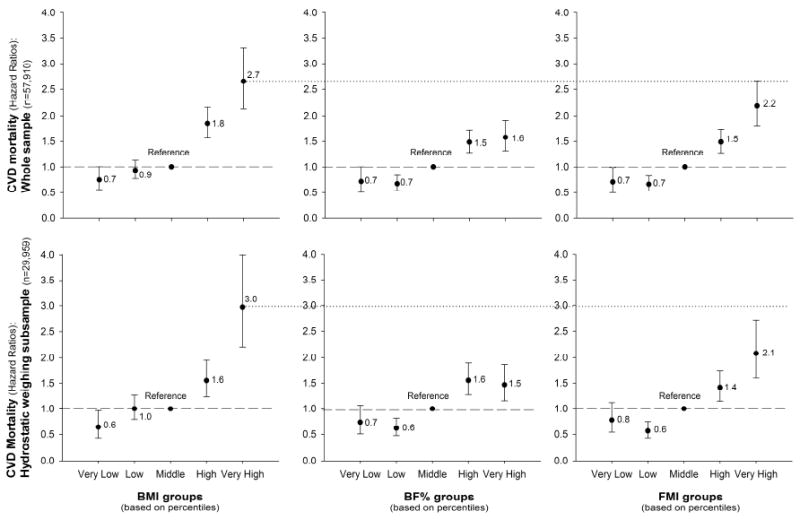
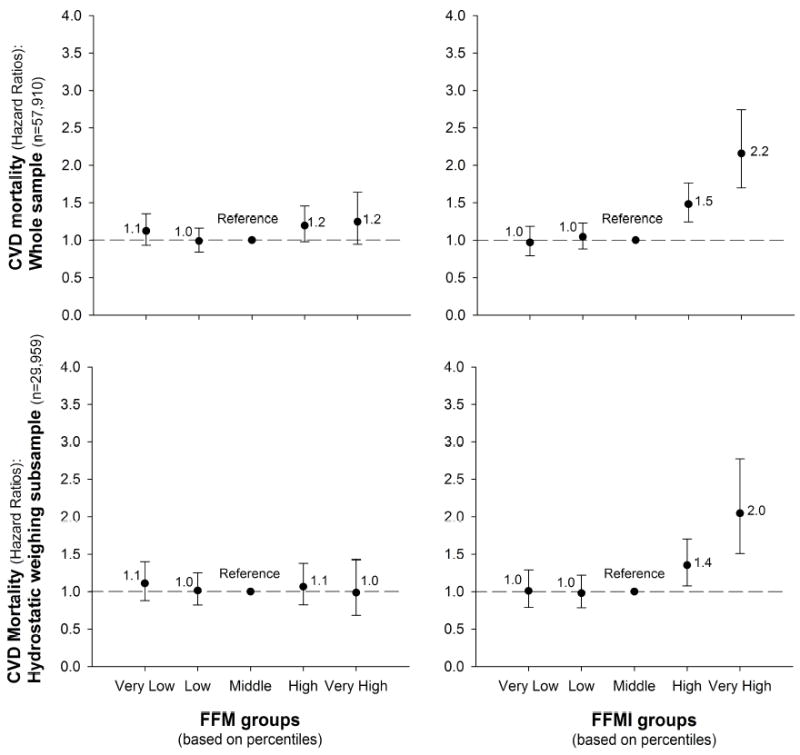
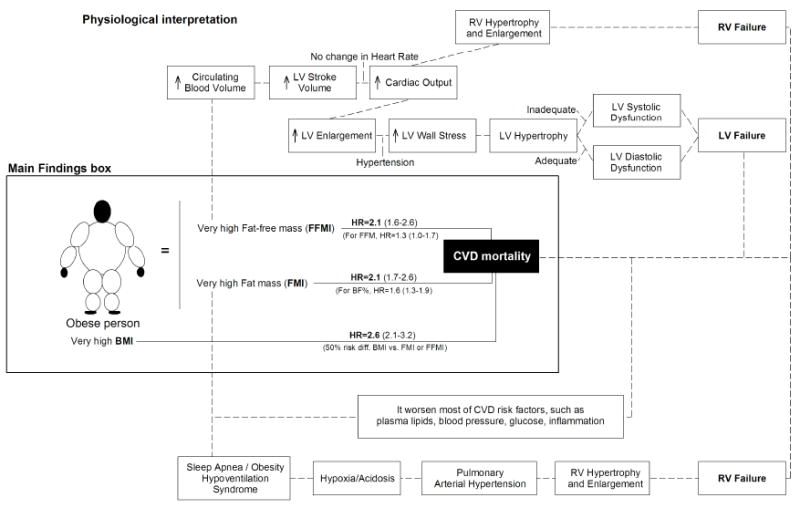
Results: Compared with a medium BMI, a very high BMI was associated with a hazard ratio (HR) of 2.7 (95% CI, 2.1-3.3) for CVD mortality, which was a stronger association than for BF% or FMI (ie, HR, 1.6; 95% CI, 1.3-1.9 and HR, 2.2; 95% CI, 1.8-2.7, respectively). Compared with a medium FFMI, a very high FFMI was associated with an HR of 2.2 (95% CI, 1.7-2.7) for CVD mortality, with these estimates being markedly smaller for FFM (ie, HR, 1.2; 95% CI, 0.9-1.6). When the analyses were restricted only to the sample assessed with hydrostatic weighing (N=29,959, 51.7%), the results were similar, with even slightly larger differences in favor of BMI (ie, HR, 3.0; 95% CI, 2.2-4.0) compared with BF% and FMI (ie, HR, 1.5; 95% CI, 1.2-1.9 and HR, 2.1; 95% CI, 1.6-2.7, respectively). We estimated Harrell's c-index as an indicator of discriminating/predictive ability of these models and observed that the c-index for models including BMI was significantly higher than that for models including BF% or FMI (P<.005 for all).
Conclusion: The simple and inexpensive measure of BMI can be as clinically important as, or even more than, total adiposity measures assessed using accurate, complex, and expensive methods. Physiological explanations for these findings are discussed.
Copyright © 2016 Mayo Foundation for Medical Education and Research. Published by Elsevier Inc. All rights reserved.
Conflict of interest statement
The authors have declared that no competing interests exist.
Figures
References
-
- Lavie CJ, McAuley PA, Church TS, Milani RV, Blair SN. Obesity and cardiovascular diseases: implications regarding fitness, fatness, and severity in the obesity paradox. J Am Coll Cardiol. 2014;63(14):1345–1354. - PubMed
-
- Ahima RS, Lazar MA. Physiology. The health risk of obesity-better metrics imperative. Science. 2013;341(6148):856–858. - PubMed
-
- Lee CD, Blair SN, Jackson AS. Cardiorespiratory fitness, body composition, and all-cause and cardiovascular disease mortality in men. Am J Clin Nutr. 1999;69(3):373–380. - PubMed
Publication types
MeSH terms
Substances
Grants and funding
LinkOut - more resources
Full Text Sources
Other Literature Sources
Miscellaneous
