


Nasal Deformities Following Nasoseptal Flap Reconstruction of Skull Base Defects
- PMID: 26949583
- PMCID: PMC4777617
- DOI: 10.1055/s-0035-1555136
Nasal Deformities Following Nasoseptal Flap Reconstruction of Skull Base Defects
Abstract
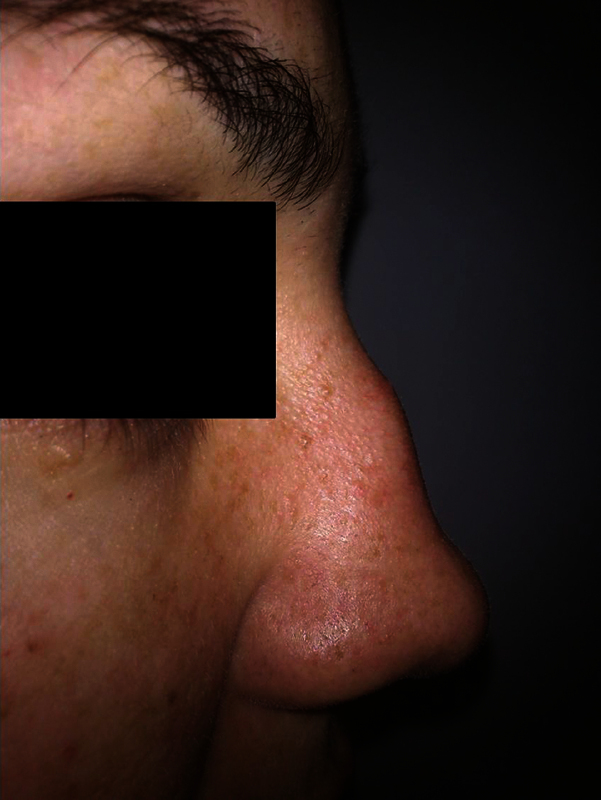
Objectives To identify the prevalence and risk factors for nasal deformities after endoscopic endonasal surgery (EES) of the skull base. Design Retrospective case series. Setting Tertiary referral academic center. Participants EES patients from January 2011 to October 2013. Main Outcome Measures Surgical approach, method of skull base reconstruction, and postoperative nasal deformities. Results Of 328 patients, 19 patients (5.8%) had nasal dorsum collapse, 3 (0.9%) with new septal perforations and 2 (0.6%) with septal deviations requiring surgical correction. Postoperative deformities were only found in the setting of nasoseptal flap reconstruction (p = 0.0001) and were most common in patients who had undergone an approach involving more than one anatomical subsite (p = 0.0021). Patients with nasal deformities were on average 6 years younger (p = 0.08) and were more likely to have a malignant pathology (p = 0.08). Conclusions All deformities were associated with use of a nasoseptal flap for reconstruction and were most common in combined approaches, suggesting that flap size may play a role in the development of nasal deformities. The mechanism of nasal dorsum collapse is unclear but does not appear to be related to septal cartilage necrosis. These findings warrant a prospective analysis to identify risk factors for postoperative nasal deformities and data for counseling of patients.
Keywords: nasoseptal flap; skull base reconstruction.
Figures
References
-
- de Almeida J R, Snyderman C H, Gardner P A, Carrau R L, Vescan A D. Nasal morbidity following endoscopic skull base surgery: a prospective cohort study. Head Neck. 2011;33(4):547–551. - PubMed
-
- Soudry E, Psaltis A J, Lee K H, Vaezafshar R, Nayak J V, Hwang P H. Complications associated with the pedicled nasoseptal flap for skull base reconstruction. Laryngoscope. 2015;125(1):80–85. - PubMed
-
- Thorp B D, Sreenath S B, Ebert C S, Zanation A M. Endoscopic skull base reconstruction: a review and clinical case series of 152 vascularized flaps used for surgical skull base defects in the setting of intraoperative cerebrospinal fluid leak. Neurosurg Focus. 2014;37(4):E4. - PubMed
-
- Shin J H, Kang S G, Kim S W. et al. Bilateral nasoseptal flaps for endoscopic endonasal transsphenoidal approach. J Craniofac Surg. 2013;24(5):1569–1572. - PubMed
-
- Menick F J. Philadelphia, PA: Saunders Elsevier; 2009. The interface of cosmetic and reconstructive rhinoplasty: the crucified tip, the saddlenose and the continuum of reconstruction and cosmesis.
LinkOut - more resources
Full Text Sources
Other Literature Sources
