


Effects of unplanned treatment interruptions on HIV treatment failure - results from TAHOD
- PMID: 26950901
- PMCID: PMC4959847
- DOI: 10.1111/tmi.12690
Effects of unplanned treatment interruptions on HIV treatment failure - results from TAHOD
Abstract
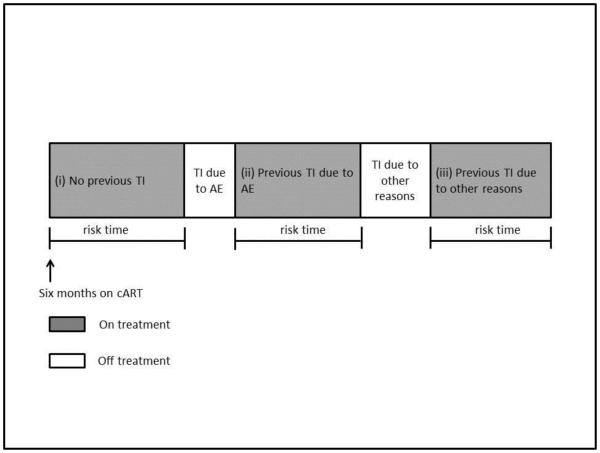
Objectives: Treatment interruptions (TIs) of combination antiretroviral therapy (cART) are known to lead to unfavourable treatment outcomes but do still occur in resource-limited settings. We investigated the effects of TI associated with adverse events (AEs) and non-AE-related reasons, including their durations, on treatment failure after cART resumption in HIV-infected individuals in Asia.
Methods: Patients initiating cART between 2006 and 2013 were included. TI was defined as stopping cART for >1 day. Treatment failure was defined as confirmed virological, immunological or clinical failure. Time to treatment failure during cART was analysed using Cox regression, not including periods off treatment. Covariables with P < 0.10 in univariable analyses were included in multivariable analyses, where P < 0.05 was considered statistically significant.
Results: Of 4549 patients from 13 countries in Asia, 3176 (69.8%) were male and the median age was 34 years. A total of 111 (2.4%) had TIs due to AEs and 135 (3.0%) had TIs for other reasons. Median interruption times were 22 days for AE and 148 days for non-AE TIs. In multivariable analyses, interruptions >30 days were associated with failure (31-180 days HR = 2.66, 95%CI (1.70-4.16); 181-365 days HR = 6.22, 95%CI (3.26-11.86); and >365 days HR = 9.10, 95% CI (4.27-19.38), all P < 0.001, compared to 0-14 days). Reasons for previous TI were not statistically significant (P = 0.158).
Conclusions: Duration of interruptions of more than 30 days was the key factor associated with large increases in subsequent risk of treatment failure. If TI is unavoidable, its duration should be minimised to reduce the risk of failure after treatment resumption.
Keywords: Asia; Asie; HIV; VIH; adverse events; antiretroviral; antirretroviral; antirétroviral; effets indésirables; eventos adversos; interrupción del tratamiento; interruptions de traitement; treatment interruptions.
© 2016 John Wiley & Sons Ltd.
Figures
References
-
- Strategies for Management of Antiretroviral Therapy Study G. El-Sadr WM, Lundgren J, Neaton JD, Gordin F, Abrams D, et al. CD4+ count-guided interruption of antiretroviral treatment. The New England journal of medicine. 2006;355(22):2283–96. - PubMed
-
- Holkmann Olsen C, Mocroft A, Kirk O, Vella S, Blaxhult A, Clumeck N, et al. Interruption of combination antiretroviral therapy and risk of clinical disease progression to AIDS or death. HIV Med. 2007;8(2):96–104. - PubMed
-
- Abdissa SG, Fekade D, Feleke Y, Seboxa T, Diro E. Adverse drug reactions associated with antiretroviral treatment among adult Ethiopian patients in a tertiary hospital. Ethiopian medical journal. 2012;50(2):107–13. - PubMed
Publication types
MeSH terms
Substances
Grants and funding
LinkOut - more resources
Full Text Sources
Other Literature Sources
Medical
