


Deciphering ocean carbon in a changing world
- PMID: 26951682
- PMCID: PMC4812754
- DOI: 10.1073/pnas.1514645113
Deciphering ocean carbon in a changing world
Abstract
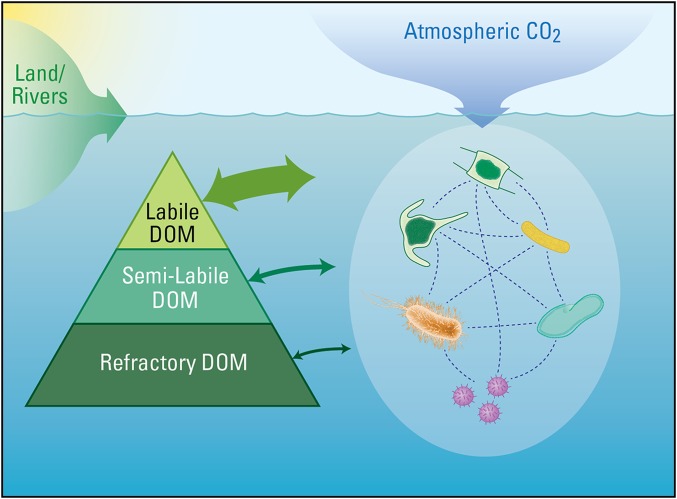
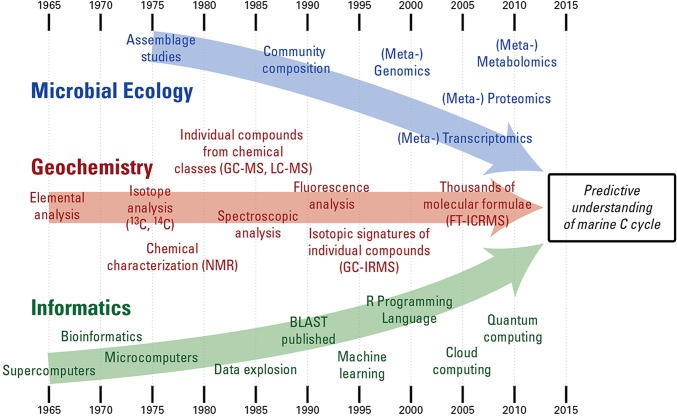
Dissolved organic matter (DOM) in the oceans is one of the largest pools of reduced carbon on Earth, comparable in size to the atmospheric CO2 reservoir. A vast number of compounds are present in DOM, and they play important roles in all major element cycles, contribute to the storage of atmospheric CO2 in the ocean, support marine ecosystems, and facilitate interactions between organisms. At the heart of the DOM cycle lie molecular-level relationships between the individual compounds in DOM and the members of the ocean microbiome that produce and consume them. In the past, these connections have eluded clear definition because of the sheer numerical complexity of both DOM molecules and microorganisms. Emerging tools in analytical chemistry, microbiology, and informatics are breaking down the barriers to a fuller appreciation of these connections. Here we highlight questions being addressed using recent methodological and technological developments in those fields and consider how these advances are transforming our understanding of some of the most important reactions of the marine carbon cycle.
Keywords: cyberinfrastructure; dissolved organic matter; marine microbes.
Conflict of interest statement
The authors declare no conflict of interest.
Figures
References
-
- Doney SC, et al. Climate change impacts on marine ecosystems. Annu Rev Mar Sci. 2012;4:11–37. - PubMed
-
- Hansell DA. Recalcitrant dissolved organic carbon fractions. Annu Rev Mar Sci. 2013;5:421–445. - PubMed
-
- DeLong EF, Karl DM. Genomic perspectives in microbial oceanography. Nature. 2005;437(7057):336–342. - PubMed
-
- Koch BP, Ludwichowski KU, Kattner G, Dittmar T, Witt M. Advanced characterization of marine dissolved organic matter by combining reversed-phase liquid chromatography and FT-ICR-MS. Mar Chem. 2008;111(3-4):233–241.
Publication types
MeSH terms
Substances
LinkOut - more resources
Full Text Sources
Other Literature Sources
Miscellaneous
