


State of the Art Review: Poverty and the Developing Brain
- PMID: 26952506
- PMCID: PMC4811314
- DOI: 10.1542/peds.2015-3075
State of the Art Review: Poverty and the Developing Brain
Abstract
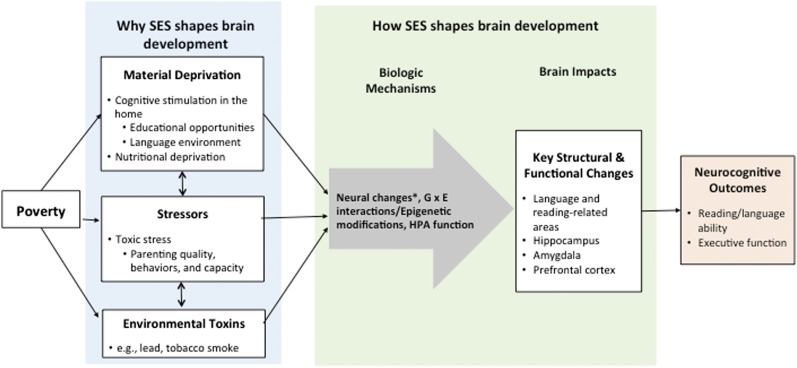
In the United States, >40% of children are either poor or near-poor. As a group, children in poverty are more likely to experience worse health and more developmental delay, lower achievement, and more behavioral and emotional problems than their more advantaged peers; however, there is broad variability in outcomes among children exposed to similar conditions. Building on a robust literature from animal models showing that environmental deprivation or enrichment shapes the brain, there has been increasing interest in understanding how the experience of poverty may shape the brain in humans. In this review, we summarize research on the relationship between socioeconomic status and brain development, focusing on studies published in the last 5 years. Drawing on a conceptual framework informed by animal models, we highlight neural plasticity, epigenetics, material deprivation (eg, cognitive stimulation, nutrient deficiencies), stress (eg, negative parenting behaviors), and environmental toxins as factors that may shape the developing brain. We then summarize the existing evidence for the relationship between child poverty and brain structure and function, focusing on brain areas that support memory, emotion regulation, and higher-order cognitive functioning (ie, hippocampus, amygdala, prefrontal cortex) and regions that support language and literacy (ie, cortical areas of the left hemisphere). We then consider some limitations of the current literature and discuss the implications of neuroscience concepts and methods for interventions in the pediatric medical home.
Copyright © 2016 by the American Academy of Pediatrics.
Conflict of interest statement
Figures
References
-
- DeNavas-Walt C, Proctor BD, US Census Bureau . Income and Poverty in the United States: 2013, Current Population Reports. Washington, D.C.: US Government Printing Office; 2014:60–249
-
- American Academy of Pediatrics Agenda for Children—Strategic Plan 2014. Available at: www.aap.org/en-us/about-the-aap/aap-facts/AAP-Agenda-for-Children-Strate.... Accessed January 20, 2014
-
- Duncan GJ, Brooks-Gunn J, Klebanov PK Economic deprivation and early childhood development. Child Dev 1994;65(2 Spec No):296–318 - PubMed
-
- Ackerman BP, Brown ED, Izard CE. The relations between persistent poverty and contextual risk and children’s behavior in elementary school. Dev Psychol. 2004;40(3):367–377 - PubMed
-
- Brooks-Gunn J, Duncan GJ. The effects of poverty on children. Future Child. 1997;7(2):55–71 - PubMed
Publication types
MeSH terms
Grants and funding
LinkOut - more resources
Full Text Sources
Other Literature Sources
Research Materials
