


Repeated praziquantel treatments remodel the genetic and spatial landscape of schistosomiasis risk and transmission
- PMID: 26953255
- PMCID: PMC4844855
- DOI: 10.1016/j.ijpara.2016.01.007
Repeated praziquantel treatments remodel the genetic and spatial landscape of schistosomiasis risk and transmission
Abstract
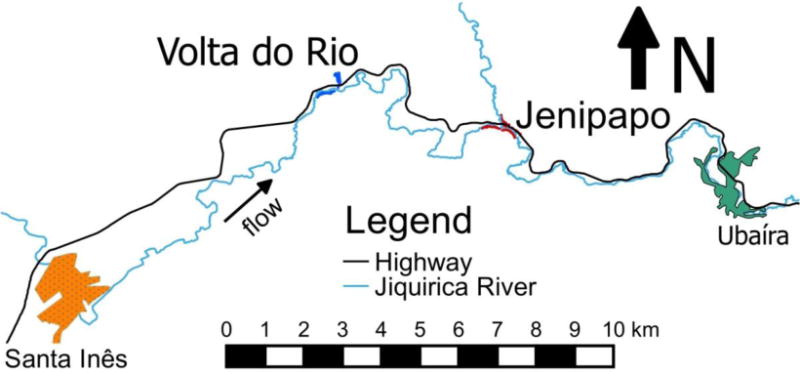
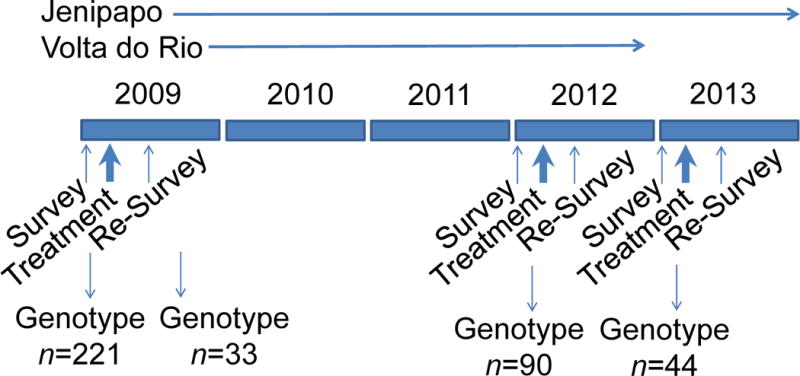
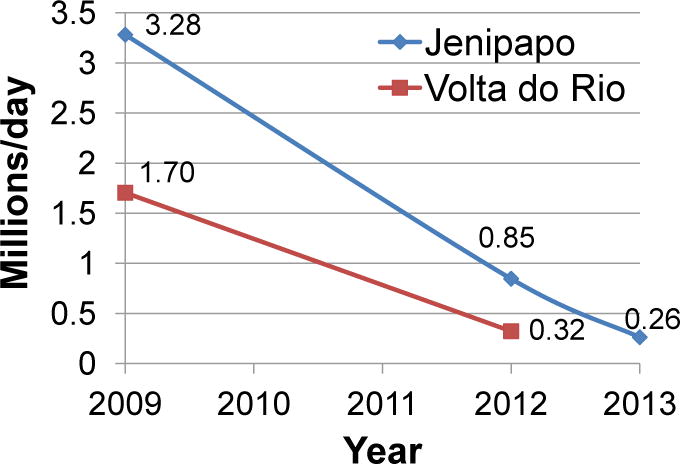
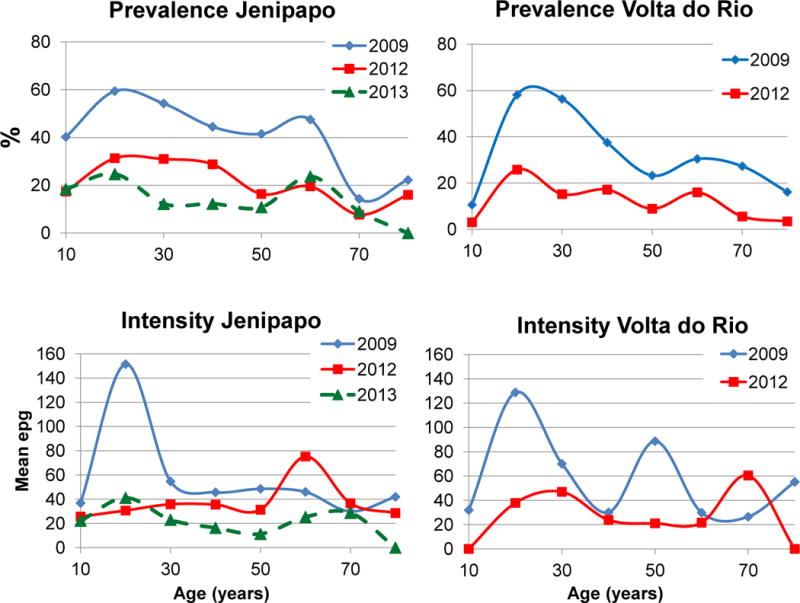
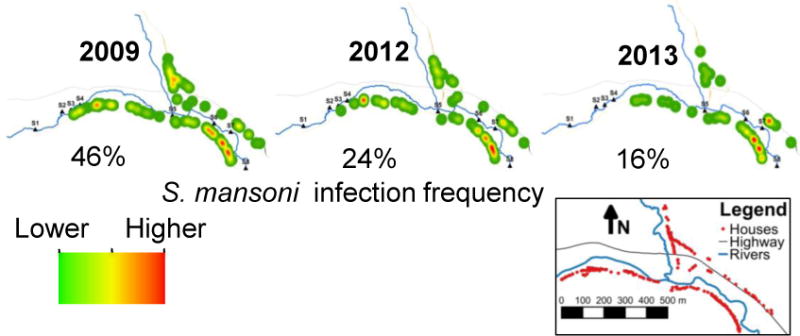
Repeated treatments with praziquantel reduce schistosomiasis prevalence and morbidity, but transmission persists and populations often recover within a few years. To identify factors associated with persistence, we surveyed and treated all identified Schistosoma mansoni infections in two rural Brazilian communities (Jenipapo and Volta do Rio) in 2009, 2012 and 2013. Eggs were collected from all infected individuals and genotyped with 11 microsatellite markers to evaluate parasite differentiation and diversity. After successive rounds of community-wide treatment, prevalence decreased from 45% to 24% then 16%. Intensity of infection decreased by 57% over this period, and the number of eggs transmitted to the environment decreased by 92%. During all time periods the majority of eggs were excreted by those >15years of age. The incidence was 23% in 2012 and 15% in 2013, consistent with a decrease in transmission. There was little immigration or gene flow over a distance of 6km. On reinfection, infrapopulations were moderately differentiated indicating that pretreatment multilocus genotypes were not fully reacquired. The effective population size responded to census population decline more rapidly than differentiation. Reinfection was concentrated in the downstream portion of Jenipapo, consistent with the observed increased human fecal contamination. At this scale and in this area S. mansoni infections exist on a fragmented landscape with a highly focal pattern of transmission that may facilitate future elimination.
Keywords: Brazil; Effective population size; Extinction; Genetic differentiation; Praziquantel; Reinfection; Spatial analysis.
Copyright © 2016 Australian Society for Parasitology Inc. Published by Elsevier Ltd. All rights reserved.
Figures
References
-
- Amaral RS, Tauil PL, Lima DD, Engels D. An analysis of the impact of the Schistosomiasis Control Programme in Brazil. Mem Inst Oswaldo Cruz. 2006;101(Suppl 1):79–85. - PubMed
-
- Berhe N, Medhin G, Erko B, Smith T, Gedamu S, Bereded D, Moore R, Habte E, Redda A, Gebre-Michael T, Gundersen SG. Variations in helminth faecal egg counts in Kato-Katz thick smears and their implications in assessing infection status with Schistosoma mansoni. Acta Trop. 2004;92:205–212. - PubMed
Publication types
MeSH terms
Substances
Grants and funding
LinkOut - more resources
Full Text Sources
Other Literature Sources
