. 2015 Jun:81:1-26.
doi: 10.1016/j.simyco.2015.08.001. Epub 2015 Oct 2.

Phylogeny of tremellomycetous yeasts and related dimorphic and filamentous basidiomycetes reconstructed from multiple gene sequence analyses

Affiliations

Phylogeny of tremellomycetous yeasts and related dimorphic and filamentous basidiomycetes reconstructed from multiple gene sequence analyses

X-Z Liu et al. Stud Mycol. 2015 Jun.

Abstract

The Tremellomycetes (Basidiomycota) contains a large number of unicellular and dimorphic fungi with stable free-living unicellular states in their life cycles. These fungi have been conventionally classified as basidiomycetous yeasts based on physiological and biochemical characteristics. Many currently recognised genera of these yeasts are mainly defined based on phenotypical characters and are highly polyphyletic. Here we reconstructed the phylogeny of the majority of described anamorphic and teleomorphic tremellomycetous yeasts using Bayesian inference, maximum likelihood, and neighbour-joining analyses based on the sequences of seven genes, including three rRNA genes, namely the small subunit of the ribosomal DNA (rDNA), D1/D2 domains of the large subunit rDNA, and the internal transcribed spacer regions (ITS 1 and 2) of rDNA including 5.8S rDNA; and four protein-coding genes, namely the two subunits of the RNA polymerase II (RPB1 and RPB2), the translation elongation factor 1-α (TEF1) and the mitochondrial gene cytochrome b (CYTB). With the consideration of morphological, physiological and chemotaxonomic characters and the congruence of phylogenies inferred from analyses using different algorithms based on different data sets consisting of the combined seven genes, the three rRNA genes, and the individual protein-coding genes, five major lineages corresponding to the orders Cystofilobasidiales, Filobasidiales, Holtermanniales, Tremellales, and Trichosporonales were resolved. A total of 45 strongly supported monophyletic clades with multiple species and 23 single species clades were recognised. This phylogenetic framework will be the basis for the proposal of an updated taxonomic system of tremellomycetous yeasts that will be compatible with the current taxonomic system of filamentous basidiomycetes accommodating the 'one fungus, one name' principle.

Keywords: Basidiomycota; Fungi; Multigene phylogeny; Tremellomycetes; Yeasts.


Figures
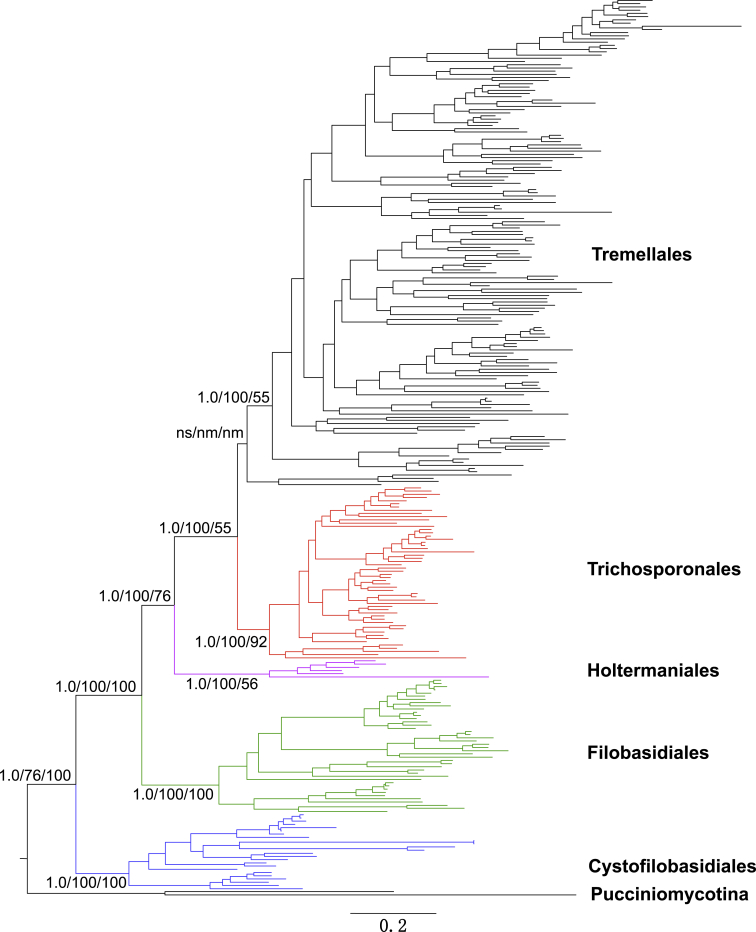
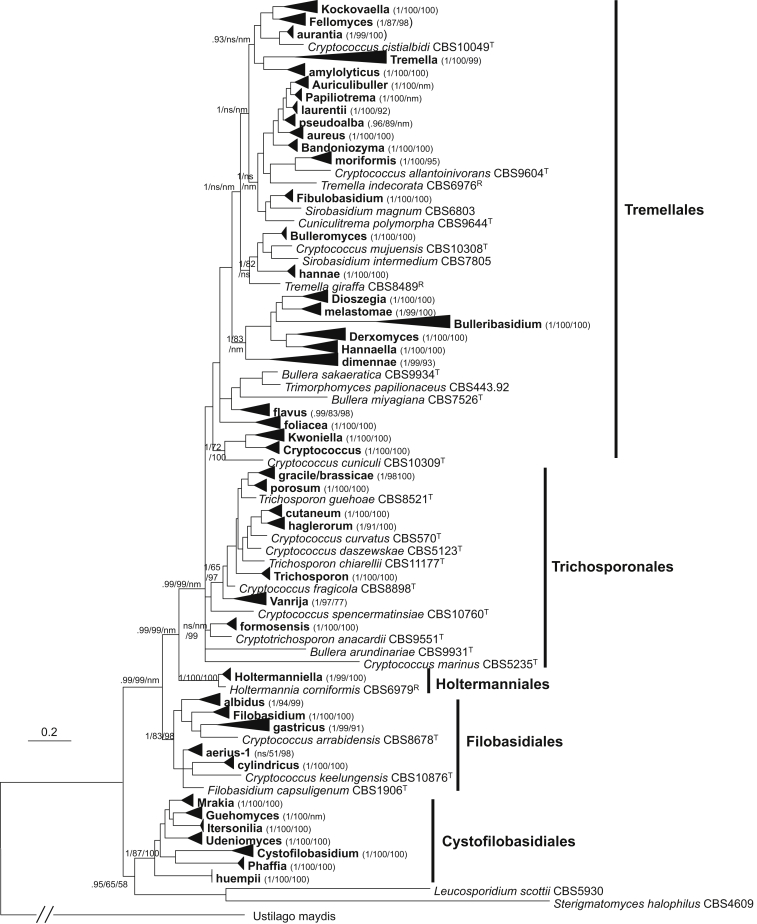
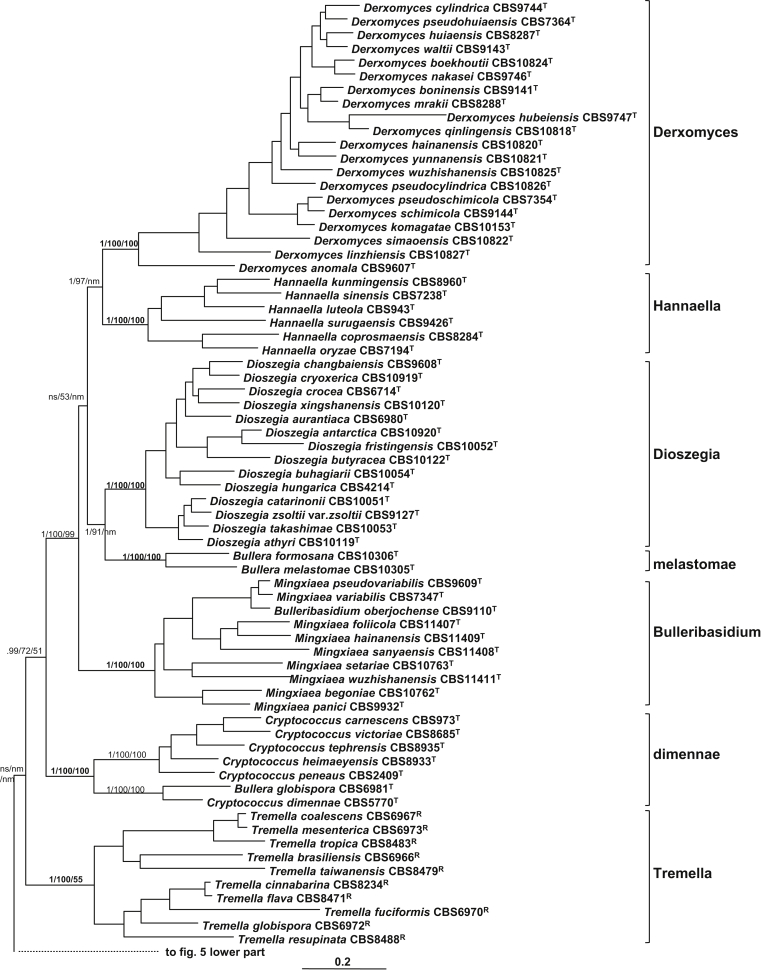
Fig. 1
Fig. 1
An outline of the phylogeny of tremellomycetous yeasts and dimorphic taxa inferred from a seven-gene data set including sequences of three rDNA genes, RPB1, RPB2, TEF1 and CYTB. The tree backbone is constructed using Bayesian analysis. Branch lengths are scaled in terms of expected numbers of nucleotide substitutions per site. The Bayesian posterior probabilities (PP) and bootstrap percentages (BP) of maximum likelihood and neighbour-joining analyses from 1 000 replicates are shown respectively from left to right on the deep and major branches resolved. Note: ns, not supported (PP < 0.9 or BP < 50 %); nm, not monophyletic.
Fig. 2
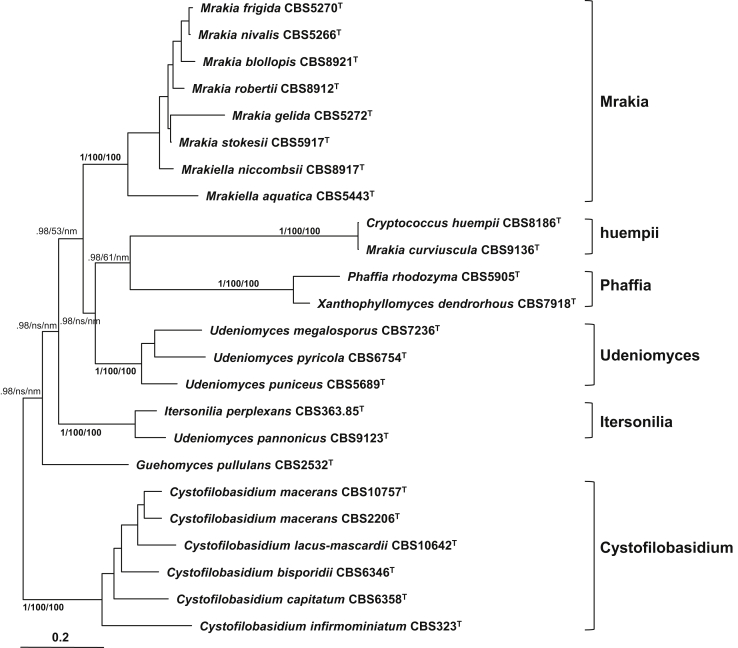
Fig. 2
The phylogenetic relationships among species of the Cystofilobasidiales inferred from a seven-gene data set including sequences of three rDNA genes, RPB1, RPB2, TEF1 and CYTB. The tree backbone is constructed using Bayesian analysis. The Bayesian posterior probabilities (PP) and bootstrap percentages (BP) of maximum likelihood and neighbour-joining analyses from 1 000 replicates are shown respectively from left to right on the deep and major branches and clades resolved. Note: nm, not monophyletic; ns, not supported (PP < 0.9 or BP < 50 %).
Fig. 3
Fig. 3
Phylogeny of tremellomycetous yeasts and dimorphic taxa based on the rDNA data set containing ITS, D1/D2, and SSU rDNA sequences. The tree backbone is constructed using Bayesian analysis. The Bayesian posterior probabilities (PP) and bootstrap percentages (BP) of maximum likelihood and neighbour-joining analyses from 1 000 replicates are shown respectively from left to right on the deep and major branches and in brackets following the clades resolved. Notes: nm, not monophyletic; ns, not supported (PP < 0.9 or BP < 50 %).
Fig. 4
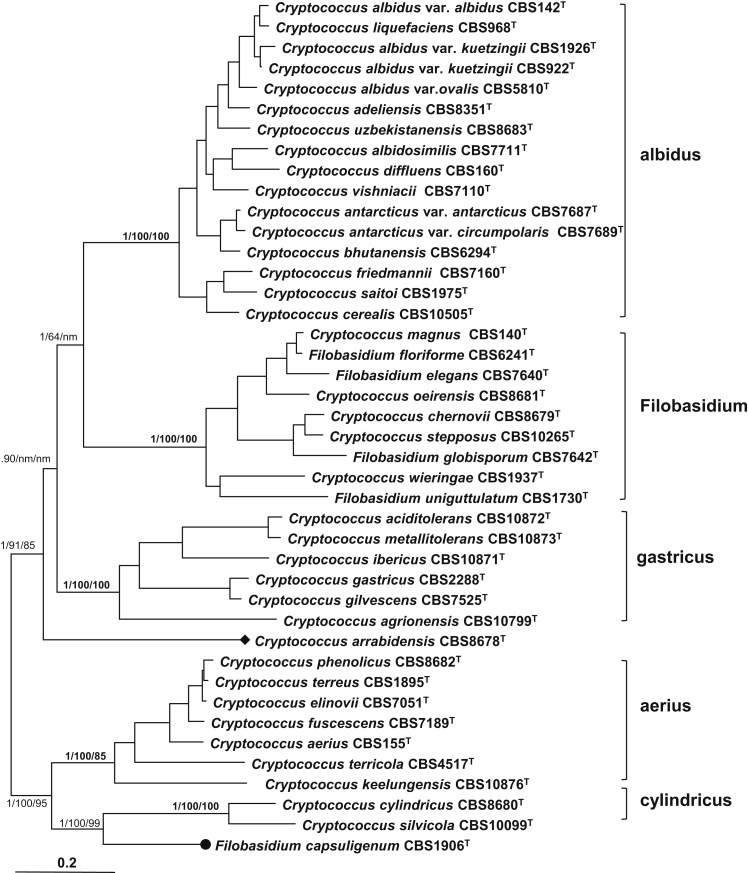
Fig. 4
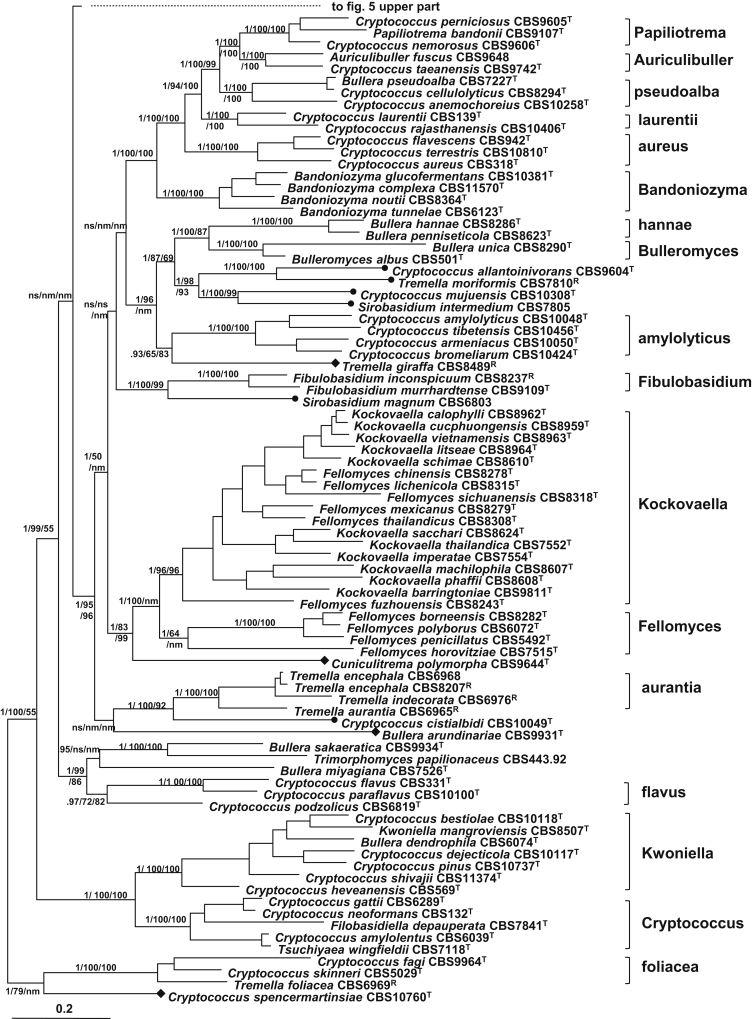
The phylogenetic relationships among species of the Filobasidiales inferred from a seven-gene data set including sequences of three rDNA genes, RPB1, RPB2, TEF1 and CYTB sequences. The tree backbone is constructed using Bayesian analysis. The Bayesian posterior probabilities (PP) and bootstrap percentages (BP) of maximum likelihood and neighbour-joining analyses from 1 000 replicates are shown respectively from left to right on the deep and major branches and clades resolved. The branches ending with a filled cycle and a diamond represent single-species clades with a stable and unstable position, respectively. Note: nm, not monophyletic.
Fig. 5
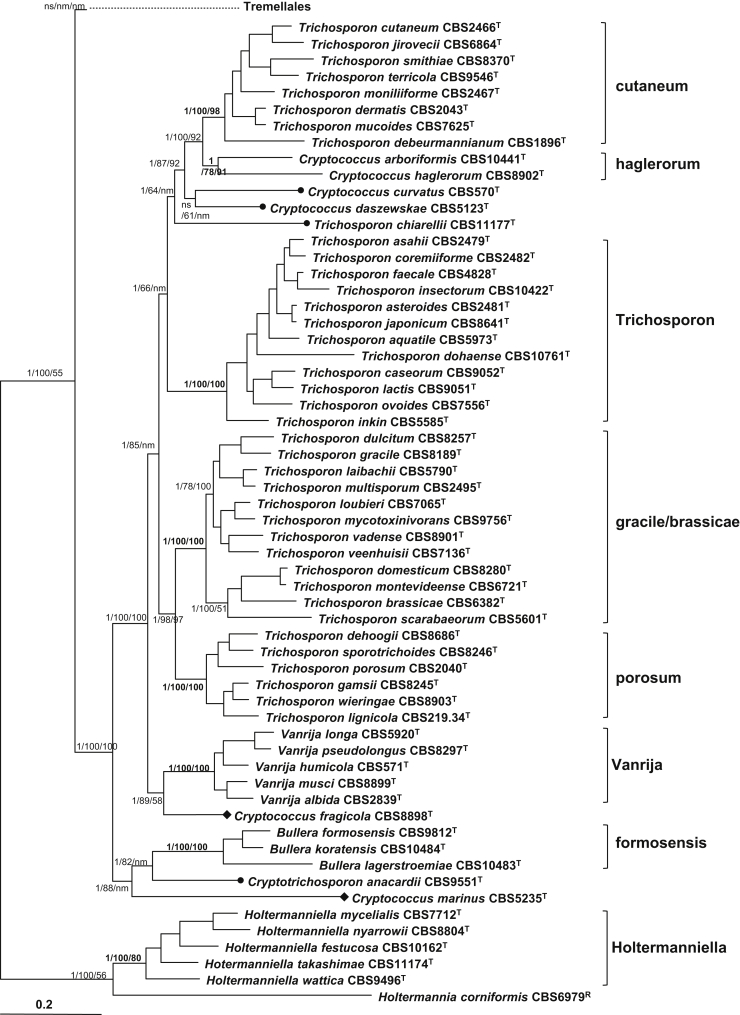
Fig. 5
The phylogenetic relationships among species of the Trichosporonales and Holtermaniales inferred from a seven-gene data set including sequences of three rDNA gene, RPB1, RPB2, TEF1 and CYTB sequences. The tree backbone is constructed using Bayesian analysis. The Bayesian posterior probabilities (PP) and bootstrap percentages (BP) of maximum likelihood and neighbour-joining analyses from 1 000 replicates are shown respectively from left to right on the deep and major branches resolved. The branches ending with filled cycles and diamonds represent single-species clades with a stable and unstable position, respectively. Note: nm, not monophyletic; ns, not supported (PP < 0.9 or BP < 50 %).
Fig. 6
Fig. 6
The phylogenetic relationships among species of the Tremellales inferred from a seven-gene data set including sequences of three rDNA genes, RPB1, RPB2, TEF1 and CYTB sequences. The tree backbone is constructed using Bayesian analysis. The Bayesian posterior probabilities (PP) and bootstrap percentages (BP) of maximum likelihood and neighbour-joining analyses from 1 000 replicates are shown respectively from left to right on the deep and major branches resolved. The branches ending with filled cycles and diamonds represent single-species clades with a stable and unstable position, respectively. Note: nm, not monophyletic; ns, not supported (PP < 0.9 or BP < 50 %).
Fig. 6
Fig. 6
The phylogenetic relationships among species of the Tremellales inferred from a seven-gene data set including sequences of three rDNA genes, RPB1, RPB2, TEF1 and CYTB sequences. The tree backbone is constructed using Bayesian analysis. The Bayesian posterior probabilities (PP) and bootstrap percentages (BP) of maximum likelihood and neighbour-joining analyses from 1 000 replicates are shown respectively from left to right on the deep and major branches resolved. The branches ending with filled cycles and diamonds represent single-species clades with a stable and unstable position, respectively. Note: nm, not monophyletic; ns, not supported (PP < 0.9 or BP < 50 %).
Fig. 7
Fig. 7
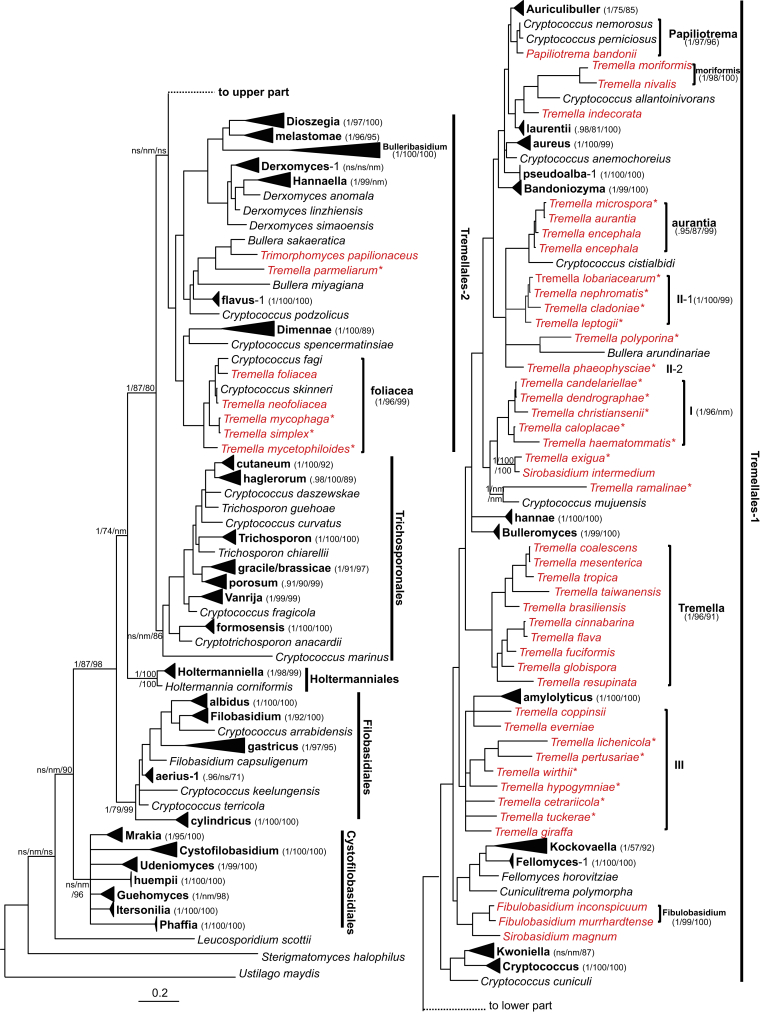
Phylogeny of tremellomycetous yeasts and dimorphic taxa based on 5.8S and LSU D1/D2 rDNA sequences from strains employed in this study and 26 more Tremella species employed in Millanes et al. (2011). The tree backbone is constructed using Bayesian analysis. The Bayesian posterior probabilities (PP) and bootstrap percentages (BP) of maximum likelihood and neighbour-joining analyses from 1 000 replicates are shown respectively from left to right on the deep and major branches and in brackets following the clades resolved. The species names in red represent fruiting-body forming taxa and those with a star superscript indicate that the sequences are from herbarium specimens of lichen-inhabiting species. Note: nm, not monophyletic; ns, not supported (PP < 0.9 or BP < 50 %).

References

    1. Alfaro M.E., Zoller S., Lutzoni F. Bayes or bootstrap? A simulation study comparing the performance of Bayesian Markov chain Monte Carlo sampling and bootstrapping in assessing phylogenetic confidence. Molecular Biology and Evolution. 2003;20:255–266. - PubMed
    1. Babenko V.N., Rogozin L.B., Mekhedov S.L. Prevalence of intron gain over intron loss in the evolution of paralogous gene families. Nucleic Acids Research. 2004;32:3724–3733. - PMC - PubMed
    1. Bandoni R.J. Dimorphic heterobasidiomycetes, taxonomy and parasitism. Studies in Mycology. 1995;38:13–27.
    1. Bandoni R.J., Boekhout T. Trimorphomyces Bandoni & Oberwinkler. In: Kurtzman C.P., Fell J.W., editors. The yeasts: a taxonomic study. Elsevier; London: 2011. pp. 1591–1594.
    1. Biswas S.K., Wang L., Yokoyama K. Molecular analysis of Cryptococcus neoformans mitochondrial cytochrome b gene sequences. Journal of Clinical Microbiology. 2003;41:5572–5576. - PMC - PubMed

LinkOut - more resources