


Toll-like receptor signalling in regenerative myogenesis: friend and foe
- PMID: 26956975
- PMCID: PMC4957968
- DOI: 10.1002/path.4714
Toll-like receptor signalling in regenerative myogenesis: friend and foe
Abstract
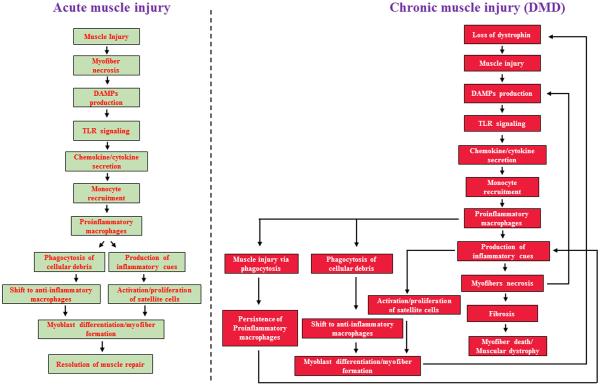
Skeletal muscle regeneration in normal and diseased muscle is regulated by multiple factors and cells present in the injured muscle micro-environment. In addition to muscle progenitor cells, several immunocytes participate in the regenerative response. Among them, macrophages are one of the most important components of the immune response that governs the step-wise progression of muscle regeneration. The initial role of macrophages is to phagocytose muscle cell debris and later, through their transition to an anti-inflammatory phenotype, they promote regeneration. However, in several genetic muscle disorders, continuous muscle injury disrupts the balance between pro-inflammatory and anti-inflammatory macrophages, leading to an overall inflammatory milieu and inhibition of muscle regeneration. Accumulating evidence suggests that Toll-like receptor (TLR)-mediated signalling plays an important role in the regulation of macrophage phenotypes during regenerative myogenesis in response to both acute and chronic muscle injury. Here, we discuss the role of TLR signalling in regulating macrophage phenotypes and skeletal muscle regeneration in healthy and diseased muscle. Copyright © 2016 Pathological Society of Great Britain and Ireland. Published by John Wiley & Sons, Ltd.
Keywords: Toll-like receptors; macrophages; muscular dystrophy; skeletal muscle regeneration.
Copyright © 2016 Pathological Society of Great Britain and Ireland. Published by John Wiley & Sons, Ltd.
Figures
Comment on
-
Microglandular adenosis associated with triple-negative breast cancer is a neoplastic lesion of triple-negative phenotype harbouring TP53 somatic mutations.J Pathol. 2016 Apr;238(5):677-88. doi: 10.1002/path.4691. J Pathol. 2016. PMID: 26806567 Free PMC article.
References
Publication types
MeSH terms
Grants and funding
LinkOut - more resources
Full Text Sources
Other Literature Sources
