


Complementary school garden, nutrition, water, sanitation and hygiene interventions to improve children's nutrition and health status in Burkina Faso and Nepal: a study protocol
- PMID: 26957322
- PMCID: PMC4784388
- DOI: 10.1186/s12889-016-2910-7
Complementary school garden, nutrition, water, sanitation and hygiene interventions to improve children's nutrition and health status in Burkina Faso and Nepal: a study protocol
Erratum in
-
Erratum to: Complementary school garden, nutrition, water, sanitation and hygiene interventions to improve children's nutrition and health status in Burkina Faso and Nepal: a study protocol.BMC Public Health. 2016 Jul 5;16(1):522. doi: 10.1186/s12889-016-3134-6. BMC Public Health. 2016. PMID: 27381239 Free PMC article. No abstract available.
Abstract
Background: Malnutrition and intestinal parasitic infections are common among children in Burkina Faso and Nepal. However, specific health-related data in school-aged children in these two countries are scarce. In the frame of a larger multi-stakeholder project entitled "Vegetables go to School: Improving Nutrition through Agricultural Diversification" (VgtS), a study has been designed with the objectives to: (i) describe schoolchildren's health status in Burkina Faso and Nepal; and to (ii) provide an evidence-base for programme decisions on the relevance of complementary school garden, nutrition, water, sanitation and hygiene (WASH) interventions.
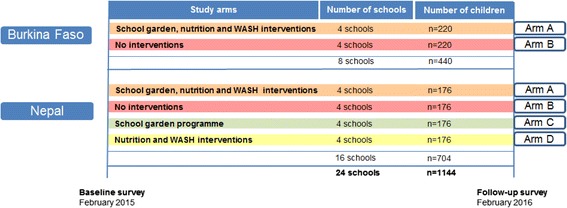
Methods/design: The studies will be conducted in the Centre Ouest and the Plateau Central regions of Burkina Faso and the Dolakha and Ramechhap districts of Nepal. Data will be collected and combined at the level of schools, children and their households. A range of indicators will be used to examine nutritional status, intestinal parasitic infections and WASH conditions in 24 schools among 1144 children aged 8-14 years at baseline and a 1-year follow-up. The studies are designed as cluster randomised trials and the schools will be assigned to two core study arms: (i) the 'complementary school garden, nutrition and WASH intervention' arm; and the (ii) 'control' arm with no interventions. Children will be subjected to parasitological examinations using stool and urine samples and to quality-controlled anthropometric and haemoglobin measurements. Drinking water will be assessed for contamination with coliform bacteria and faecal streptococci. A questionnaire survey on nutritional and health knowledge, attitudes and practices (KAP) will be administered to children and their caregivers, also assessing socioeconomic, food-security and WASH conditions at household level. Focus group and key-informant interviews on children's nutrition and hygiene perceptions and behaviours will be conducted with their caregivers and school personnel.
Discussion: The studies will contribute to fill a data gap on school-aged children in Burkina Faso and Nepal. The data collected will also serve to inform the design of school-based interventions and will contribute to deepen the understanding of potential effects of these interventions to improve schoolchildren's health in resource-constrained settings. Key findings will be used to provide guidance for the implementation of health policies at the school level in Burkina Faso and Nepal.
Trial registration: ISRCTN30840 (date assigned: 17 July 2015).
Figures
References
-
- Prüss-Üstün A, Bos R, Gore F, Bartram J. Safer water, better health: costs, benefits and sustainability of interventions to protect and promote health. Geneva: World Health Organization; 2008.
-
- Institute for Health Metrics and Evaluation. Global Burden of Disease compare and visualisation. University of Washington. 2013. http://vizhub.healthdata.org/gbd-compare/. Accessed 15 December 2015.
-
- WHO . Diarrhoeal diseases. Geneva: World Health Organization; 2013.
Publication types
MeSH terms
Substances
Associated data
LinkOut - more resources
Full Text Sources
Other Literature Sources
Medical
Miscellaneous
