


Thwarted Belongingness Mediates the Relationship between Fear of Negative Evaluation and Suicidal Ideation
- PMID: 26957677
- PMCID: PMC4779438
- DOI: 10.1007/s10608-015-9715-3
Thwarted Belongingness Mediates the Relationship between Fear of Negative Evaluation and Suicidal Ideation
Abstract
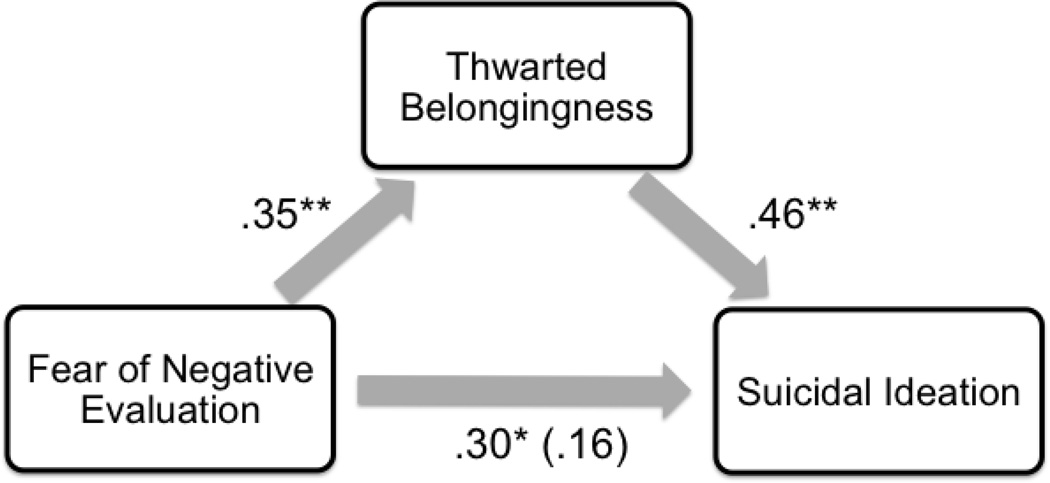
Fear of negative evaluation has been documented as a mechanism that explains variations in feelings of belongingness. According to the interpersonal theory of suicide (Joiner, 2005), feelings of thwarted belongingness, that one does not belong, can significantly increase desire and risk for suicide. We proposed that differences in thwarted belongingness may explain variations in suicidal ideation and behavior as a function of levels of fear of negative evaluation. This hypothesis was tested by examining self-reported fears of negative evaluation, thwarted belongingness, and suicidal ideation in 107 young adults, many who were explicitly targeted for recruitment due to a history of suicidal ideation and behavior (13.1% had thoughts about suicide without a previous attempt; 15.9% reported at least one previous attempt [max = 5 attempts]). Mediation analyses were conducted with suicidal ideation entered as the outcome variable. Results indicated that greater fears of negative evaluation were significantly and positively associated with levels of suicidal ideation. Differences in thwarted belongingness fully accounted for the relationship between fears of negative evaluation and suicidal ideation. We conclude with clinical implications and future directions.
Keywords: fear of negative evaluation; interpersonal theory of suicide; suicidal ideation; thwarted belongingness.
Conflict of interest statement
Figures
References
-
- American College Health Association. National College Health Assessment II: Reference group executive summary, fall 2013. Baltimore, MD: American College Health Association; 2014.
-
- Baumeister RF, Leary MR. The need to belong: desire for interpersonal attachments as a fundamental human motivation. Psychological Bulletin. 1995;117(3):497–529. - PubMed
-
- Beautrais AL. Suicides and serious suicide attempts: two populations or one? Psychological Medicine. 2001;31(05):837–845. - PubMed
-
- Cacioppo JT, Ernst JM, Burleson MH, McClintock MK, Malarkey WB, Hawkley LC, Berntson GG. Lonely traits and concomitant physiological processes: the MacArthur social neuroscience studies. International Journal of Psychophysiology. 2000;35(2):143–154. - PubMed
-
- Centers for Disease Control and Prevention. Suicide: Facts at a Glance. 2012 Sep 25; Retrieved from Centers for Disease Control and Prevention: http://www.cdc.gov/violenceprevention/pub/suicide_datasheet.html.
Grants and funding
LinkOut - more resources
Full Text Sources
Other Literature Sources