. 2016 Mar 8:9:55.
doi: 10.1186/s13068-016-0469-2. eCollection 2016.

Hyper-accumulation of starch and oil in a Chlamydomonas mutant affected in a plant-specific DYRK kinase

Affiliations

Hyper-accumulation of starch and oil in a Chlamydomonas mutant affected in a plant-specific DYRK kinase

Miriam Schulz-Raffelt et al. Biotechnol Biofuels. .

Abstract

Background: Because of their high biomass productivity and their ability to accumulate high levels of energy-rich reserve compounds such as oils or starch, microalgae represent a promising feedstock for the production of biofuel. Accumulation of reserve compounds takes place when microalgae face adverse situations such as nutrient shortage, conditions which also provoke a stop in cell division, and down-regulation of photosynthesis. Despite growing interest in microalgal biofuels, little is known about molecular mechanisms controlling carbon reserve formation. In order to discover new regulatory mechanisms, and identify genes of interest to boost the potential of microalgae for biofuel production, we developed a forward genetic approach in the model microalga Chlamydomonas reinhardtii.

Results: By screening an insertional mutant library on the ability of mutants to accumulate and re-mobilize reserve compounds, we isolated a Chlamydomonas mutant (starch degradation 1, std1) deficient for a dual-specificity tyrosine-phosphorylation-regulated kinase (DYRK). The std1 mutant accumulates higher levels of starch and oil than wild-type and maintains a higher photosynthetic activity under nitrogen starvation. Phylogenetic analysis revealed that this kinase (named DYRKP) belongs to a plant-specific subgroup of the evolutionarily conserved DYRK kinase family. Furthermore, hyper-accumulation of storage compounds occurs in std1 mostly under low light in photoautotrophic condition, suggesting that the kinase normally acts under conditions of low energy status to limit reserve accumulation.

Conclusions: The DYRKP kinase is proposed to act as a negative regulator of the sink capacity of photosynthetic cells that integrates nutrient and energy signals. Inactivation of the kinase strongly boosts accumulation of reserve compounds under photoautotrophic nitrogen deprivation and allows maintaining high photosynthetic activity. The DYRKP kinase therefore represents an attractive target for improving the energy density of microalgae or crop plants.

Keywords: Chlamydomonas; DYRK; Kinase; Microalgae; Nutrient deprivation; Oil; Photosynthesis; Starch.


Figures
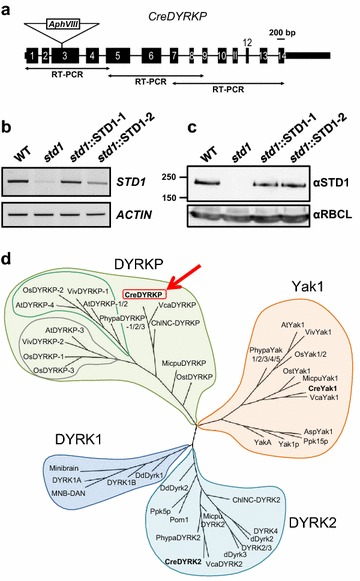
Fig. 1
Fig. 1
Molecular and phylogenetic characterization of the Chlamydomonas std1 mutant. a In std1, the paromomycin-resistance cassette (AphVIII gene, white box) is inserted within the third exon of a gene annotated as a DYRK kinase (Cre07.g337300, v5.5). The gene structure was deduced from three overlapping RT-PCR. b STD1 transcript levels were analyzed by RT-PCR in WT, std1 and two complemented lines (std1::STD1-1 and std1::STD1-2) by amplifying a 1421 bp product. A 456 bp RT-PCR actin product was amplified as a loading control. Sequence primers for RT-PCR are given in Additional file 1: Table S2. c The level of STD1 protein was analyzed by immunodetection in WT, std1 and two complemented lines (std1::STD1-1 and std1::STD1-2). d Phylogenetic analysis of the DYRK protein family indicates that STD1 (referred to here as DYRKP) belongs to a new DYRK subfamily specific to plants
Fig. 2
Fig. 2
Starch and oil hyper-accumulate in std1 mutant following N deprivation. a Starch content in cells grown photoautotrophically under low light (LL, 35 µmol photons m−2 s−1) supplemented with 2 % CO2. b Starch content in cells grown photoautotrophically under medium light (100 µmol photons m−2 s−1) supplemented with 2 % CO2. c Starch content in cells grown mixotrophically (i.e., TAP) under medium light (100 µmol photons m−2 s−1). d TAG content in cells grown photoautotrophically under medium light (100 µmol photons m−2 s−1) supplemented with 2 % CO2. e TAG content in cells grown mixotrophically (i.e., TAP media) under medium light (100 µmol photons m−2 s−1). f Nile red fluorescence (lower panel) and bright field microscopy (upper panel) of indicated cells under photoautotrophic N deprivation. Scale bar 10 µm. MM minimal medium. Data are means ± SD (n = 3). Cell counts, cellular volumes, and chlorophyll content measurements related to these experiments are shown on Additional file 1: Figure S4
Fig. 3
Fig. 3
Biomass and starch production during photoautotrophic N deprivation. All strains were grown photoautotrophically in an MM medium supplemented with 2 % CO2, at a light intensity of 100 µmol photons m−2 s−1 and then subjected to N deprivation (at day 0). a Visual observation of cell pellets from 1 ml N-starved cells harvested at different time points. b Biomass (measured as dry weight) and intracellular starch were determined in N-starved strains. Data represent means ± SD (n = 3) (upper error bar dry weight, lower error bar, starch). c Northern blot analysis of DYRKP transcripts in response to N deprivation
Fig. 4
Fig. 4
Biomass productivity of WT and std1 Chlamydomonas cells measured in photobioreactors operated as turbidostats during photoautotrophic N deprivation. Cells were grown under constant illumination (125 µmol photons m−2 s−1) in the presence of 2 % CO2 enriched air. Cell density was measured using an absorption probe and maintained at a constant level by injection of fresh medium. Due to the aggregation phenotype of std1, OD880nm was regulated at different values for WT (OD880nm = 0. 4) and std1 (OD880nm = 0. 3) to reach similar biomass concentrations (0. 15 g dry weight L−1). After a 48-h stabilization period in the presence of MM, the dilution medium was replaced by MM-N (t 0). a Cumulated amounts of fresh medium were added to maintain the culture at a constant biomass concentration. Measurements of ammonium concentration (dotted lines) in the culture medium showed complete exhaustion after 45 h. The 100 % value corresponds to 7.5 mM NH4 +, which is the ammonium concentration of the minimal medium. Shown are mean ± SD (n = 3). b Biomass productivity (g dry weight L−1 d−1) was determined from dilution rates and biomass measurements at t 0, and 48 and 72 h after N-removal. Shown are means ± SD (n = 3)
Fig. 5
Fig. 5
Photosynthetic activity of WT and std1 Chlamydomonas cells during mixotrophic or photoautotrophic N deprivation. PSII yields were determined at different light intensities in the std1 mutant, in the WT and in two complemented mutant lines by measuring pulse amplitude-modulated chlorophyll fluorescence. Cells were grown under a light intensity of 100 µmol photons m−2 s−1 under a Photoautotrophic conditions (i.e., MM supplemented with 2 % CO2) or b Mixotrophic conditions (i.e., TAP). At t 0, cells were resuspended in an N-free medium and fluorescence measurements were performed at t0 (N-replete) and after 2 and 3 days of N deprivation. Data are means ± SD (n = 6 for a, and n = 4 for b)
Fig. 6
Fig. 6
A hypothetical model of the DYRKP (STD1) function in response to nutrient deprivation. We propose that DYRKP negatively regulates the sink capacity in response to both nutrient and energy signals. DYRKP is induced in response to nutrient limitation, and would be active in conditions of low energy status. Disruption of DYRKP in std1 allows sustained synthesis of reserve compounds, thereby increasing electron sink capacity and maintaining a high photosynthetic rate

References

    1. Hu Q, Sommerfeld M, Jarvis E, Ghirardi M, Posewitz M, Seibert M, et al. Microalgal triacylglycerols as feedstocks for biofuel production: perspectives and advances. Plant J. 2008;54:621–639. doi: 10.1111/j.1365-313X.2008.03492.x. - DOI - PubMed
    1. Wijffels RH, Barbosa MJ. An outlook on microalgal biofuels. Science. 2010;329:796–799. doi: 10.1126/science.1189003. - DOI - PubMed
    1. Georgianna DR, Mayfield SP. Exploiting diversity and synthetic biology for the production of algal biofuels. Nature. 2012;488:329–335. doi: 10.1038/nature11479. - DOI - PubMed
    1. Larkum AWD, Ross IL, Kruse O, Hankamer B. Selection, breeding and engineering of microalgae for bioenergy and biofuel production. TiBiotech. 2012;30:198–205. doi: 10.1016/j.tibtech.2011.11.003. - DOI - PubMed
    1. Ball SG, Dirick L, Decq A, Martiat JC, Matagne RF. Physiology of starch storage in the monocellular alga Chlamydomonas reinhardtii. Plant Sci. 1990;66:1–9. doi: 10.1016/0168-9452(90)90162-H. - DOI
