Importance and benefits of the doctoral thesis for medical graduates
- PMID: 26958656
- PMCID: PMC4766933
- DOI: 10.3205/zma001007
Importance and benefits of the doctoral thesis for medical graduates
Abstract
Introduction: The majority of medical graduates in Germany complete a doctorate, even though a doctoral degree is not necessary for the practice of medicine. So far, little is known about doctoral candidates' view on the individual benefit a doctoral thesis has for them. Consequently, this is the subject of the present investigation.
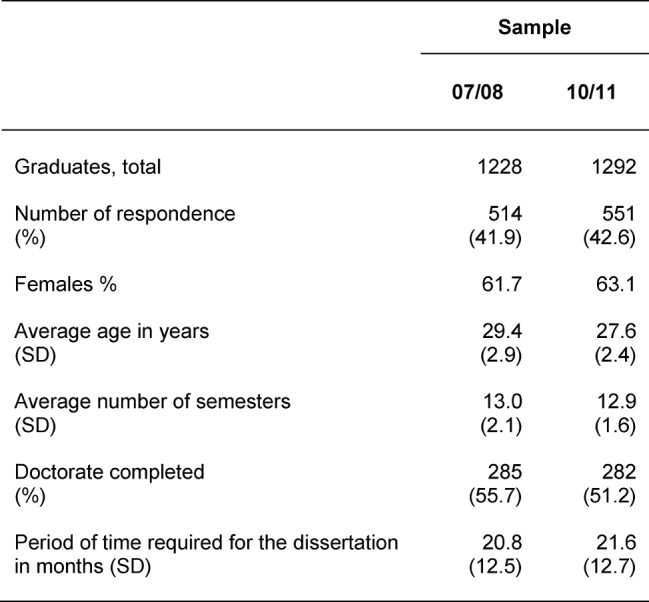
Method: Data from surveys with graduates of the five medical faculties of Baden-Württemberg from the graduation years 2007/2008 (N=514) and 2010/2011 (N=598) were analysed.
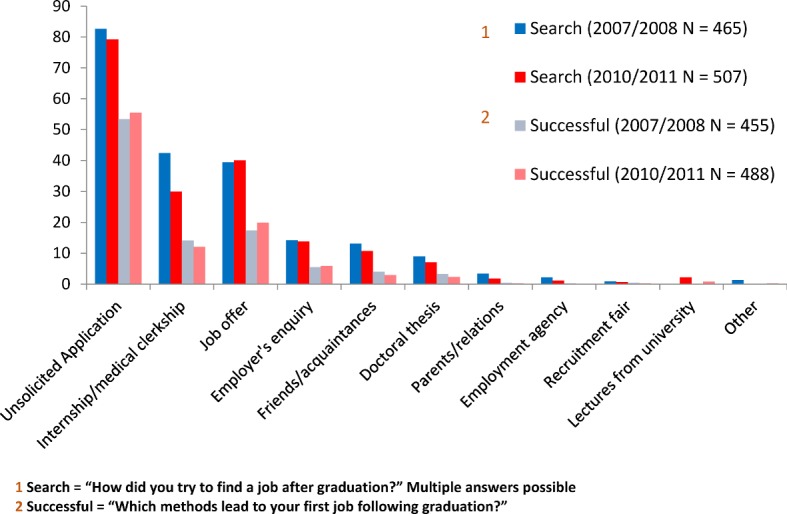
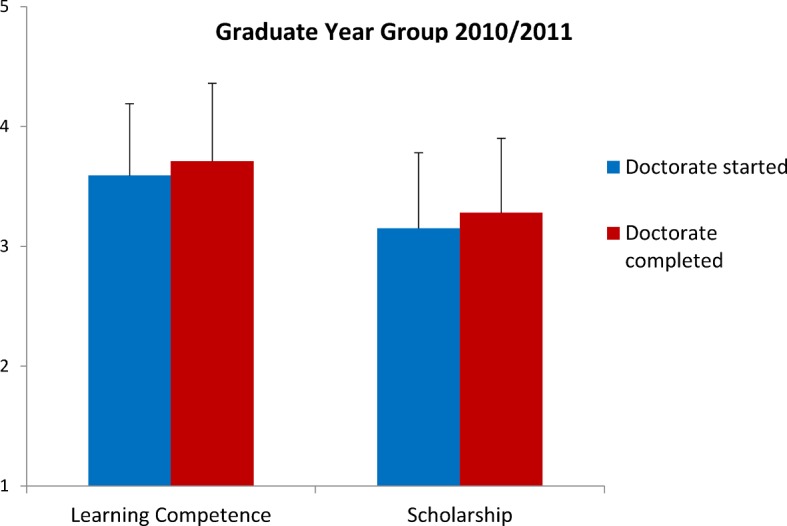
Results: One and a half years after graduating 53% of those interviewed had completed their doctorate. When asked about their motivation for writing a doctoral thesis, participants answered most frequently "a doctorate is usual" (85%) and "improvement of job opportunities" (75%), 36% said that an academic career has been their primary motive. Less than 10% responded that they used their doctoral thesis as a means to apply for a job. The proportion of graduates working in health care is equally large among those who have completed a thesis and those who have not. Graduates who pursued a thesis due to scientific interest are also currently more interested in an academic career and recognise more opportunities for research. An implicit benefit of a medical thesis emerged with regard to the self-assessment of scientific competences as those who completed a doctorate rated their scientific competencies higher than those who have not.
Discussion: Although for the majority of physicians research interest is not the primary motivation for completing a doctorate, they might nevertheless achieve some academic competencies. For graduates pursuing an academic career the benefit of completing a medical thesis is more obvious.
Einleitung: Die Mehrheit der medizinischen AbsolventInnen in Deutschland promoviert, obwohl der Titel nicht zur ärztlichen Berufsausübung notwendig ist. Zur Frage, welchen individuellen Nutzen die Doktorarbeit aus Sicht der Promovenden hat, ist bislang nur wenig bekannt. Sie ist daher Gegenstand dieser Untersuchung.Methode: Analysiert wurden Daten aus Absolventenstudien der Abschlussjahrgänge 2007/2008 (N=514) und 2010/2011 (N=598) der Medizinischen Fakultäten Baden-Württembergs.Ergebnisse: 53% der Befragten haben 1,5 Jahre nach Studienabschluss ihre Promotion abgeschlossen. Die stärkste Zustimmung zu Beweggründen, eine Doktorarbeit anzufertigen, erfahren die Motive „Promotion ist üblich“ (85%) und „Verbesserung der Berufschancen“ (75%). Dem Motiv, eine akademische Karriere anzustreben, stimmten 36% zu. Weniger als 10% der Befragten setzen ihre Promotionsarbeit als Strategie bei der Stellensuche ein. Der Anteil der AbsolventInnen, die in der Krankenversorgung arbeiten ist unter den Promovierten praktisch genauso groß wie unter den Nicht-Promovierten. Diejenigen, die für die Promotion stärker wissenschaftliche Motive angeben, sind auch aktuell stärker an einer akademischen Karriere interessiert und sehen für sich mehr Möglichkeiten wissenschaftlich zu arbeiten. Als impliziter Nutzen zeigte sich, dass die promovierten AbsolventInnen ihre wissenschaftlichen Kompetenzen signifikant höher einschätzen, als ihre nicht promovierten KollegInnen.Diskussion: Obwohl die meisten MedizinerInnen eine Promotion nicht in erster Linie aus originärem Forschungsinteresse anstreben, erweitern sie dadurch dennoch ihre wissenschaftlichen Kompetenzen. Einen offensichtlicheren Nutzen hat die Promotion für diejenigen, die eine wissenschaftliche Karriere anstreben.
Keywords: Doctorate, medical; Evaluation; Graduate survey; Methods, academic; Motivation.
Figures
References
-
- Rehn T, Brandt G, Fabian G, Briedis K. Hochschulabschlüsse im Umbruch. Studium und Übergang von Absolventinnen und Absolventen reformierter und traditioneller Studiengänge des Jahrgangs 2009. Report No. 2011-17. Hannover: HIS Forum Hochschule; 2011. Available from: http://www.his.de/pdf/pub_fh/fh-201117.pdf.
-
- Schwarzer A, Fabian G. Medizinreport 2012 - Berufsstart und Berufsverlauf von Humanmedizinerinnen und Humanmedizinern. Report No: 2012-05. Hannover: HIS Forum Hochschule; 2012. Available from: http://www.his.de/pdf/22/medizinerreport_2012.pdf.
-
- Grotheer M, Isleib S, Netz N, Biedis K. Hochqualifiziert und gefragt. Ergebnisse der zweiten HIS-HF Absolventenbefragung des Jahrgangs 2005. Report No.; 2012-14. Hannover: HIS Forum Hochschule; 2012. Available from: http://www.his.de/pdf/pub_fh/fh-201214.pdf.
-
- Wissenschaftsrat. Anforderungen an die Qualitätssicherung der Promotion. Köln: Wissenschaftsrat; 2011. Available from: http://www.wissenschaftsrat.de/download/archiv/1704-11.pdf.
-
- Wissenschaftsrat. Empfehlungen zur Doktorandenausbildung. Köln: Wissenschaftsrat; 2002. pp. 56–57. Available from: http://www.wissenschaftsrat.de/download/archiv/5459-02.pdf.
MeSH terms
LinkOut - more resources
Full Text Sources
Molecular Biology Databases