


Epidemiology of Polypharmacy and Potential Drug-Drug Interactions Among Pediatric Patients in ICUs of U.S. Children's Hospitals
- PMID: 26959349
- PMCID: PMC5243142
- DOI: 10.1097/PCC.0000000000000684
Epidemiology of Polypharmacy and Potential Drug-Drug Interactions Among Pediatric Patients in ICUs of U.S. Children's Hospitals
Abstract
Objectives: Polypharmacy is common in hospitalized children in the United States and has been identified as a major risk factor for exposure to potential drug-drug interactions. Little is known about the characteristics and prevalence of exposure of pediatric patients to polypharmacy and potential drug-drug interactions in PICUs.
Design: Retrospective cohort study using the Pediatric Health Information System database.
Setting: Forty-two freestanding children's hospitals throughout the United States.
Patients: A total of 54,549 patients less than 18 years old cared for in PICUs in 2011. Patients in neonatal ICUs were not included.
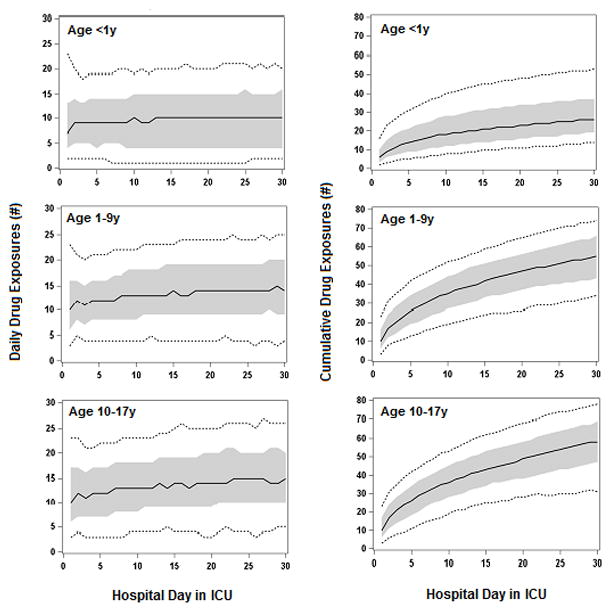
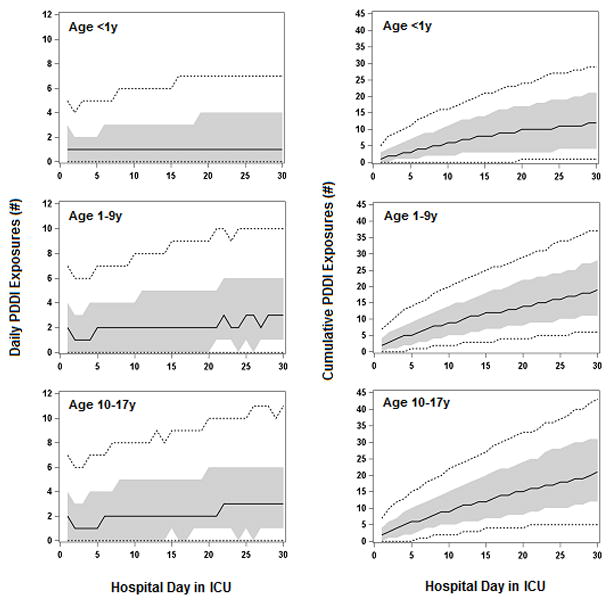
Measurements and main results: PICU patients were on average exposed to 10 distinct drugs each hospital day and to 20 drugs cumulatively during their hospitalization. Seventy-five percent of patients were exposed to greater than or equal to one potential drug-drug interaction regardless of severity level, 6% to greater than or equal to one contraindicated potential drug-drug interaction, 69% to greater than or equal to one major potential drug-drug interaction, 57% to greater than or equal to one moderate potential drug-drug interaction, 19% to greater than or equal to one minor potential drug-drug interaction. Potential drug-drug interaction exposures were significantly associated with specific diagnoses (p < 0.001), presence of complex chronic conditions (p < 0.001), increasing number of total distinct drugs used (p < 0.001), increasing length of stay in PICU (p < 0.001), and white race (p < 0.001).
Conclusions: Many PICU patients are exposed to substantial polypharmacy and potential drug-drug interactions. Future research should identify the risk of adverse drug events following specific potential drug-drug interaction exposures, especially the risk of adverse drug events due to multiple potential drug-drug interaction exposures, and determine the probability and magnitude of the actual harm (if any) for each specific potential drug-drug interaction, especially for multiple potential drug-drug interaction exposures.
Conflict of interest statement
The authors have no conflicts of interest to disclose.
Figures
Comment in
-
"Potential" Drug-Drug Interactions and the PICU: Should We Worry About ICU Polypharmacy?Pediatr Crit Care Med. 2016 May;17(5):470-2. doi: 10.1097/PCC.0000000000000694. Pediatr Crit Care Med. 2016. PMID: 27144698 No abstract available.
References
-
- US Department of Health and Human Services. [Accessed September 12, 2014];Best Pharmaceuticals for Children Act Literature Reviews and Assessments. Available at: http://www.bpca.nichd.nih.gov/resources/reviews/index.cfm.
-
- Kweder S. [Accessed September 12, 2014];Programs Affecting Safety and Innovation in Pediatric Therapies. Available at: http://www.fda.gov/NewsEvents/Testimony/ucm153848.htm.
-
- Mizokami F1, Koide Y, Noro T, Furuta K. Polypharmacy with common diseases in hospitalized elderly patients. Am J Geriatr Pharmacother. 2012;10:123–128. - PubMed
-
- Petersson G, Hovstadius B. Factors leading to excessive polypharmacy. Clin Geriatr Med. 2012;28:159–172. - PubMed
-
- Feudtner C, Dai D, Hexem KR, et al. Prevalence of polypharmacy exposure among hospitalized children in the United States. Arch Pediatr Adolesc Med. 2012;166:6–16. - PubMed
Publication types
MeSH terms
Grants and funding
LinkOut - more resources
Full Text Sources
Other Literature Sources
Medical
