. 2016 Aug 15;22(16):4045-56.
doi: 10.1158/1078-0432.CCR-15-2840. Epub 2016 Mar 9.

The Genomic Landscape of Male Breast Cancers

Affiliations

The Genomic Landscape of Male Breast Cancers

Salvatore Piscuoglio et al. Clin Cancer Res. .

Abstract

Purpose: Male breast cancer is rare, and its genomic landscape has yet to be fully characterized. Lacking studies in men, treatment of males with breast cancer is extrapolated from results in females with breast cancer. We sought to define whether male breast cancers harbor somatic genetic alterations in genes frequently altered in female breast cancers.

Experimental design: All male breast cancers were estrogen receptor-positive, and all but two were HER2-negative. Fifty-nine male breast cancers were subtyped by immunohistochemistry, and tumor-normal pairs were microdissected and subjected to massively parallel sequencing targeting all exons of 241 genes frequently mutated in female breast cancers or DNA-repair related. The repertoires of somatic mutations and copy number alterations of male breast cancers were compared with that of subtype-matched female breast cancers.

Results: Twenty-nine percent and 71% of male breast cancers were immunohistochemically classified as luminal A-like or luminal B-like, respectively. Male breast cancers displayed a heterogeneous repertoire of somatic genetic alterations that to some extent recapitulated that of estrogen receptor (ER)-positive/HER2-negative female breast cancers, including recurrent mutations affecting PIK3CA (20%) and GATA3 (15%). ER-positive/HER2-negative male breast cancers, however, less frequently harbored 16q losses, and PIK3CA and TP53 mutations than ER-positive/HER2-negative female breast cancers. In addition, male breast cancers were found to be significantly enriched for mutations affecting DNA repair-related genes.

Conclusions: Male breast cancers less frequently harbor somatic genetic alterations typical of ER-positive/HER2-negative female breast cancers, such as PIK3CA and TP53 mutations and losses of 16q, suggesting that at least a subset of male breast cancers are driven by a distinct repertoire of somatic changes. Given the genomic differences, caution may be needed in the application of biologic and therapeutic findings from studies of female breast cancers to male breast cancers. Clin Cancer Res; 22(16); 4045-56. ©2016 AACR.


Conflict of interest statement

Disclosure of potential conflicts of interest: C.A. Eberle is an employee of Genomic Health, Inc. J.B. Hicks is a consultant/ advisory board member for Celmatix, Inc. and Curis Inc. No potential conflicts of interest were disclosed by the other authors.

Figures

Figure 1
Figure 1. Repertoires of mutations and copy number alterations in male breast cancer, ER-positive/HER2-negative female breast cancer and female breast cancer of luminal subtype
Somatic mutations in the 241 genes, either recurrently mutated in female breast cancer (FBC) or related to DNA repair, included in the targeted capture massively parallel sequencing assay employed in this study. The results for (A) ER-positive/HER2-negative male breast cancer (MaBC) and ER-positive/HER2-negative female breast cancer and (B) male breast cancer and FBC of luminal subtype are ordered from top to bottom in decreasing order of mutational frequency in MaBCs (Top). Patterns of copy number alterations in MaBCs and FBCs in selected genes (Middle). Expression of ER, PR, HER2 and Ki-67 (MaBC only) as defined by immunohistochemistry (IHC) in the samples analyzed (Bottom). In (B), MaBCs were classified into luminal A-like and luminal B-like subtypes defined based on their immunohistochemical profiles following the St Gallen’s criteria (27), and FBCs were classified into luminal A and luminal B molecular subtypes based on PAM50. Sequencing data, copy number data and intrinsic subtype information of the FBCs were retrieved from The Cancer Genome Atlas (13).
Figure 2
Figure 2. Patterns of copy number alterations in male breast cancer
Repertoire of copy number alterations as defined by targeted capture massively parallel sequencing in male breast cancers classified into luminal A-like and luminal B-like subtypes. Samples are distributed along the y-axis; the 232 genes mapping to autosomes included in the targeted capture massively parallel sequencing assay are distributed according to their genomic position on the x-axis. Dark blue: amplification, light blue: copy number gain; white: neutral; light red: copy number loss; dark red: homozygous deletion.
Figure 3
Figure 3. Comparative genomic profiling of luminal A-like and luminal B-like male breast cancers
Frequency plots and multi-Fisher’s exact test comparisons of chromosomal gains and losses in luminal A-like (top) and luminal B-like (middle) male breast cancers. The frequency of gains (green bars) or losses (purple bars) for each gene is plotted on the y-axis, according to their genomic position on the x-axis. Inverse Log10 values of the Fisher’s exact test p-values are plotted according to genomic location (x-axis) (bottom). Note the lack of any significant differences in the copy number profiles between luminal A-like and luminal B-like MaBCs.
Figure 4
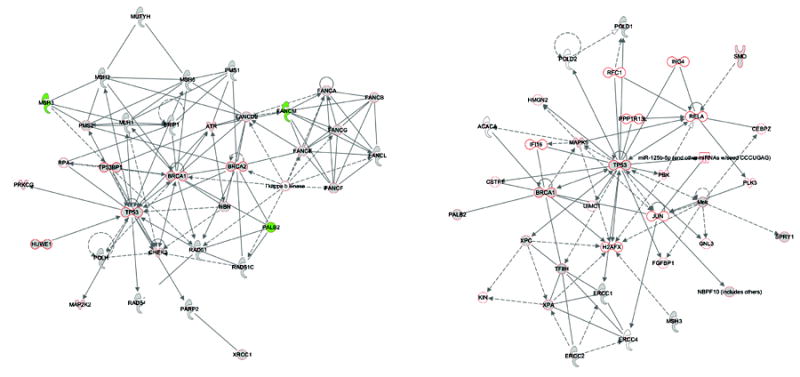
Figure 4. Ingenuity Pathway Analysis of 25 genes mutated in ER-positive/HER2-negative male breast cancers but not in ER-positive/HER2-negative female breast cancers from The Cancer Genome Atlas study
Likely pathogenic mutations present in ER-positive/HER2-negative male breast cancers but not targeted by likely pathogenic mutations in ER-positive/HER2-negative female breast cancers from The Cancer Genome Atlas (TCGA) study were annotated using Ingenuity Pathway Analysis (IPA). The ‘DNA replication, recombination and repair’ network was significantly enriched for the 25 genes affected by likely pathogenic mutations present in ER-positive/HER2-negative male breast cancers but not in ER-positive/HER2-negative female breast cancers from TCGA (IPA score 17). Two views of the network are shown.
Figure 5
Figure 5. Patterns of copy number alterations in male breast cancers and ER-positive/HER2-negative female breast cancers/ post-menopausal ER-positive/HER2-negative female breast cancers from The Cancer Genome Atlas study
Frequency plots of chromosomal gains and losses in 57 ER-positive/HER2-negative male breast cancers (MaBCs) compared to 250 ER-positive/HER2-negative female breast cancers (FBCs) (left) and 132 post-menopausal ER-positive/HER2-negative FBCs (right) from The Cancer Genome Atlas study. The frequency of gains (green bars) or losses (purple bars) for each gene is plotted on the y-axis, according to their genomic position on the x-axis. Inverse Log10 values of the Fisher’s exact test p-values are plotted according to genomic location (x-axis). Copy number data of FBCs were retrieved from The Cancer Genome Atlas (13).

References

    1. Anderson WF, Jatoi I, Tse J, Rosenberg PS. Male breast cancer: a population-based comparison with female breast cancer. J Clin Oncol. 2010;28:232–9. - PMC - PubMed
    1. American Cancer Society. Cancer Facts & Figures 2015. Atlanta, GA: American Cancer Society; 2015.
    1. Fentiman IS, Fourquet A, Hortobagyi GN. Male breast cancer. Lancet. 2006;367:595–604. - PubMed
    1. Rahman N, Seal S, Thompson D, Kelly P, Renwick A, Elliott A, et al. PALB2, which encodes a BRCA2-interacting protein, is a breast cancer susceptibility gene. Nat Genet. 2007;39:165–7. - PMC - PubMed
    1. Breast Cancer Linkage C. Cancer risks in BRCA2 mutation carriers. J Natl Cancer Inst. 1999;91:1310–6. - PubMed

MeSH terms

Substances