


Determinants of intimate partner violence during pregnancy among married women in Abay Chomen district, Western Ethiopia: a community based cross sectional study
- PMID: 26960962
- PMCID: PMC4785641
- DOI: 10.1186/s12905-016-0294-6
Determinants of intimate partner violence during pregnancy among married women in Abay Chomen district, Western Ethiopia: a community based cross sectional study
Abstract
Background: Intimate partner violence during pregnancy is the most common form of violence that harms the health of women and the fetus but practiced commonly in developing countries. There is scarcity of information regarding intimate partner violence during pregnancy in Ethiopia. Thus, this study aimed to assess the prevalence and associated factors of intimate partner violence during recent pregnancy in Abay Chomen district, Western Ethiopia.
Methods: Community based cross sectional study was conducted among married pregnant women in Abay Chomen district in April, 2014 using a standard WHO multi-country study questionnaire. Two hundred eighty two randomly selected pregnant women aged 15-49 years participated in the study. Logistic regression and multivariate analysis were employed.
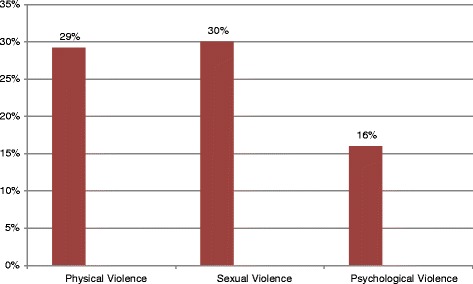
Results: The prevalence of intimate partner violence during recent pregnancy was 44.5% (95% CI, 32.6, 56.4). More than half 157 (55.5%) experienced all three forms of intimate partner violence during recent pregnancy. The joint occurrence of intimate partner physical and psychological violence during recent pregnancy as well as joint occurrence of intimate partner physical and sexual violence was 160 (56.5%). Pregnant women who were ever lived with their partner's family were 46% less likely to experience recent intimate partner violence. Dowry payment decreases intimate partner violence during recent pregnancy (AOR 0.09, 95% CI 0.04, 0.2) and pregnant women who didn't undergo marriage ceremony during their marriage were 79% are less likely to experience violence (AOR 0.21, 95% CI 0.1, 0.44).
Conclusion: Nearly half of interviewed pregnant women experienced intimate partner violence during pregnancy implying the prevalence of such practice in the study site. To that end, increasing community awareness about the consequences of the practice could be important. Moreover, as health extension workers works closely with households, they could be crucial players to increase community awareness about intimate partner violence on pregnant mothers and halt it or its risk factors.
Figures
References
-
- UN General Assembly. Declaration on the elimination of Violence against Women: Resolution A/RES/48/104, 23 February 1994.
-
- WHO .Global and regional estimate of violence against women: prevalence and health effects of intimate partner violence and non-partner sexual violence, 2013.
-
- García-Moreno C, Jansen HA, Ellsberg M, et al. WHO Multi-Country Study on Women’s Health and Domestic Violence against Women: initial results on prevalence, health outcomes and women's responses. Geneva: World Health Organization; 2005.
MeSH terms
LinkOut - more resources
Full Text Sources
Other Literature Sources
Medical
Miscellaneous
