


Estimating Sodium and Potassium Intakes and Their Ratio in the American Diet: Data from the 2011-2012 NHANES
- PMID: 26962185
- PMCID: PMC4807641
- DOI: 10.3945/jn.115.221184
Estimating Sodium and Potassium Intakes and Their Ratio in the American Diet: Data from the 2011-2012 NHANES
Abstract
Background: The dietary sodium-to-potassium ratio (Na:K) is shown to be more strongly associated with an increased risk of cardiovascular disease (CVD) and CVD-related mortality than either sodium or potassium intake alone.
Objective: The aim was to estimate the Na:K in the diet of US adults.
Methods: Among US adults from the 2011-2012 NHANES (≥20 y; 2393 men and 2337 women), the National Cancer Institute method was used to estimate sodium and potassium intakes, Na:K, and the percentage of individuals with Na:K <1.0 utilizing the complex, stratified, multistage probability cluster sampling design.
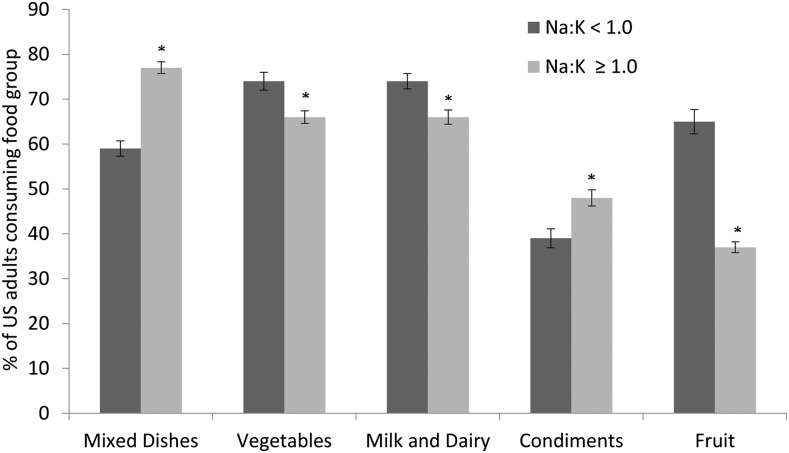
Results: Overall, women had a significantly lower Na:K than men (mean ± SE: 1.32 ± 0.02 compared with 1.45 ± 0.02). Non-Hispanic whites had a significantly lower Na:K than non-Hispanic blacks and non-Hispanic Asians (1.34 ± 0.02 compared with 1.54 ± 0.03 and 1.49 ± 0.04, respectively). Only 12.2% ± 1.5% of US adults had a Na:K < 1.0. The Na:K decreased linearly as age increased. Most adults (90% ± 0.8%) had sodium intakes >2300 mg/d, whereas <3% had potassium intakes >4700 mg/d. Grains and vegetables were among the highest contributors to sodium intakes for adults with Na:K < 1.0, compared with protein foods and grains for those with Na:K ≥ 1.0. Vegetables and milk and dairy products constituted the primary dietary sources of potassium for individuals with Na:K < 1.0, whereas mixed dishes and protein foods contributed the most potassium for individuals with ratios ≥1.0. Individuals with a Na:K < 1.0 were less likely to consume mixed dishes and condiments and were more likely to consume vegetables, milk and dairy products, and fruit than those with a Na:K ≥ 1.0.
Conclusion: Only about one-tenth of US adults have a Na:K consistent with the WHO guidelines for reduced risk of mortality. Continued efforts to reduce sodium intake in tandem with novel strategies to increase potassium intake are warranted.
Keywords: NHANES; Na:K; diet; potassium; ratio; sodium.
© 2016 American Society for Nutrition.
Conflict of interest statement
Author disclosures: RL Bailey, EA Parker, DG Rhodes, JD Goldman, JC Clemens, AJ Moshfegh, SV Thuppal, and CM Weaver, no conflicts of interest.
Figures
References
-
- US Department of Agriculture, US Department of Health and Human Services. Dietary Guidelines for Americans, 2010. 7th ed. Washington (DC): US Government Printing Office, 2010.
-
- Yang Q, Liu T, Kuklina EV, Flanders WD, Hong Y, Gillespie C, Chang MH, Gwinn M, Dowling N, Khoury MJ, et al. Sodium and potassium intake and mortality among US adults: prospective data from the Third National Health and Nutrition Examination Survey. Arch Intern Med 2011;171:1183–91. - PubMed
LinkOut - more resources
Full Text Sources
Other Literature Sources
