. 2015 Aug;16(4):264-78.
doi: 10.2174/1389202916666150528000412.

Role of Genetic Factors in the Pathogenesis of Radial Deficiencies in Humans

Affiliations

Role of Genetic Factors in the Pathogenesis of Radial Deficiencies in Humans

Amira Elmakky et al. Curr Genomics. 2015 Aug.

Abstract

Radial deficiencies (RDs), defined as under/abnormal development or absence of any of the structures of the forearm, radial carpal bones and thumb, occur with a live birth incidence ranging from 1 out of 30,000 to 1 out 6,000 newborns and represent about one third/one fourth of all the congenital upper limb anomalies. About half of radial disorders have a mendelian cause and pattern of inheritance, whereas the remaining half appears sporadic with no known gene involved. In sporadic forms certain anomalies, such as thumb or radial hypoplasia, may occur either alone or in association with systemic conditions, like vertebral abnormalities or renal defects. All the cases with a mendelian inheritance are syndromic forms, which include cardiac defects (in Holt-Oram syndrome), bone marrow failure (in Fanconi anemia), platelet deficiency (in thrombocytopenia-absent-radius syndrome), ocular motility impairment (in Okihiro syndrome). The genetics of radial deficiencies is complex, characterized by genetic heterogeneity and high inter- and intra-familial clinical variability: this review will analyze the etiopathogenesis and the genotype/phenotype correlations of the main radial deficiency disorders in humans.

Keywords: Congenital upper limb anomalies; Radial deficiency; Thumb hypoplasia.


Figures
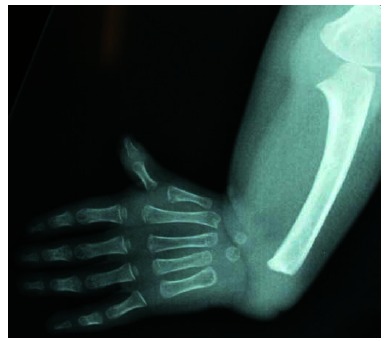
Fig. (1)
Fig. (1)
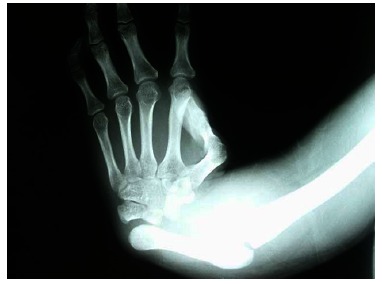
Anteroposterior X-ray showing the complete absence of the radius with the presence of the thumb.
Fig. (2)
Fig. (2)
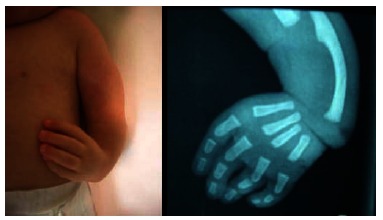
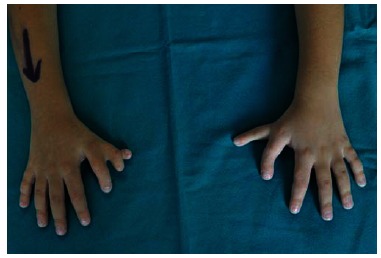
Clinical photograph (A) and anteroposterior X-ray (B) of a patient affected by VACTERL association showing a complete aplasia of both radius and thumb.
Fig. (3)
Fig. (3)
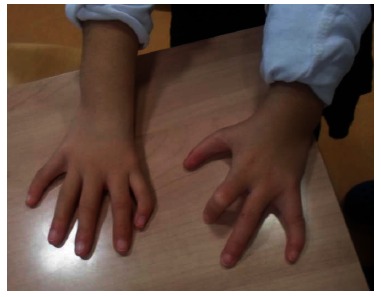
Clinical photograph of a patient with Holt-Oram syndrome with right non opposable triphalangeal thumb and left thumb aplasia treated by index finger pollicization.
Fig. (4)
Fig. (4)
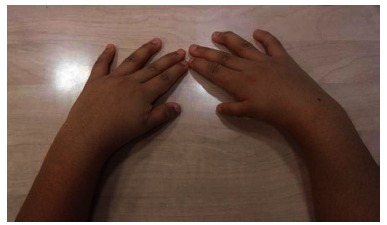
Clinical photograph of bilateral thumb hypoplasia in a patient affected by Okihiro syndrome.
Fig. (5)
Fig. (5)
Anteroposterior X-ray of a patient affected by TAR syndrome showing complete aplasia of the radius and a triphalangeal thumb.
Fig. (6)
Fig. (6)
Clinical photograph of bilateral thumb duplication in a patient affected by Townes-Brocks Syndrome.

References

    1. Goldfarb C.A., Wall L., Manske P.R. Radial longitudinal deficiency: the incidence of associated medical and musculoskeletal conditions. J. Hand Surg. Am. 2006;31(7):1176–1182. doi: 10.1016/j.jhsa.2006.05.012. - DOI - PubMed
    1. Koskimies E., Lindfors N., Gissler M., Peltonen J., Nietosvaara Y. Congenital upper limb deficiencies and associated malformations in Finland: a population-based study. J. Hand Surg. Am. 2011;36(6):1058–1065. doi: 10.1016/j.jhsa.2011.03.015. - DOI - PubMed
    1. Pakkasjärvi N., Koskimies E., Ritvanen A., Nietosvaara Y., Mäkitie O. Characteristics and associated anomalies in radial ray deficiencies in Finland--a population-based study. Am. J. Med. Genet. A. 2013;161A(2):261–267. doi: 10.1002/ajmg.a.35707. - DOI - PubMed
    1. Giele H., Giele C., Bower C., Allison M. The incidence and epidemiology of congenital upper limb anomalies: a total population study. J. Hand Surg. Am. 2001;26(4):628–634. doi: 10.1053/jhsu.2001.26121. - DOI - PubMed
    1. Kozin S.H. Upper-extremity congenital anomalies. J. Bone Joint Surg. Am. 2003;85-A(8):1564–1576. - PubMed

LinkOut - more resources