Review
. 2016 Apr 25;7(2):167-86.
doi: 10.1080/19491034.2016.1162933. Epub 2016 Mar 10.

Recent advances in understanding nuclear size and shape

Affiliations
Review

Recent advances in understanding nuclear size and shape

Richik N Mukherjee et al. Nucleus. .

Abstract

Size and shape are important aspects of nuclear structure. While normal cells maintain nuclear size within a defined range, altered nuclear size and shape are associated with a variety of diseases. It is unknown if altered nuclear morphology contributes to pathology, and answering this question requires a better understanding of the mechanisms that control nuclear size and shape. In this review, we discuss recent advances in our understanding of the mechanisms that regulate nuclear morphology, focusing on nucleocytoplasmic transport, nuclear lamins, the endoplasmic reticulum, the cell cycle, and potential links between nuclear size and size regulation of other organelles. We then discuss the functional significance of nuclear morphology in the context of early embryonic development. Looking toward the future, we review new experimental approaches that promise to provide new insights into mechanisms of nuclear size control, in particular microfluidic-based technologies, and discuss how altered nuclear morphology might impact chromatin organization and physiology of diseased cells.

Keywords: Cancer; cell size; chromatin; developmental scaling; endoplasmic reticulum; microfluidics; nuclear lamina; nuclear shape regulation; nuclear size regulation; nucleocytoplasmic transport; organelle size.


Figures
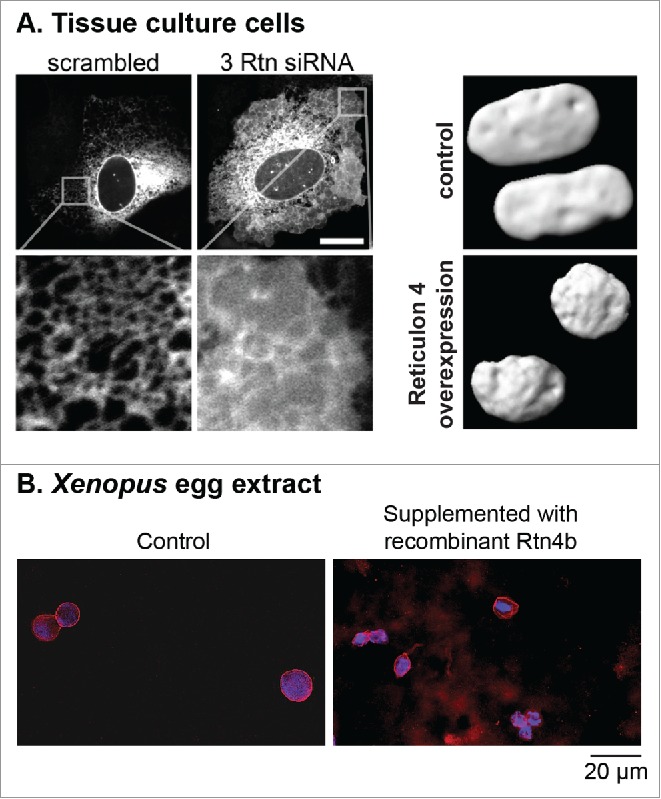
Figure 1.
Figure 1.
Reticulon expression levels affect ER structure and nuclear size. (A) In the left panel, the ER is visualized in U2OS cells with a Sec61-GFP construct. Knockdown of Rtn1, Rtn3, and Rtn4 by siRNA (labeled 3 Rtn siRNA) leads to less ER tubulation and more ER sheets, with a concomitant increased rate of post-mitotic nuclear formation. The scale bar is 20 µm. In the right panel, nuclei in U2OS cells are visualized with GFP-NLS at 160 minutes after nuclear formation. In cells overexpressing V4-Rtn4, nuclei are smaller due to slower nuclear expansion. Images used with permission from. (B) Nuclei were assembled in Xenopus laevis egg extract for 45 min. The extract was then supplemented with 67 nM recombinant purified Rtn4b protein and incubated for another 45 min. Nuclei were fixed, spun onto coverslips, and stained with mAb414 to visualize the NPC and NE (red) and Hoechst to visualize the DNA (blue). Nuclear cross-sectional areas were quantified. Exogenous addition of Rtn4b led to an ∼2.4-fold reduction in nuclear cross-sectional area (our unpublished data).
Figure 2.
Figure 2.
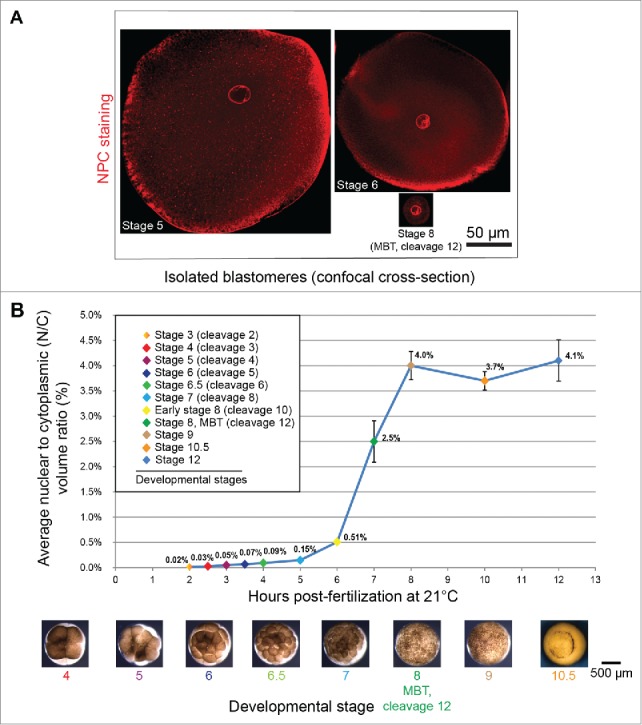
Nuclear scaling in early Xenopus embryos. (A) Isolated blastomeres from different stage X. laevis embryos were stained with mAb414 antibody against the NPC and imaged by confocal microscopy. (B) Average nuclear and cell volumes were quantified for the indicated stages of development, and used to obtain average nuclear-to-cytoplasmic (N/C) volume ratios. Error bars are SE. Images used with permission from.
Figure 3.
Figure 3.
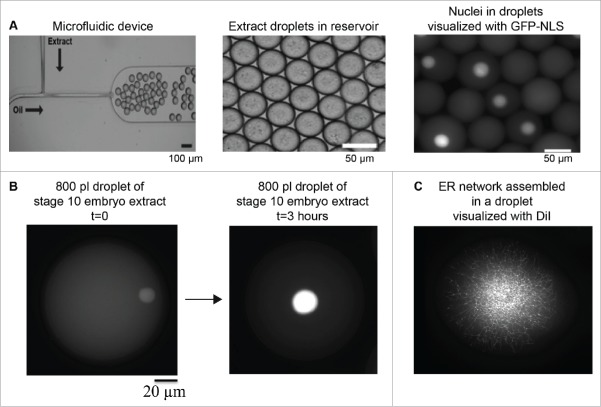
Microfluidic encapsulation technology to study organelle size scaling. (A) A standard microfluidic T-junction device is shown. At the junction where oil/surfactant and X. laevis egg extract mix, droplets are generated. Droplet size can be tuned by altering device geometry and flow rates. Image courtesy of John Oakey and Jay Gatlin. (B) Large 800 pl droplets containing stage 10 X. laevis embryonic cytoplasm and endogenous nuclei are shown. Nuclei are visualized by import of GFP-NLS. Over the course of ∼3 hours at room temperature, nuclear size expands (our unpublished data). (C) Partially fractionated X. laevis egg extract was encapsulated in a droplet, and ER network formation was visualized with DiI (our unpublished data).
Figure 4.
Figure 4.
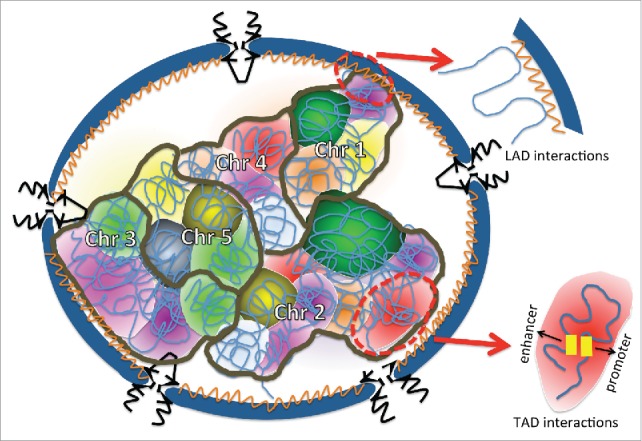
Chromosomes are spatially organized within the nucleus. The NE is blue, and the nuclear lamina is the orange structure lining the nucleoplasmic face of the NE. NPCs are black and inserted into the NE. Each chromosome is outlined in brown and is composed of multiple different TADs that are depicted with different colors. An example of the type of chromatin interaction occurring within a TAD is shown within the red oval. LAD interactions of chromatin with the nuclear lamina are also depicted. It is easy to imagine how a change in nuclear volume and/or shape might impact this chromosomal organization.

References

    1. Walters AD, Bommakanti A, Cohen-Fix O. Shaping the nucleus: Factors and forces. J Cell Biochem 2012; 113:2813-21; PMID:22566057; http://dx.doi.org/10.1002/jcb.24178 - DOI - PMC - PubMed
    1. Webster MT, McCaffery JM, Cohen-Fix O. Vesicle trafficking maintains nuclear shape in Saccharomyces cerevisiae during membrane proliferation. J Cell Biol 2010; 191:1079-88; PMID:21135138; http://dx.doi.org/10.1083/jcb.201006083 - DOI - PMC - PubMed
    1. Rout MP, Aitchison JD, Suprapto A, Hjertaas K, Zhao Y, Chait BT. The yeast nuclear pore complex: composition, architecture, and transport mechanism. J Cell Biol 2000; 148:635-51; PMID:10684247; http://dx.doi.org/10.1083/jcb.148.4.635 - DOI - PMC - PubMed
    1. Cronshaw JM, Krutchinsky AN, Zhang W, Chait BT, Matunis MJ. Proteomic analysis of the mammalian nuclear pore complex. J Cell Biol 2002; 158:915-27; PMID:12196509; http://dx.doi.org/10.1083/jcb.200-206106 - DOI - PMC - PubMed
    1. Alber F, Dokudovskaya S, Veenhoff LM, Zhang W, Kipper J, Devos D, Suprapto A, Karni-Schmidt O, Williams R, Chait BT, et al.. The molecular architecture of the nuclear pore complex. Nature 2007; 450:695-701; PMID:18046406; http://dx.doi.org/10.1038/nature06405 - DOI - PubMed

LinkOut - more resources