Review
. 2016 May;18(3):589-604.
doi: 10.1208/s12248-016-9889-y. Epub 2016 Mar 10.

Gut Wall Metabolism. Application of Pre-Clinical Models for the Prediction of Human Drug Absorption and First-Pass Elimination

Affiliations
Review

Gut Wall Metabolism. Application of Pre-Clinical Models for the Prediction of Human Drug Absorption and First-Pass Elimination

Christopher R Jones et al. AAPS J. 2016 May.

Abstract

Quantifying the multiple processes which control and modulate the extent of oral bioavailability for drug candidates is critical to accurate projection of human pharmacokinetics (PK). Understanding how gut wall metabolism and hepatic elimination factor into first-pass clearance of drugs has improved enormously. Typically, the cytochrome P450s, uridine 5'-diphosphate-glucuronosyltransferases and sulfotransferases, are the main enzyme classes responsible for drug metabolism. Knowledge of the isoforms functionally expressed within organs of first-pass clearance, their anatomical topology (e.g. zonal distribution), protein homology and relative abundances and how these differ across species is important for building models of human metabolic extraction. The focus of this manuscript is to explore the parameters influencing bioavailability and to consider how well these are predicted in human from animal models or from in vitro to in vivo extrapolation. A unique retrospective analysis of three AstraZeneca molecules progressed to first in human PK studies is used to highlight the impact that species differences in gut wall metabolism can have on predicted human PK. Compared to the liver, pharmaceutical research has further to go in terms of adopting a common approach for characterisation and quantitative prediction of intestinal metabolism. A broad strategy is needed to integrate assessment of intestinal metabolism in the context of typical DMPK activities ongoing within drug discovery programmes up until candidate drug nomination.

Keywords: animal models; drug-metabolising enzymes; first-pass oral clearance; gut wall metabolism; oral bioavailability.


Figures
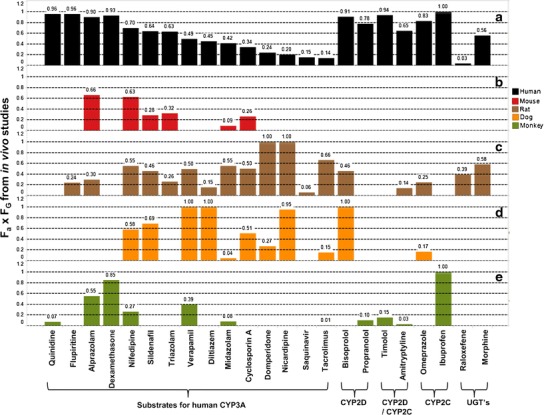
Fig. 1
Fig. 1
In vivo intestinal availability determined across species for selected human CYP3A, CYP2C, CYP2D and UGT substrates. Human data is presented in a (15,25,75,79). Mouse data is presented in b (79,81). Rat data is presented in c (75,79). Dog data is presented in d (,–81) (AstraZeneca unpublished data). Note that for diltiazem, midazolam and verapamil clearance approached or exceeded liver blood flow (LBF) in the dog; therefore, significant uncertainty and error is expected in the calculation of intestinal availability. Monkey data is presented in e (15,79,83)
Fig. 2
Fig. 2
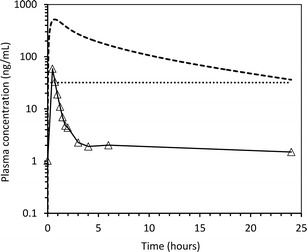
Phase 1 clinical PK data for AZ12470164. The open triangles represent geometric mean plasma concentrations determined from patients (n = 3) who received a single oral 80-mg dose. The dotted line is the biological effective target concentration derived from the quantitative PKPD-efficacy relationship in tumour-bearing mice. The dashed line is simulated steady-state oral PK profile for a 154-mg dose
Fig. 3
Fig. 3
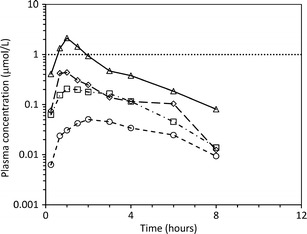
Geometric mean PK profiles from clinical single ascending dose studies with AZD1283. The open circles, squares, diamonds and triangles represent geometric mean plasma concentrations of AZD1283 determined in cohorts (n = 2 to 6 male healthy volunteers) receiving 50, 250, 750 or 2000 mg. The dotted line is the estimated biological effective target concentration derived from the quantitative PK/PD efficacy relationship in the anaesthetized dog anti-thrombotic model
Fig. 4
Fig. 4
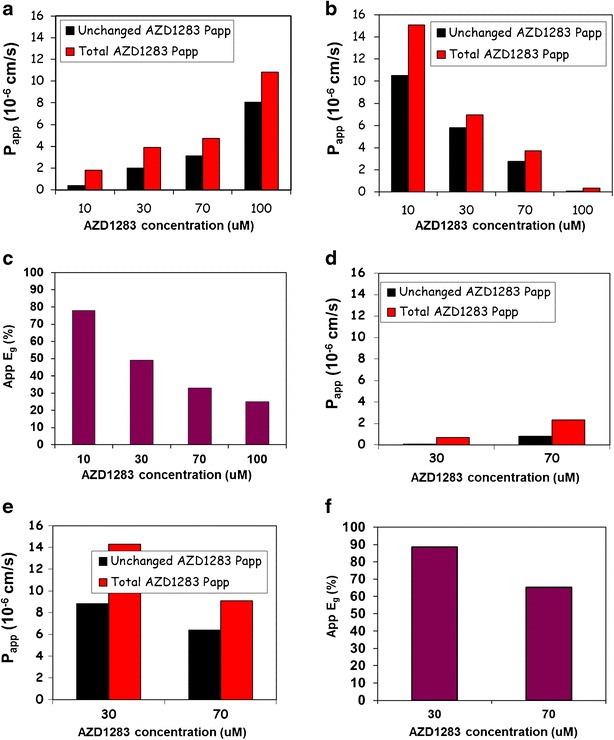
Effect of intestinal metabolism on apparent permeability of AZD1283 in human jejunal tissue (n = 2) in Ussing chamber. Differences in permeability between AZD1283 and 14C radio-labelled AZD1283 is shown. a P app in the mucosa to serosa direction at 10, 30, 70 and 100 uM for unchanged AZD1283 (black bars) and for total 14C radio-labelled AZD1283, e.g. contributions from unchanged parent and its metabolites (red bars). b P app in the serosa to mucosa direction at identical concentrations of unchanged AZD1283 (black bars) and total 14C radio-labelled AZD1283 (red bars). c Apparent extraction ratio (App E g) calculated from the equation App E g = (P total − P unchanged) / (P total). The methodology and approach have been described elsewhere (36). d–f Analogous permeability plots to a–c tested at 30 and 70 uM and from the colon (n = 1) rather than the jejunal tissue

References

    1. Liu G, Franssen E, Fitch MI, Warner E. Patient preferences for oral versus intravenous palliative chemotherapy. J Clin Oncol. 1997;15(1):110–5. - PubMed
    1. Lesko LJ, Rowland M, Peck CC, Blaschke TF. Optimizing the science of drug development: opportunities for better candidate selection and accelerated evaluation in humans. Pharm Res. 2000;17(11):1335–44. doi: 10.1023/A:1007574217260. - DOI - PubMed
    1. Hellriegel ET, Bjornsson TD, Hauck WW. Interpatient variability in bioavailability is related to the extent of absorption: implications for bioavailability and bioequivalence studies. Clin Pharmacol Ther. 1996;60(6):601–7. doi: 10.1016/S0009-9236(96)90208-8. - DOI - PubMed
    1. Hurst S, Loi C-M, Brodfuehrer J, El-Kattan A. Impact of physiological, physicochemical and biopharmaceutical factors in absorption and metabolism mechanisms on the drug oral bioavailability of rats and humans. Expert Opin Drug Metab Toxicol. 2007;3(4):469–89. doi: 10.1517/17425255.3.4.469. - DOI - PubMed
    1. Ballard P, Brassil P, Bui KH, Dolgos H, Petersson C, Tunek A, et al. The right compound in the right assay at the right time: an integrated discovery DMPK strategy. Drug Metab Rev. 2012;44(3):224–52. doi: 10.3109/03602532.2012.691099. - DOI - PubMed

Publication types

MeSH terms

Substances