Review
. 2016:2016:8606878.
doi: 10.1155/2016/8606878. Epub 2016 Feb 7.

Sphingosine-1-Phosphate Signaling in Immune Cells and Inflammation: Roles and Therapeutic Potential

Affiliations
Review

Sphingosine-1-Phosphate Signaling in Immune Cells and Inflammation: Roles and Therapeutic Potential

Masayo Aoki et al. Mediators Inflamm. 2016.

Erratum in

Abstract

Sphingosine-1-phosphate (S1P) is a bioactive sphingolipid metabolite involved in many critical cell processes. It is produced by the phosphorylation of sphingosine by sphingosine kinases (SphKs) and exported out of cells via transporters such as spinster homolog 2 (Spns2). S1P regulates diverse physiological processes by binding to specific G protein-binding receptors, S1P receptors (S1PRs) 1-5, through a process coined as "inside-out signaling." The S1P concentration gradient between various tissues promotes S1PR1-dependent migration of T cells from secondary lymphoid organs into the lymphatic and blood circulation. S1P suppresses T cell egress from and promotes retention in inflamed peripheral tissues. S1PR1 in T and B cells as well as Spns2 in endothelial cells contributes to lymphocyte trafficking. FTY720 (Fingolimod) is a functional antagonist of S1PRs that induces systemic lymphopenia by suppression of lymphocyte egress from lymphoid organs. In this review, we summarize previous findings and new discoveries about the importance of S1P and S1PR signaling in the recruitment of immune cells and lymphocyte retention in inflamed tissues. We also discuss the role of S1P-S1PR1 axis in inflammatory diseases and wound healing.


Figures
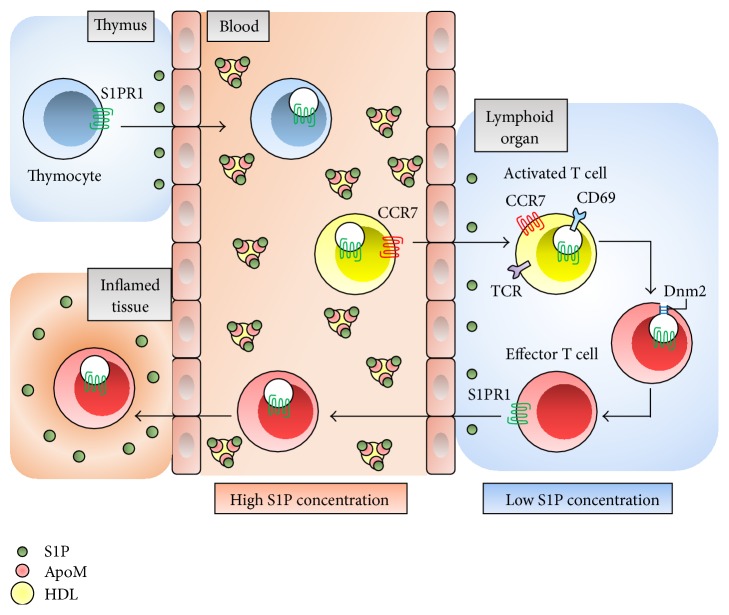
Figure 1
Figure 1
The role of S1P-S1PR1 axis in T cell trafficking. S1P is maintained at low concentration in the thymus and lymphoid organs and is in high concentration in blood, binding to ApoM in HDL particles. S1PR1 expression in T cells is downregulated in blood, and T cells are shifted into lymphoid organs with CCR7 signaling. CD69 forms a complex with S1PR1 and downregulates S1PR1 to promote retention in activated T cells. Because Dnm2 enables continuous S1PR1 signaling in lymphocytes, effector T cells can sense low S1P condition and egress from lymphoid organs. ApoM: apolipoprotein M; HDL: high-density lipoprotein; CCR7: CC-chemokine receptor 7; TCR: T cell receptor; Dnm2: dynamin 2.
Figure 2
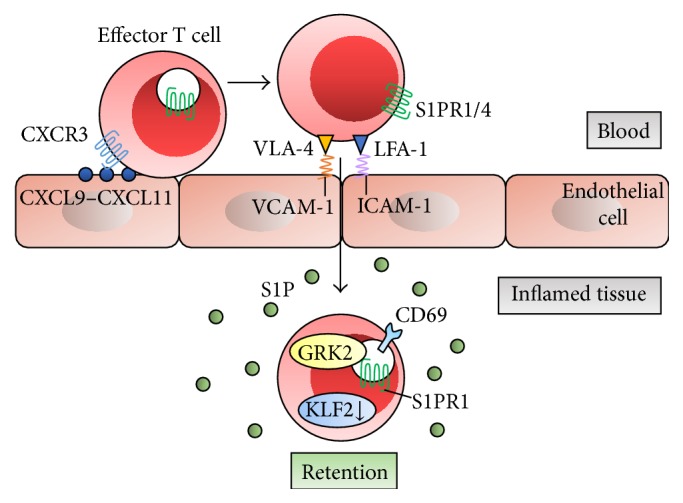
Figure 2
S1P-S1PR1 axis and lymphocyte retention in inflamed tissue. Surface expression of S1PR1 and S1PR4 on T cells is induced by chemokines CXCL9−CXCL11 presented on the endothelial surface and results in T cell migration into inflamed tissue. This is mediated at least partially by interactions of adhesion molecules LFA-1/ICAM-1 and VLA-4/VCAM-1. GRK2 downregulates S1PR1, allowing them to be retained in inflamed tissues. Downregulation of transcription factor KLF2 and S1PR1 transcription provides T cell retention in tissue, which is associated by early CD69 expression. CXCL: C-X-C chemokine ligand; CXCR3; C-X-C chemokine receptor 3; LFA-1: lymphocyte function-associated antigen-1; ICAM-1: intercellular adhesion molecule-1; VLA-4: very late antigen-4; VCAM-1: vascular cell adhesion molecule-1; GRK2: guanine nucleotide-binding protein-coupled receptor kinase-2; KLF2: Krüppel-like factor 2.

References

    1. Takabe K., Paugh S. W., Milstien S., Spiegel S. ‘Inside-out’ signaling of sphingosine-1-phosphate: therapeutic targets. Pharmacological Reviews. 2008;60(2):181–195. doi: 10.1124/pr.107.07113. - DOI - PMC - PubMed
    1. Takabe K., Spiegel S. Export of sphingosine-1-phosphate and cancer progression. Journal of Lipid Research. 2014;55(9):1839–1846. doi: 10.1194/jlr.r046656. - DOI - PMC - PubMed
    1. Nagahashi M., Ramachandran S., Kim E. Y., et al. Sphingosine-1-phosphate produced by sphingosine kinase 1 promotes breast cancer progression by stimulating angiogenesis and lymphangiogenesis. Cancer Research. 2012;72(3):726–735. doi: 10.1158/0008-5472.can-11-2167. - DOI - PMC - PubMed
    1. Proia R. L., Hla T. Emerging biology of sphingosine-1-phosphate: its role in pathogenesis and therapy. The Journal of Clinical Investigation. 2015;125(4):1379–1387. doi: 10.1172/jci76369. - DOI - PMC - PubMed
    1. Takabe K., Yamada A., Rashid O. M., et al. Twofer anti-vascular therapy targeting sphingosine-1-phosphate for breast cancer. Gland Surgery. 2012;1(2):80–83. doi: 10.3978/j.issn.2227-684X.2012.07.01. - DOI - PMC - PubMed

Publication types

LinkOut - more resources