


Standard versus tubeless mini-percutaneous nephrolithotomy: A randomised controlled trial
- PMID: 26966588
- PMCID: PMC4767792
- DOI: 10.1016/j.aju.2015.11.005
Standard versus tubeless mini-percutaneous nephrolithotomy: A randomised controlled trial
Abstract
Objective: To prospectively compare the outcome of standard mini-percutaneous nephrolithotomy (SmPCNL) versus tubeless mini-percutaneous nephrolithotomy (TmPCNL) as primary treatments of renal stones.
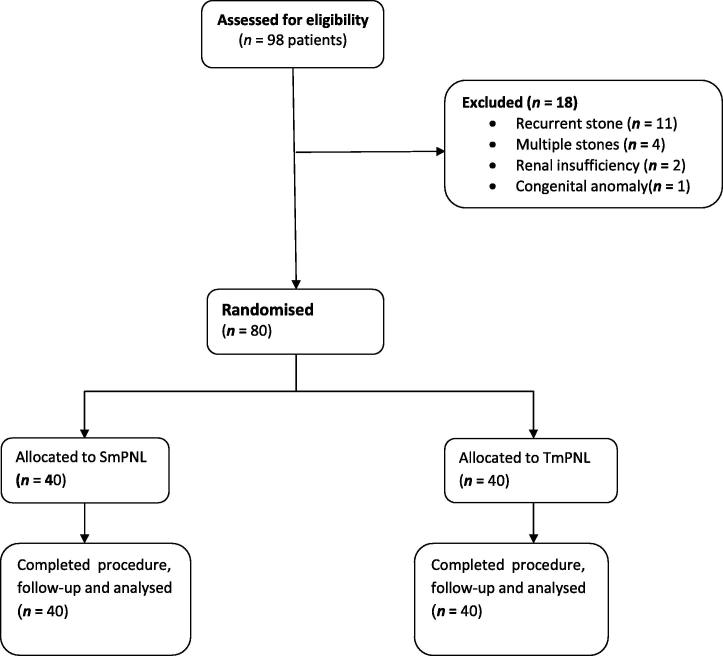
Patients and methods: In all, 80 patients with a solitary radio-opaque renal stone and candidates for PCNL were selected. The patients were randomly divided into two groups of 40, one group treated with SmPCNL and the other with TmPCNL. Patients and stone characters, as well as operative and postoperative data of both groups were compared and statistically analysed.
Results: There was no significant difference between the two groups for patient demographics and stone characteristics. There was no statistically significant difference between the two groups for the mean operative time, mean postoperative drop in haemoglobin, mean postoperative urine leakage, mean hospital stay, and stone-free rate. The mean (SD) postoperative dose of analgesia was statistically significantly higher in the SmPCNL group compared with the TmPCNL group, at 112.5 (48.03) versus 48.8 (43.5) mg, respectively.
Conclusion: Both procedures are safe and effective for managing renal stones, without any significant difference between the two procedures; however, the postoperative analgesic requirement is significantly higher in SmPCNL.
Keywords: BMI, body mass index; ESWL, extracorporeal shockwave lithotripsy; Mini-percutaneous nephrolithotomy; Nephrostomy tube; PCNL, percutaneous nephrolithotomy; RIRS, retrograde intrarenal surgery; Renal stones; SmPCNL, standard mini-percutaneous nephrolithotomy; TmPCNL, tubeless mini-percutaneous nephrolithotomy; Tubeless percutaneous nephrolithotomy.
References
-
- Nalbant I., Ozturk U., Sener N.C., Dede O., Bayraktar A.M., Imamoglu M.A. The comparison of standard and tubeless percutaneous nephrolithotomy procedures. Int Braz J Urol. 2012;38:795–800. - PubMed
-
- Gonen M., Basaran B. Tubeless percutaneous nephrolithotomy: spinal versus general anesthesia. Urol J. 2014;11:1211–1215. - PubMed
-
- Yuan H., Zheng S., Liu L., Han P., Wang J., Wei Q. The efficacy and safety of tubeless percutaneous nephrolithotomy: a systematic review and meta-analysis. Urol Res. 2011;39:401–410. - PubMed
LinkOut - more resources
Full Text Sources
Other Literature Sources
