


Age at onset of first signs or symptoms predicts age at loss of ambulation in Duchenne and Becker Muscular Dystrophy: Data from the MD STARnet
- PMID: 26966795
- PMCID: PMC5868738
- DOI: 10.3233/PRM-160361
Age at onset of first signs or symptoms predicts age at loss of ambulation in Duchenne and Becker Muscular Dystrophy: Data from the MD STARnet
Abstract
Purpose: We investigated the prognostic utility of onset age at first signs and symptoms (SS) to predict onset age at loss of ambulation (LOA) for childhood-onset Duchenne and Becker Muscular Dystrophies (DBMD).
Methods: Our cohort comprised male cases with DBMD ascertained by the population-based Muscular Dystrophy Surveillance, Tracking, and Research Network (MD STARnet). Adjusted hazard ratios (HRs) and 95% confidence intervals (CIs) were estimated using Cox proportional hazards models for associations between onset ages of first SS and LOA. Covariates controlled for were corticosteroid use, family history of DBMD, birth year, race/ethnicity, and MD STARnet site. Onset age at first SS was considered as a continuous and as a categorical variable.
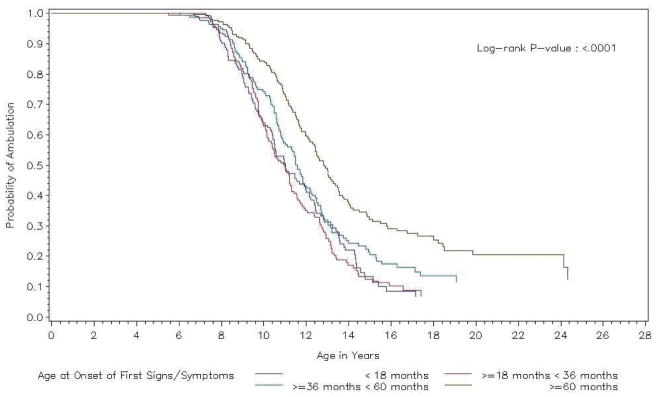
Results: A one-year increase in onset age at first SS was significantly associated with a 10% reduction in annual risk of LOA (HR = 0.90, CI = 0.87-0.94). Treating onset age at first SS as a categorical variable yielded a similar association (≥ 5 years: referent; ≥ 3 to < 5 years: HR = 1.36, CI = 1.02-1.81; 18 months to < 3 years: HR = 1.72, CI = 1.31-2.26; < 18 months: HR = 1.52, CI = 1.14-2.02).
Conclusions: Earlier onset age at first SS is associated with earlier onset age at LOA and may have clinical utility in differentiating childhood-onset Duchenne and Becker muscular dystrophies.
Keywords: Becker Muscular Dystrophy; Duchenne Muscular Dystrophy; ambulation.
Conflict of interest statement
The authors have no conflict of interest to declare.
Figures
References
-
- Aartsma-Rus A, Van Deutekom JC, Fokkema IF, Van Ommen GJ, Den Dunnen JT. Entries in the Leiden Duchenne muscular dystrophy mutation database: an overview of mutation types and paradoxical cases that confirm the reading-frame rule. Muscle Nerve. 2006;34(2):135–144. - PubMed
Publication types
MeSH terms
Grants and funding
LinkOut - more resources
Full Text Sources
Other Literature Sources
Medical
