


Review
doi: 10.1016/j.cell.2016.02.037.
Signaling in Host-Associated Microbial Communities
Affiliations
- PMID: 26967294
- PMCID: PMC4801507
- DOI: 10.1016/j.cell.2016.02.037
Item in Clipboard
Review
Signaling in Host-Associated Microbial Communities
Cell.
.
Abstract
Human-associated microbiota form and stabilize communities based on interspecies interactions. We review how these microbe-microbe and microbe-host interactions are communicated to shape communities over a human's lifespan, including periods of health and disease. Modeling and dissecting signaling in host-associated communities is crucial to understand their function and will open the door to therapies that prevent or correct microbial community dysfunction to promote health and treat disease.
Copyright © 2016 Elsevier Inc. All rights reserved.
Figures
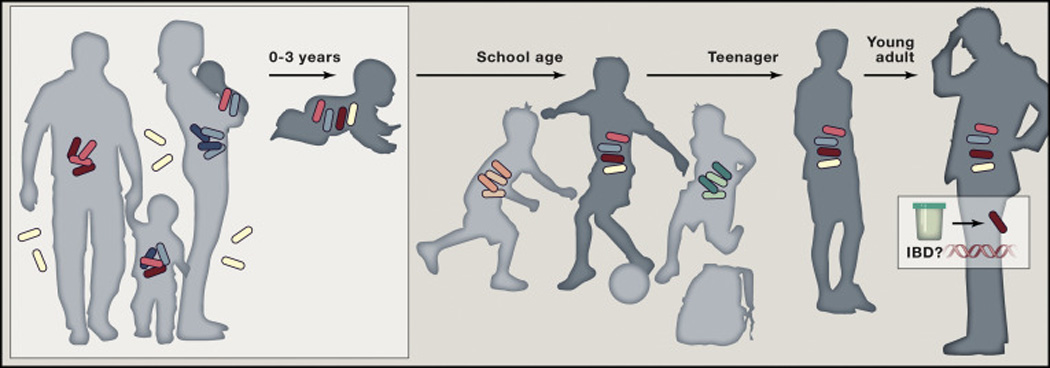
During the first three years of life children acquire microbes from closely relatives and environment. Heritance may act on individual species and/or microbial communities. These strains are stably maintained and may impact the relative risk or severity for complex adult-onset disorders such as inflammatory bowel disease.
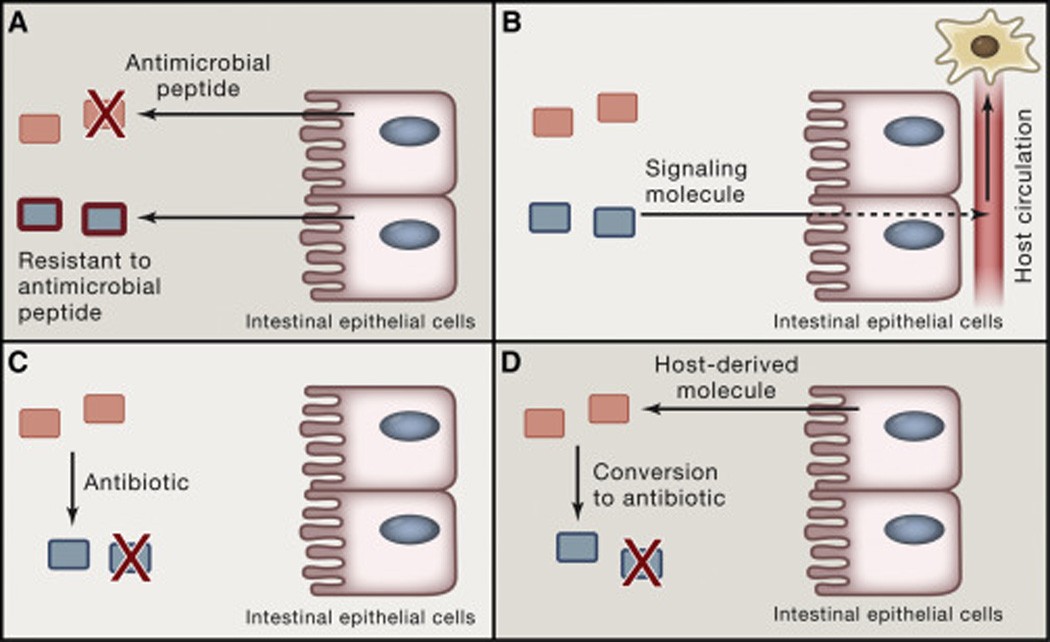
(A) Host pruning of a bacterial community. In the example shown, the host produces an antimicrobial peptide to which one species is sensitive and the other resistant. (B) Bacterially derived molecules acting at a distance. A bacterial species produces a signaling molecule that traverses the intestinal epithelium, enters circulation, and acts on a distal cellular target. (C) Direct microbe-microbe interaction, for example by the production of an antibiotic to which a neighboring species is sensitive. (D) Conversion of a host-derived molecule (e.g., a primary bile acid) to a derivative that inhibits the growth of a neighboring species.
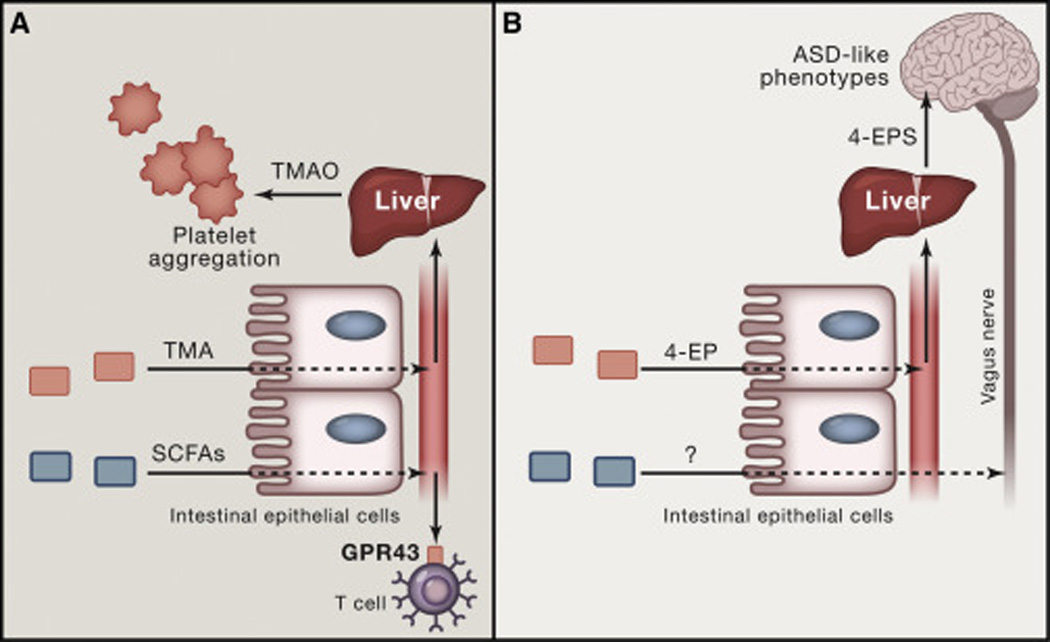
(A) Two examples are shown in which a molecule produced by a gut bacterium acts at a distance in the host. Trimethylamine (TMA) is produced by gut bacterial metabolism of choline and carnitine, enters the bloodstream, and is N-hydroxylated in the liver to trimethylamine-N-oxide (TMAO). TMAO then acts directly on platelets, causing them to aggregate. Short-chain fatty acids (SCFAs) produced by gut bacteria are sensed by a variety of cells that produce GPR41 or GPR43, including T cells. (B) Two mechanisms by which gut bacteria can signal to the brain. In the first example, a bacterial species in the gut produces 4-ethylphenol (4-EP), which is sulfated in the liver to 4-EPS. 4-EPS is then thought to cross the blood-brain barrier, where it can alter host cognition, resulting in some of the phenotypes characteristic of autism spectrum disorder (ASD). Another route by which gut bacteria can signal directly to the brain is less well understood, but involves signal transmission via the vagus nerve.
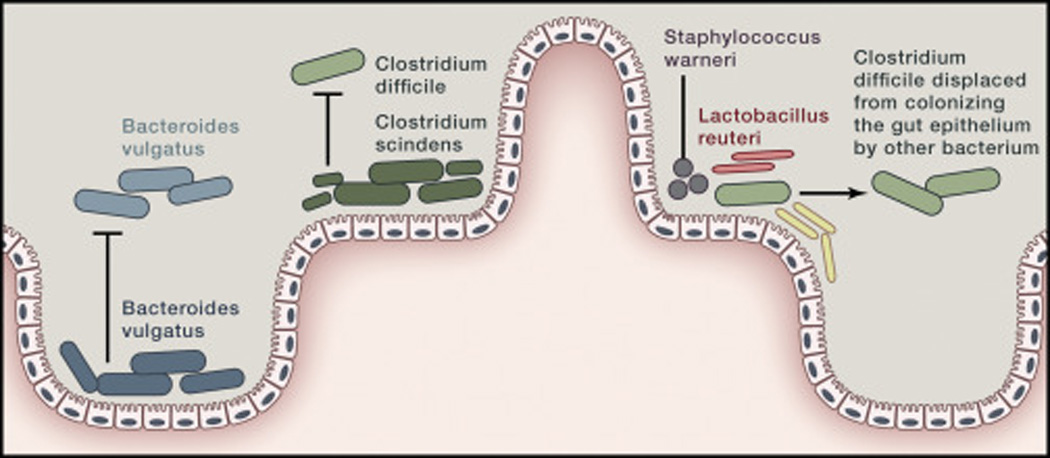
An example of competition exclusion is one strain of Bacteroides vulgatus (dark blue) excluding another (lighter blue) from colonizing the gut epithelium. Similarly, colonization resistance is demonstrated when Clostridium scindens in combination with a stable microbial community excludes the pathogen C. difficile from colonizing the gut. If C. difficile colonizes the gut epithelium, a mixture of Staphylococcus warneri, Enterococcus hirae, Lactobacillus reuteri, and novel species of Anaerostipes, Bacteroidetes and Enterorhabdus can displace the C. difficile resulting in decolonization.
References
-
- Atarashi K, Tanoue T, Oshima K, Suda W, Nagano Y, Nishikawa H, Fukuda S, Saito T, Narushima S, Hase K, et al. Treg induction by a rationally selected mixture of Clostridia strains from the human microbiota. Nature. 2013;500:232–236. - PubMed
Publication types
MeSH terms
Grants and funding
LinkOut - more resources
Full Text Sources
Other Literature Sources
