. 2016 Apr;43(4):249-54.
doi: 10.1097/OLQ.0000000000000423.

HIV Incidence Among Men Who Have Sex With Men After Diagnosis With Sexually Transmitted Infections

Affiliations

HIV Incidence Among Men Who Have Sex With Men After Diagnosis With Sexually Transmitted Infections

David A Katz et al. Sex Transm Dis. 2016 Apr.

Abstract

Background: Men who have sex with men (MSM) are at high risk for acquiring HIV infection after diagnosis with other sexually transmitted infections (STIs). Identifying the STIs associated with the greatest risk of subsequent HIV infection could help target prevention interventions, particularly preexposure prophylaxis (PrEP).

Methods: Using matched HIV and STI surveillance data from Washington State from January 1, 2007, to June 30, 2013, we calculated the incidence of new HIV diagnoses after different STI diagnoses among MSM. Men entered observation at the time of their first STI diagnosis during the study period and exited at HIV diagnosis or June 30, 2013. Cox proportional hazards regression was used to conduct a global comparison of rates.

Results: From January 1, 2007, to June 30, 2013, 6577 HIV-negative MSM were diagnosed as having 10,080 bacterial STIs at 8371 unique time points and followed for 17,419 person-years. Two hundred eighty (4.3%) men were subsequently diagnosed as having HIV infection for an overall incidence of 1.6 per 100 person-years (95% confidence interval, 1.4-1.8). The estimated incidence of HIV diagnoses among all MSM in the state was 0.4 per 100 person-years. Men who have sex with men were at the greatest risk for HIV diagnosis after being diagnosed as having rectal gonorrhea (HIV incidence, 4.1 per 100 person-years), followed by early syphilis (2.8), urethral gonorrhea (1.6), rectal chlamydial infection (1.6), pharyngeal gonorrhea (1.1), late syphilis (1.0), and urethral chlamydial infection (0.6; P < 0.0001 overall).

Conclusions: Men who have sex with men diagnosed as having rectal gonorrhea and early syphilis were at the greatest risk for being diagnosed as having HIV infection after STI diagnosis. These men should be prioritized for more intensive prevention interventions, including PrEP.


Conflict of interest statement

Conflicts of Interest

Dr. Golden has received research support from Cempra Pharmaceuticals and Melina Pharmaceuticals. The remaining authors have no potential conflicts of interest to declare.

Figures
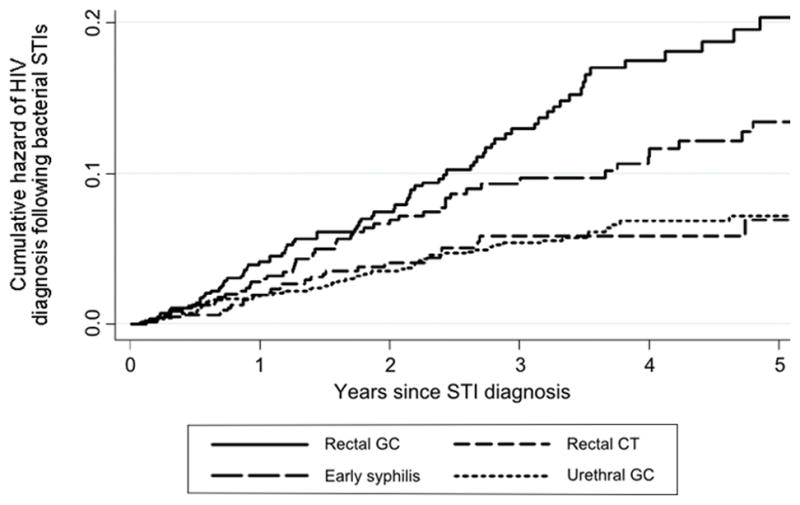
Figure 1
Figure 1. Cumulative hazard of HIV diagnosis following bacterial sexually transmitted infections (STI)
GC = gonorrhea. CT = chlamydial infection.
Figure 2
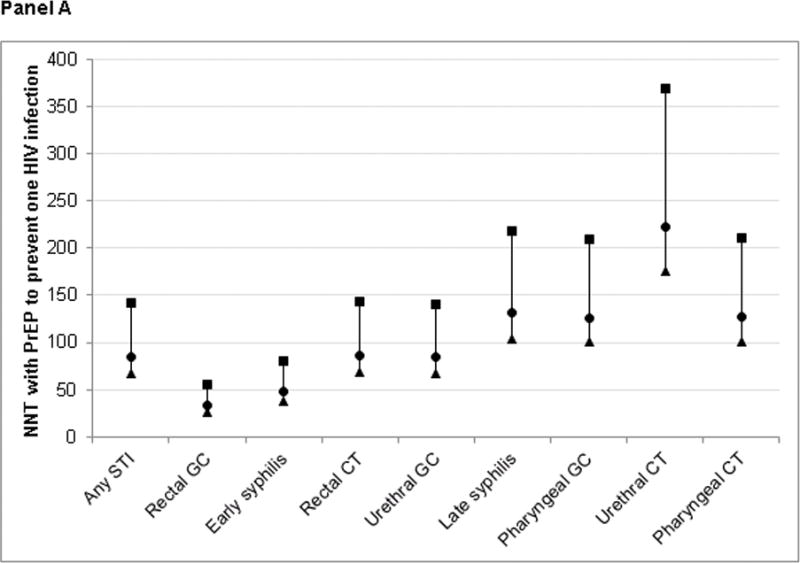
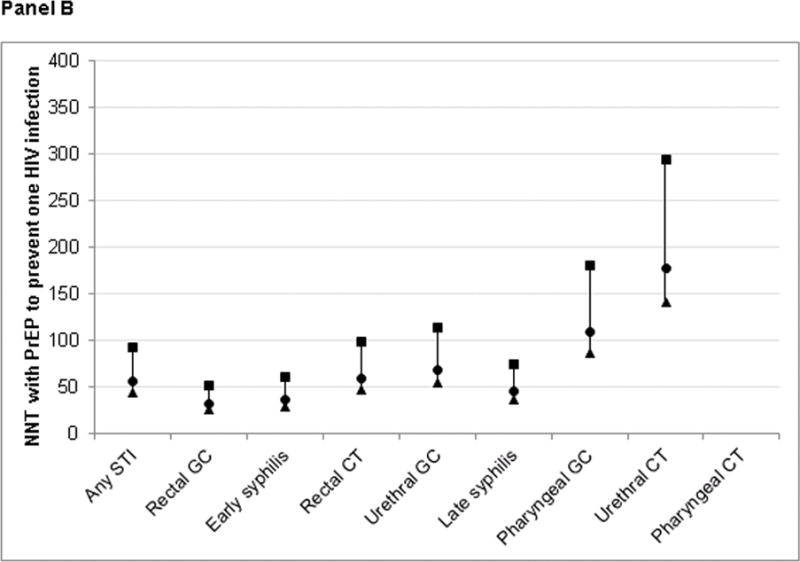
Figure 2. Number needed to treat (NNT) with HIV pre-exposure prophylaxis to directly prevent one new HIV infection by sexually transmitted infection type
Panel A: Primary analysis – Estimated from incidence of HIV diagnosis in Washington State Panel B: Sensitivity analysis – Estimated from incidence of HIV infection among MSM diagnosed at publicly funded HIV/STI testing programs MSM = men who have sex with men. GC = gonorrhea. CT = chlamydial infection. PrEP = HIV pre-exposure prophylaxis. This figure presents estimates of the number of HIV-negative MSM with each infection that would need to be treated with PrEP for one year in order to prevent one HIV infection among PrEP recipients (NNT) based on three estimates of PrEP effectiveness from iPrex: overall (44%; ■), with at least 90% adherence (73%; ●), and with detectable blood levels of PrEP drug (92%; ▲). Panel A shows NNTs estimated from the incidence of HIV diagnosis following STI diagnoses among all MSM in Washington State (primary analysis). Panel B presents estimates from the incidence of HIV infection among MSM diagnosed at publicly funded HIV/STI testing programs (sensitivity analysis). The date of HIV infection was estimated as the midpoint between the last negative and first positive HIV test from HIV surveillance, HIV partner services, or STI partner services data.
Figure 2
Figure 2. Number needed to treat (NNT) with HIV pre-exposure prophylaxis to directly prevent one new HIV infection by sexually transmitted infection type
Panel A: Primary analysis – Estimated from incidence of HIV diagnosis in Washington State Panel B: Sensitivity analysis – Estimated from incidence of HIV infection among MSM diagnosed at publicly funded HIV/STI testing programs MSM = men who have sex with men. GC = gonorrhea. CT = chlamydial infection. PrEP = HIV pre-exposure prophylaxis. This figure presents estimates of the number of HIV-negative MSM with each infection that would need to be treated with PrEP for one year in order to prevent one HIV infection among PrEP recipients (NNT) based on three estimates of PrEP effectiveness from iPrex: overall (44%; ■), with at least 90% adherence (73%; ●), and with detectable blood levels of PrEP drug (92%; ▲). Panel A shows NNTs estimated from the incidence of HIV diagnosis following STI diagnoses among all MSM in Washington State (primary analysis). Panel B presents estimates from the incidence of HIV infection among MSM diagnosed at publicly funded HIV/STI testing programs (sensitivity analysis). The date of HIV infection was estimated as the midpoint between the last negative and first positive HIV test from HIV surveillance, HIV partner services, or STI partner services data.
Figure 3
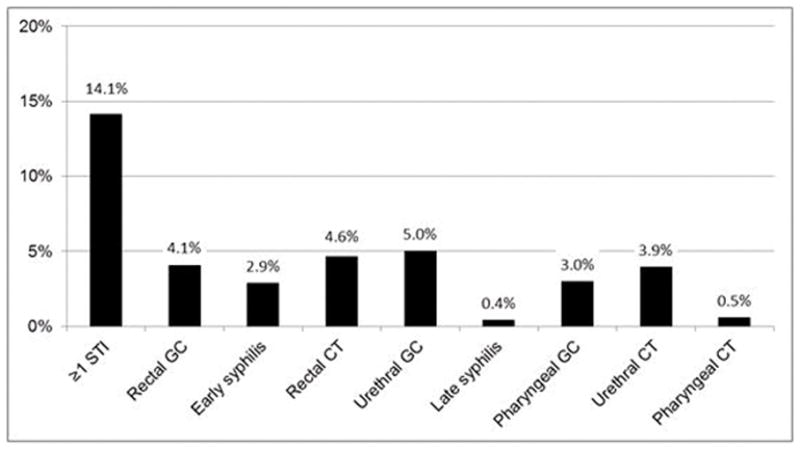
Figure 3. Proportion of 736 MSM newly diagnosed with HIV infection July 2011-June 2013 with a reported sexually transmitted infection diagnosis in the 2 years prior to HIV diagnosis
GC = gonorrhea. CT = chlamydial infection.

References

    1. Piot P, Laga M. Genital ulcers, other sexually transmitted diseases, and the sexual transmission of HIV. BMJ. 1989;298(6674):623–4. - PMC - PubMed
    1. Fleming DT, Wasserheit JN. From epidemiological synergy to public health policy and practice: the contribution of other sexually transmitted diseases to sexual transmission of HIV infection. Sex Transm Infect. 1999;75(1):3–17. - PMC - PubMed
    1. Ward H, Ronn M. Contribution of sexually transmitted infections to the sexual transmission of HIV. Curr Opin HIV AIDS. 2010;5(4):305–10. - PMC - PubMed
    1. Cohen CR, Plummer FA, Mugo N, et al. Increased interleukin-10 in the the endocervical secretions of women with non-ulcerative sexually transmitted diseases: a mechanism for enhanced HIV-1 transmission? AIDS. 1999;13(3):327–32. - PubMed
    1. de Jong MA, de Witte L, Oudhoff MJ, Gringhuis SI, Gallay P, Geijtenbeek TB. TNF-alpha and TLR agonists increase susceptibility to HIV-1 transmission by human Langerhans cells ex vivo. The Journal of clinical investigation. 2008;118(10):3440–52. - PMC - PubMed

Publication types

MeSH terms

Supplementary concepts