


Vascular Complications of Cancer Chemotherapy
- PMID: 26968393
- PMCID: PMC4989034
- DOI: 10.1016/j.cjca.2015.12.023
Vascular Complications of Cancer Chemotherapy
Abstract
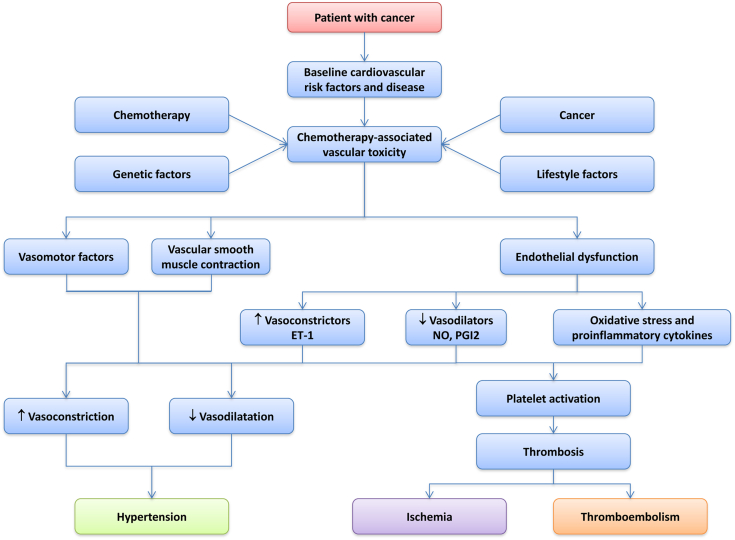
Development of new anticancer drugs has resulted in improved mortality rates and 5-year survival rates in patients with cancer. However, many of the modern chemotherapies are associated with cardiovascular toxicities that increase cardiovascular risk in cancer patients, including hypertension, thrombosis, heart failure, cardiomyopathy, and arrhythmias. These limitations restrict treatment options and might negatively affect the management of cancer. The cardiotoxic effects of older chemotherapeutic drugs such as alkylating agents, antimetabolites, and anticancer antibiotics have been known for a while. The newer agents, such as the antiangiogenic drugs that inhibit vascular endothelial growth factor signalling are also associated with cardiovascular pathology, especially hypertension, thromboembolism, myocardial infarction, and proteinuria. Exact mechanisms by which vascular endothelial growth factor inhibitors cause these complications are unclear but impaired endothelial function, vascular and renal damage, oxidative stress, and thrombosis might be important. With increasing use of modern chemotherapies and prolonged survival of cancer patients, the incidence of cardiovascular disease in this patient population will continue to increase. Accordingly, careful assessment and management of cardiovascular risk factors in cancer patients by oncologists and cardiologists working together is essential for optimal care so that prolonged cancer survival is not at the expense of increased cardiovascular events.
La mise au point de nouveaux médicaments anticancéreux a permis de réduire le taux de mortalité et d’améliorer le taux de survie après 5 ans des patients atteints de cancer. Cependant, nombre de ces nouveaux anticancéreux sont associés à une toxicité cardiovasculaire qui accroît le risque cardiovasculaire de ces patients, notamment en ce qui a trait à l’hypertension, à la thrombose, à l’insuffisance cardiaque, à la cardiomyopathie et à l’arythmie. Cette problématique limite les choix de traitement et peut avoir une incidence négative sur la prise en charge du cancer. La cardiotoxicité des anticancéreux plus anciens comme les agents alkylants, les antimétabolites et les antibiotiques anticancéreux est connue depuis assez longtemps. Les nouveaux agents comme les antiangiogéniques, qui inhibent l’expression de facteurs de croissance endothéliale vasculaire, sont également associés à des pathologies cardiovasculaires, plus particulièrement à l’hypertension, à la thromboembolie, à l’infarctus du myocarde et à la protéinurie. Le mécanisme causal exact des complications liées aux antiangiogéniques demeure encore inexpliqué, mais la dysfonction endothéliale, les dommages vasculaires et rénaux, le stress oxydatif et la thrombose pourraient être des facteurs importants. Le recours de plus en plus fréquent aux nouvelles chimiothérapies et la prolongation de la survie des patients feront encore augmenter l’incidence des maladies cardiovasculaires dans cette population. Les oncologues devront donc travailler de pair avec les cardiologues afin de soigneusement évaluer et prendre en charge les facteurs de risque cardiovasculaire pour assurer les meilleurs soins possibles et ainsi éviter que la prolongation de la survie des patients se fasse au prix d’un nombre accru d’événements cardiovasculaires.
Copyright © 2016 The Authors. Published by Elsevier Inc. All rights reserved.
Figures
References
-
- Suter T.M., Ewer M.S. Cancer drugs and the heart: importance and management. Eur Heart J. 2013;34:1102–1111. - PubMed
-
- Daher I.N., Yeh E.T. Vascular complications of selected cancer therapies. Nat Clin Pract Cardiovasc Med. 2008;5:797–805. - PubMed
-
- Truong J., Yan A.T., Cramarossa G., Chan K.K. Chemotherapy-induced cardiotoxicity: detection, prevention, and management. Can J Cardiol. 2014;30:869–878. - PubMed
-
- Soultati A., Mountzios G., Avgerinou C. Endothelial vascular toxicity from chemotherapeutic agents: preclinical evidence and clinical implications. Cancer Treat Rev. 2012;38:473–483. - PubMed
Publication types
MeSH terms
Substances
Grants and funding
LinkOut - more resources
Full Text Sources
Other Literature Sources
