


Understanding Racial and Ethnic Disparities in Postsurgical Complications Occurring in U.S. Hospitals
- PMID: 26969578
- PMCID: PMC5264108
- DOI: 10.1111/1475-6773.12475
Understanding Racial and Ethnic Disparities in Postsurgical Complications Occurring in U.S. Hospitals
Abstract
Objective: To examine the role of patient, hospital, and community characteristics on racial and ethnic disparities in in-hospital postsurgical complications.
Data sources: Healthcare Cost and Utilization Project, 2011 State Inpatient Databases; American Hospital Association Annual Survey of Hospitals; Area Health Resources Files; Centers for Medicare & Medicaid Services Hospital Compare database.
Methods: Nonlinear hierarchical modeling was conducted to examine the odds of patients experiencing any in-hospital postsurgical complication, as defined by Agency for Healthcare Research and Quality Patient Safety Indicators.
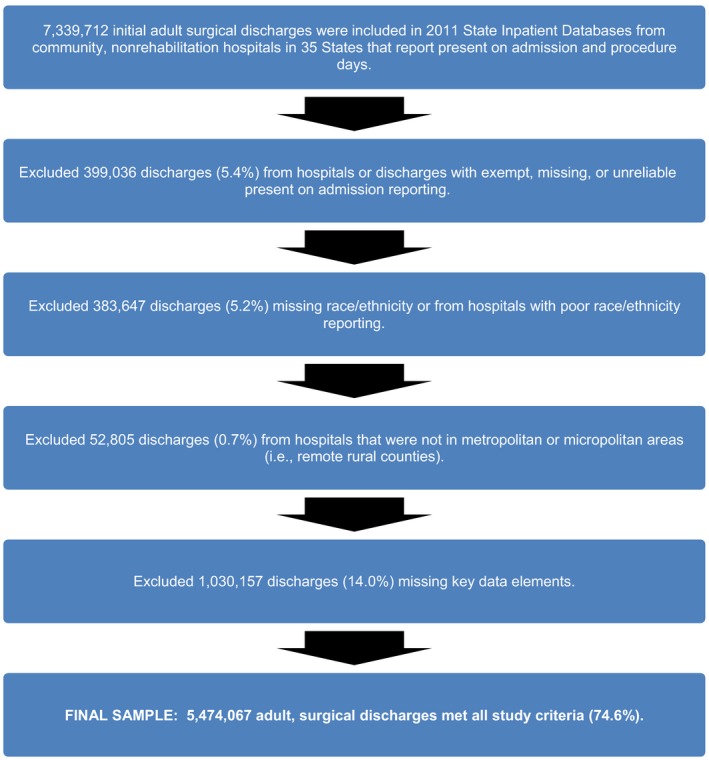
Principal findings: A total of 5,474,067 inpatient surgical discharges were assessed using multivariable logistic regression. Clinical risk, payer coverage, and community-level characteristics (especially income) completely attenuated the effect of race on the odds of postsurgical complications. Patients without private insurance were 30 to 50 percent more likely to have a complication; patients from low-income communities were nearly 12 percent more likely to experience a complication. Private, not-for-profit hospitals in small metropolitan or micropolitan areas and higher nurse-to-patient ratios led to fewer postsurgical complications.
Conclusions: Race does not appear to be an important determinant of in-hospital postsurgical complications, but insurance and community characteristics have an effect. A population-based approach that includes improving the socioeconomic context may help reduce disparities in these outcomes.
Keywords: Postsurgical complications; community socioeconomic status; health disparities; health insurance; racial/ethnic differences in health care; surgery.
© Health Research and Educational Trust.
Figures
References
-
- Agarwal, S. , Menon V., and Jaber W. A.. 2015. “Residential Zip Code Influences Outcomes Following Hospitalization for Acute Pulmonary Embolism in the United States.” Vascular Medicine 20 (5): 439–46. - PubMed
-
- AHRQ . 2012. Patient Safety Indicators: Technical Specifications, AHQR Quality Indicators, Version 4.4 SAS. Rockville, MD: Agency for Healthcare Research and Quality.
-
- AHRQ . 2014a. 2014 Annual Progress Report to Congress: National Strategy for Quality Improvement in Health Care, pp. 1–27. Rockville, MD: The Agency for Healthcare Research and Quality.
-
- AHRQ . 2014b. National Healthcare Disparities Report, 2013, pp. 1–271. Rockville, MD: The Agency for Healthcare Research and Quality.
MeSH terms
LinkOut - more resources
Full Text Sources
Other Literature Sources
Medical
