. 2016 Apr;67(9):2689-98.
doi: 10.1093/jxb/erw103. Epub 2016 Mar 11.

Overexpression of the rice AKT1 potassium channel affects potassium nutrition and rice drought tolerance

Affiliations

Overexpression of the rice AKT1 potassium channel affects potassium nutrition and rice drought tolerance

Izhar Ahmad et al. J Exp Bot. 2016 Apr.

Abstract

Potassium (K(+)) is the most important cationic nutrient for all living organisms and has roles in most aspects of plant physiology. To assess the impact of one of the main K(+) uptake components, the K(+) inward rectifying channel AKT1, we characterized both loss of function and overexpression of OsAKT1 in rice. In many conditions, AKT1 expression correlated with K(+) uptake and tissue K(+) levels. No salinity-related growth phenotype was observed for either loss or gain of function mutants. However, a correlation between AKT1 expression and root Na(+) when the external Na/K ratio was high suggests that there may be a role for AKT1 in Na(+) uptake in such conditions. In contrast to findings with Arabidopsis thaliana, we did not detect any change in growth of AKT1 loss of function mutants in the presence of NH4 (+) Nevertheless, NH4 (+)-dependent inhibition was detected during K(+) uptake assays in loss of function and wild type plants, depending on pre-growth conditions. The most prominent result of OsAKT1 overexpression was a reduction in sensitivity to osmotic/drought stress in transgenic plants: the data suggest that AKT1 overexpression improved rice osmotic and drought stress tolerance by increasing tissue levels of K(+), especially in the root.

Keywords: Drought; Oryza sativa; OsAKT1; ion channel; osmotic stress; rice..


Figures

Fig. 1.
Fig. 1.
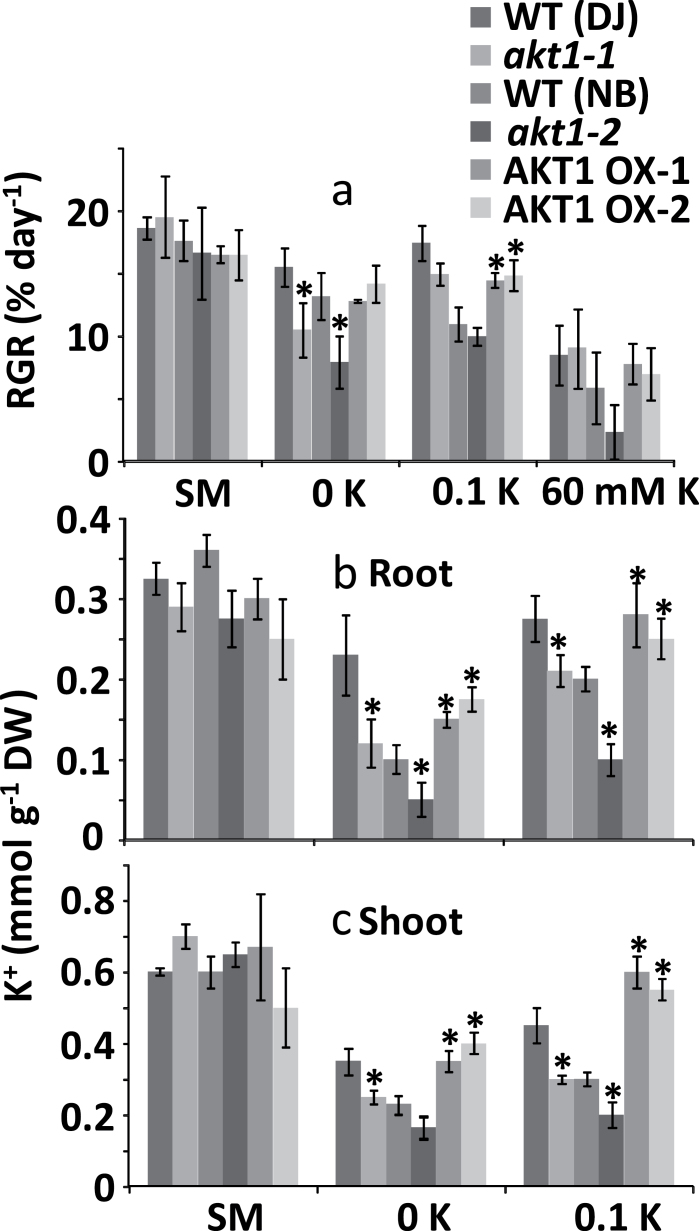
Relative growth rate and tissue K+ for hydroponically grown rice. (a) Relative growth rate (RGR, % day−1) of 5-week-old rice plants exposed to standard medium (SM), and media containing 0mM K+, 100 µM K+, and 60mM K+. (b) Root K+ content of plants grown in SM, 0mM K+ and 100 µM K+ conditions. (c) Shoot K+ content of plants grown in the conditions mentioned under (b). *Significant difference by t-test at a probability level of P<0.05 between each genotype and its respective wild type.
Fig. 2.
Fig. 2.
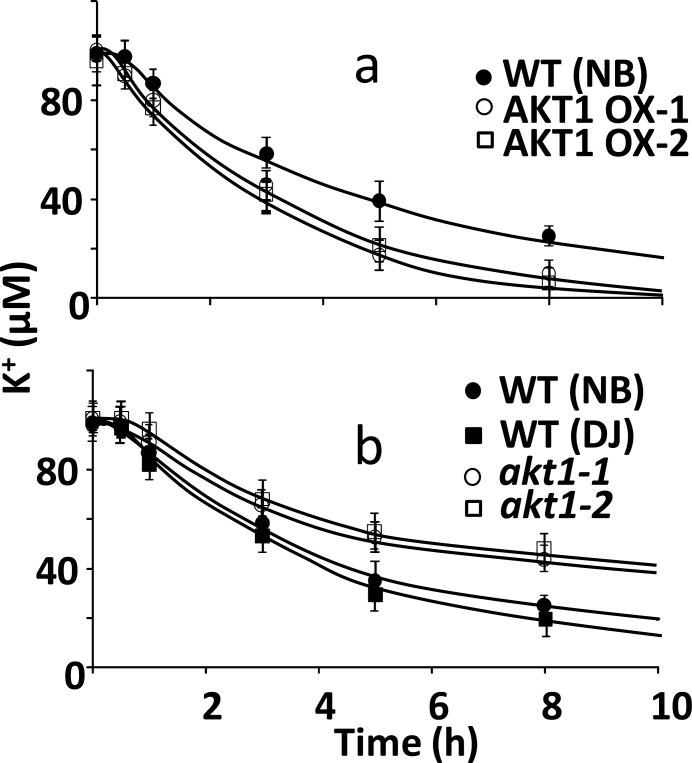
Net K+ uptake in hydroponically grown rice. (a) Net K+ uptake for WT (Nipponbare) and two independent AKT1 overexpressing lines from a solution containing 100 µM K+. (b) Same as (a) for WT (NN and DJ) and akt1 loss of function mutants.
Fig. 3.
Fig. 3.
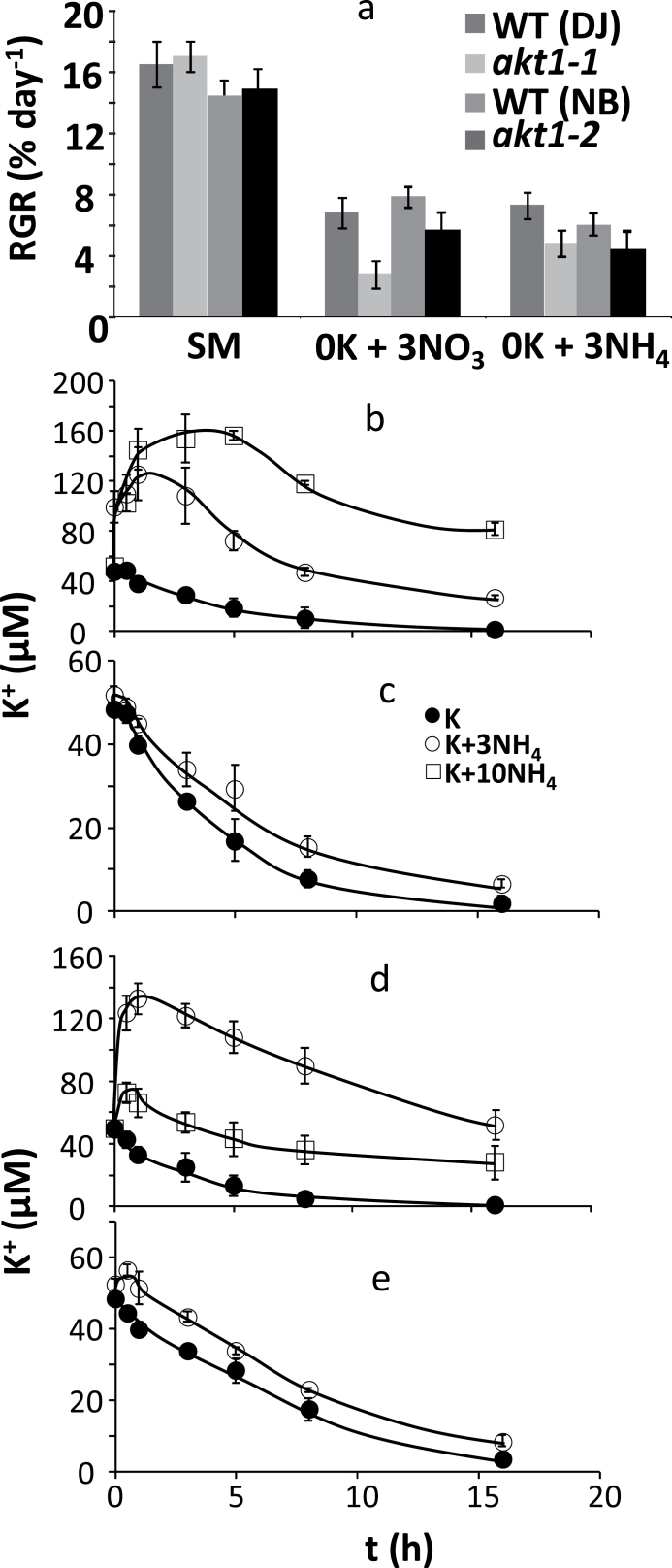
The effect of ammonium on growth rate and K+ uptake. (a) Relative growth rate (RGR, % day−1) of 5-week-old rice plants exposed to standard medium (SM), and media containing 0mM K+ and zero ammonium (0K + 3NO3), or 0mM K+ plus 3 or 10mM ammonium (0K + 3NH4 or 0K + 10NH4). (b–e) Net K+ uptake for WT (Nipponbare; b and c) and akt1-2 (d and e) plants from a solution containing 50 µM K+, either in the absence or the presence of 3 or 10mM NH4 +. Plants were pregrown in the absence of NH4 + (b and d) or with 1.5mM NH4 + in the growth medium (c and e). *Significant difference by t-test at a probability level of P<0.05 between each genotype and its respective wild type.
Fig. 4.
Fig. 4.
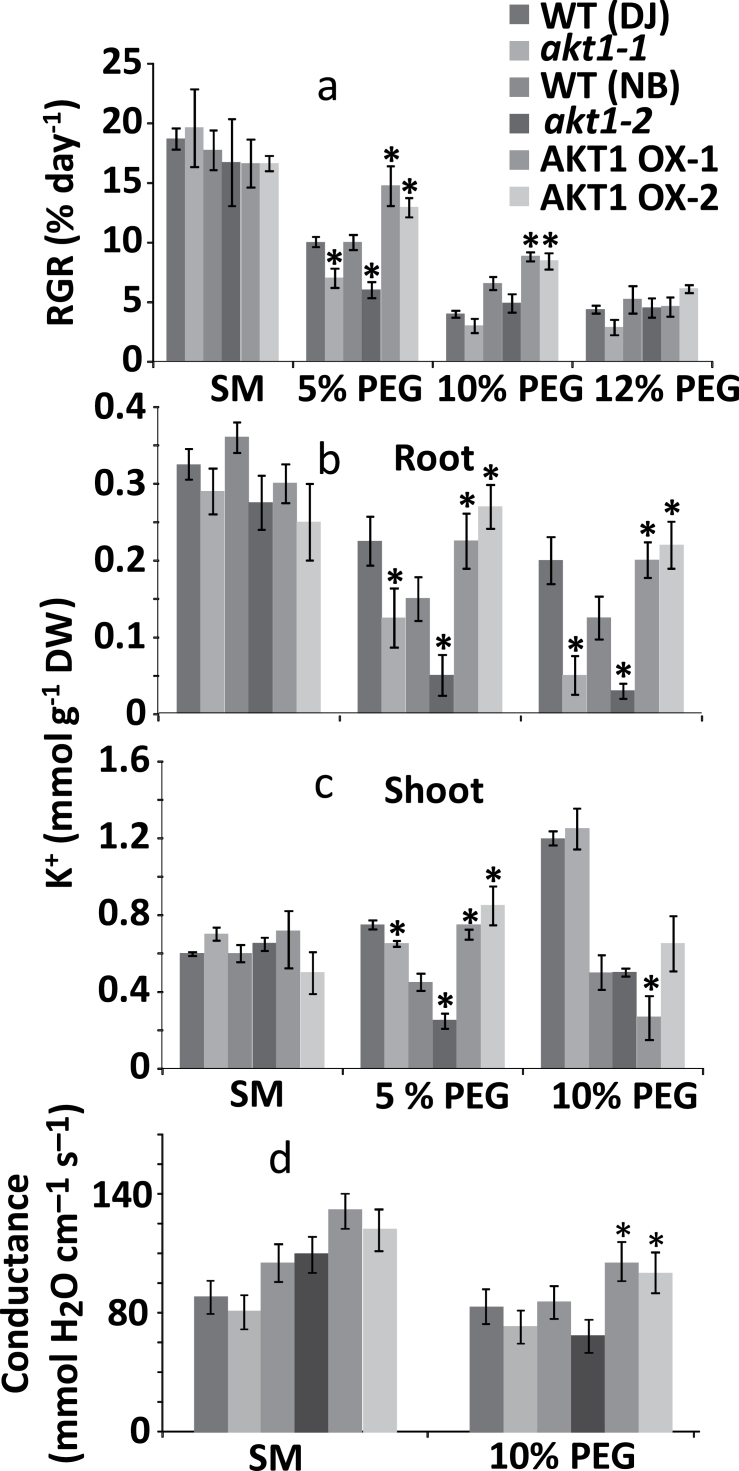
Relative growth rate and K+ content of osmotically stressed rice. (a) Relative growth rate (RGR, % day−1) of 5-week-old rice plants exposed to standard medium (SM), and media containing 5, 10 or 12% polyethylene glycol (PEG). (b) Root K+ content of plants grown in the standard medium, and 5 and 10% PEG conditions. (c) Shoot K+ content of plants grown in the conditions mentioned under (b). (d) Leaf stomatal conductance of the five genotypes for plants grown in standard medium or plants exposed to osmotic stress. *Significant difference by t-test at a probability level of P<0.05 between each genotype and its respective wild type.
Fig. 5.
Fig. 5.
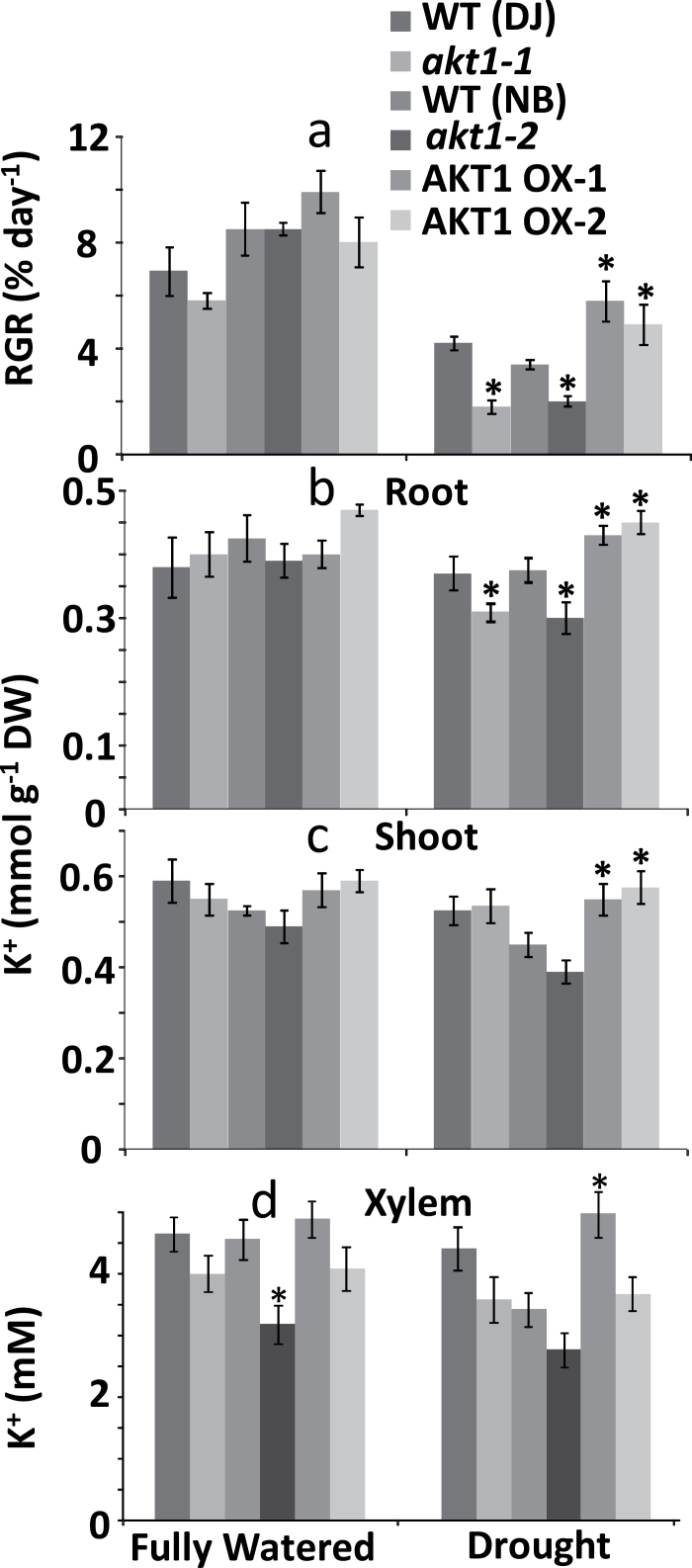
Growth and tissue and xylem K+ content of drought treated rice. (a) RGR of pot grown plants exposed for 6 weeks to full watering (100% field capacity) or limited water supply (~40% field capacity). (b) Root K+ content of plants grown in the conditions mentioned under (a). (c) Shoot K+ content of plants grown in the conditions mentioned under (a). (d) Xylem sap K+ concentration. *Significant difference by t-test at a probability level of P<0.05 between each genotype and its respective wild type.
Fig. 6.
Fig. 6.
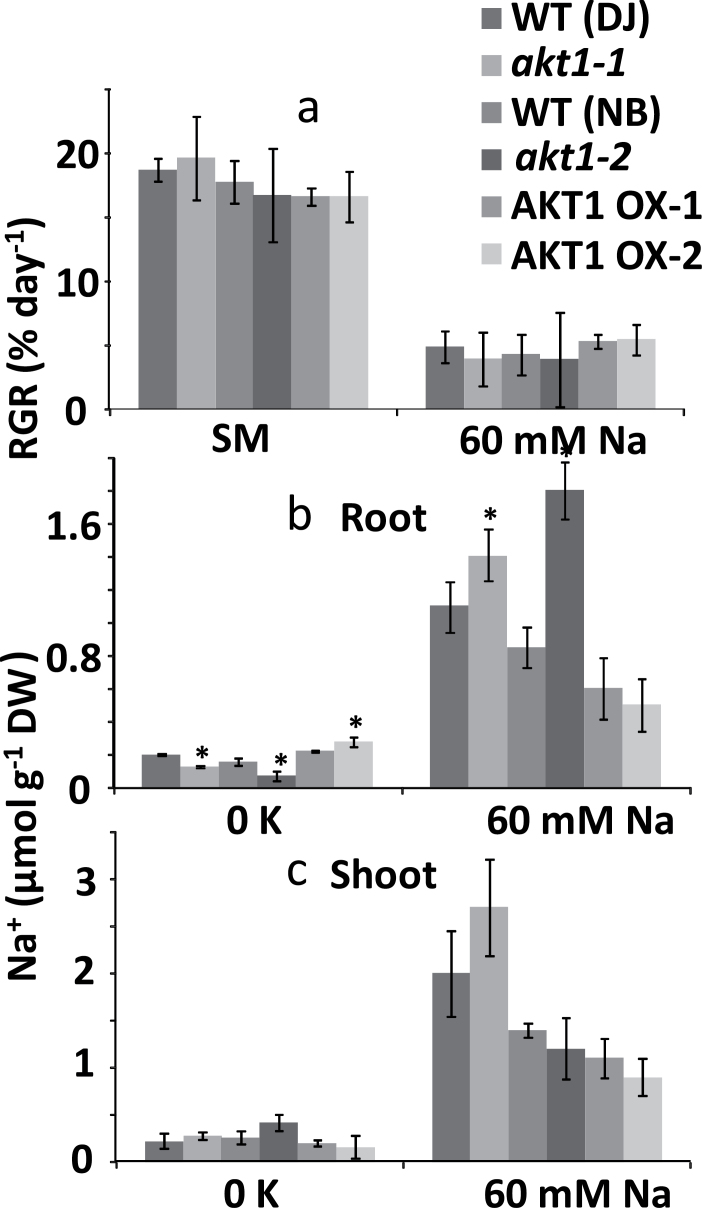
Relative growth rate and tissue Na+ for hydroponically grown rice. (a) Relative growth rate (RGR, % day−1) of 5-week-old rice plants exposed to standard medium (SM), and 60mM Na+. (b) Root Na+ content of plants grown in 0K and 60mM NaCl conditions. (c) Shoot Na+ content of plants grown in 0K and 60mM NaCl conditions. *Significant difference by t-test at a probability level of P<0.05 between each genotype and its respective wild type.

References

    1. Ahmad I, Maathuis FJ. 2014. Cellular and tissue distribution of potassium: physiological relevance, mechanisms and regulation. Journal of Plant Physiology 171, 708–714. - PubMed
    1. Ahn SJ, Shin R, Schachtman DP. 2004. Expression of KT/KUP genes in Arabidopsis and the role of root hairs in K+ uptake. Plant Physiology 134, 1135–1145. - PMC - PubMed
    1. Amtmann A, Beilby MJ. 2010. The role of ion channels in plant salt tolerance. In: Demidchik V, Maathuis F, eds. Ion channels and plant stress responses. Berlin, Heidelberg: Springer, 23–46.
    1. Amtmann A, Sanders D. 1999. Mechanisms of Na+ uptake by plant cells. Advances in Botanical Research 29, 75–112.
    1. Anil VS, Krishnamurthy P, Kuruvilla S, Sucharitha K, Thomas G, Mathew MK. 2005. Regulation of the uptake and distribution of Na+ in shoots of rice (Oryza sativa) variety Pokkali: role of Ca2+ in salt tolerance response. Physiologia Plantarum 124, 451–464.