


Opposing effects of negative emotion on amygdalar and hippocampal memory for items and associations
- PMID: 26969864
- PMCID: PMC4884322
- DOI: 10.1093/scan/nsw028
Opposing effects of negative emotion on amygdalar and hippocampal memory for items and associations
Abstract
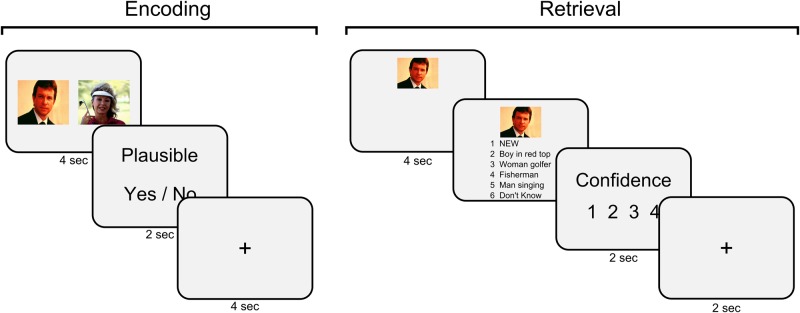
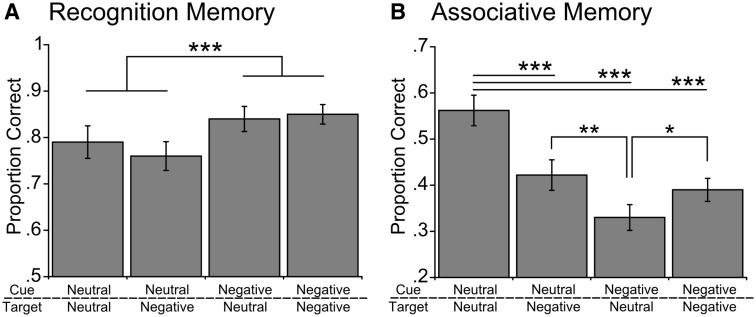
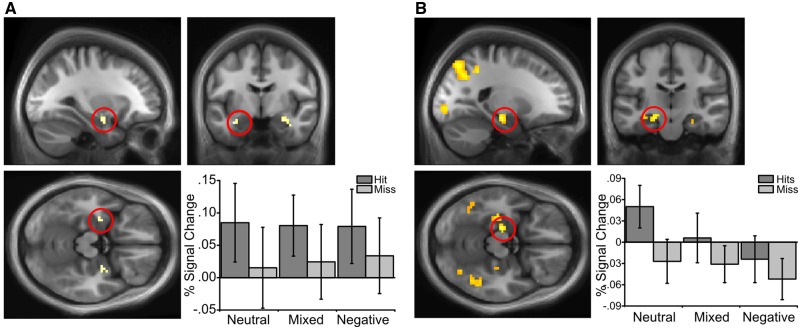
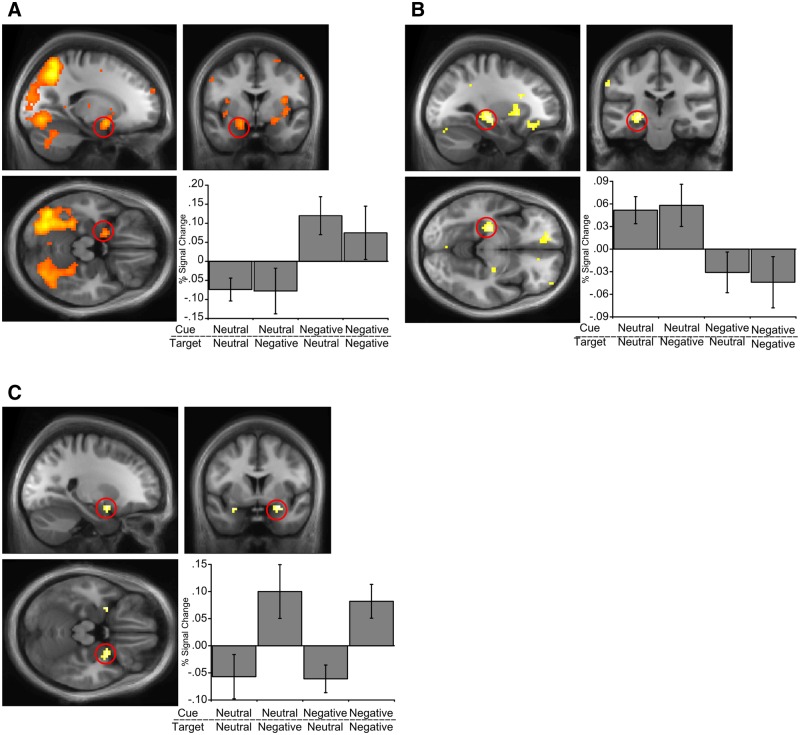
Although negative emotion can strengthen memory of an event it can also result in memory disturbances, as in post-traumatic stress disorder (PTSD). We examined the effects of negative item content on amygdalar and hippocampal function in memory for the items themselves and for the associations between them. During fMRI, we examined encoding and retrieval of paired associates made up of all four combinations of neutral and negative images. At test, participants were cued with an image and, if recognised, had to retrieve the associated (target) image. The presence of negative images increased item memory but reduced associative memory. At encoding, subsequent item recognition correlated with amygdala activity, while subsequent associative memory correlated with hippocampal activity. Hippocampal activity was reduced by the presence of negative images, during encoding and correct associative retrieval. In contrast, amygdala activity increased for correctly retrieved negative images, even when cued by a neutral image. Our findings support a dual representation account, whereby negative emotion up-regulates the amygdala to strengthen item memory but down-regulates the hippocampus to weaken associative representations. These results have implications for the development and treatment of clinical disorders in which diminished associations between emotional stimuli and their context contribute to negative symptoms, as in PTSD.
Keywords: amygdala; associative memory; hippocampus; item memory.
© The Author (2016). Published by Oxford University Press.
Figures
References
-
- Aggleton J.P., Brown M.W. (1999). Episodic memory, amnesia, and the hippocampal-anterior thalamic axis. Behavioral and Brain Sciences, 22, 425–44. - PubMed
-
- Anderson L., Shimamura A.P. (2005). Influences of emotion on context memory while viewing film clips. American Journal of Psychology, 118, 323–37. - PubMed
-
- Barense M.D., Gaffan D., Graham K.S. (2007). The human medial temporal lobe processes online representations of complex objects. Neuropsychologia, 45, 2963–74. - PubMed
-
- Becker S., Macqueen G., Wojtowicz J.M. (2009). Computational modeling and empirical studies of hippocampal neurogenesis-dependent memory: effects of interference, stress and depression. Brain Research, 1299, 45–54. - PubMed
Publication types
MeSH terms
Grants and funding
LinkOut - more resources
Full Text Sources
Other Literature Sources
Medical
