


Socioeconomic differences in overweight and weight-related behaviors across adolescence and young adulthood: 10-year longitudinal findings from Project EAT
- PMID: 26970036
- PMCID: PMC4884479
- DOI: 10.1016/j.ypmed.2016.03.007
Socioeconomic differences in overweight and weight-related behaviors across adolescence and young adulthood: 10-year longitudinal findings from Project EAT
Abstract
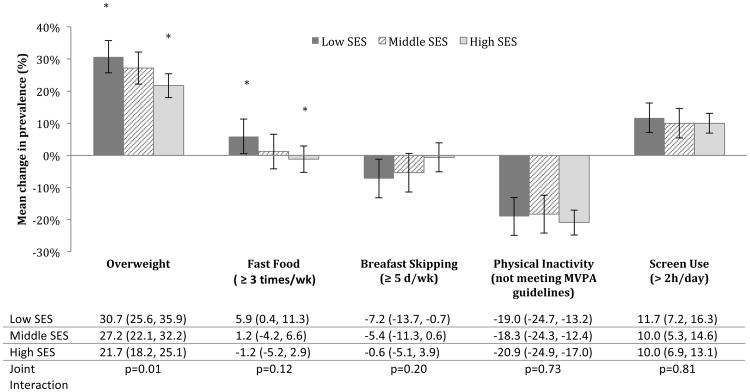
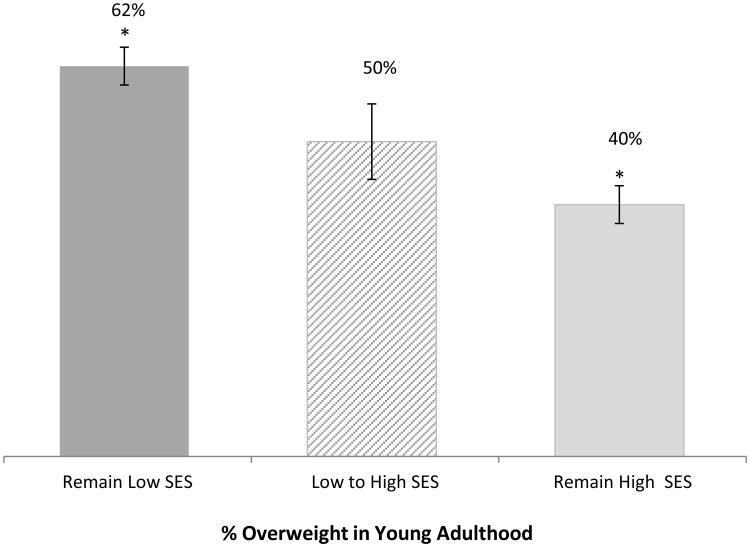
Reducing socioeconomic disparities in weight-related health is a public health priority. The purpose of this paper was to examine 10-year longitudinal patterns in overweight and weight-related behaviors from adolescence to young adulthood as a function of family-level socioeconomic status (SES) and educational attainment. Project EAT (Eating and Activity in Teens and Young Adults) followed a diverse sample of 2287 adolescents from 1999 to 2009. Mixed-effects regression tested longitudinal trends in overweight, fast food, breakfast skipping, physical inactivity, and screen use by family-level SES. The influence of subsequent educational attainment in young adulthood was examined. Results revealed that the prevalence of overweight increased significantly from adolescence to young adulthood with the greatest change seen in those from low SES (mean change=30.7%, 95% CI=25.6%-35.9%) as compared to high SES families (mean change=21.7%, 95% CI=18.2%-25.1%). Behavioral changes from adolescence to young adulthood also differed by SES background; the prevalence of frequent fast food intake (≥3times/week) increased most dramatically in those from low SES (mean change=6%, 95% CI=0.5%-11%) as compared to high SES families (mean change=-1.2%, 95% CI=-5.2%-2.9%). Overall trends suggest that a higher educational attainment mitigates the negative impacts of a low SES background. These findings suggest that continued effort is needed to ensure that public health strategies addressing obesity and related behaviors reach adolescents and young adults from low SES backgrounds and do not contribute to widening socioeconomic gaps in weight-related health.
Keywords: Adolescent; Health behavior; Overweight; Socioeconomic status; Young adult.
Copyright © 2016 Elsevier Inc. All rights reserved.
Conflict of interest statement
Figures
References
-
- Ogden C, Lamb M, Carroll M, Flegal K. NCHS Data Brief no 51. Hyattsville, MD: National Center for Health Statistics; 2010. Obesity and socioeconomic status in children: United States 1988-1994 and 2005-2008.
-
- Singh GK, Siahpush M, Kogan MD. Rising social inequalities in US childhood obesity, 2003-2007. Ann Epidemiol. 2010;20(1):40–52. - PubMed
-
- Miech RA, Kumanyika SK, Stettler N, Link BG, Phelan JC, Chang VW. Trends in the association of poverty with overweight among US adolescents, 1971-2004. JAMA. 2006;295(20):2385–2393. - PubMed
Publication types
MeSH terms
Grants and funding
LinkOut - more resources
Full Text Sources
Other Literature Sources
