Review
. 2016 Aug:40:56-63.
doi: 10.1016/j.copbio.2016.02.011. Epub 2016 Mar 9.

Modular protein domains: an engineering approach toward functional biomaterials

Affiliations
Review

Modular protein domains: an engineering approach toward functional biomaterials

Charng-Yu Lin et al. Curr Opin Biotechnol. 2016 Aug.

Abstract

Protein domains and peptide sequences are a powerful tool for conferring specific functions to engineered biomaterials. Protein sequences with a wide variety of functionalities, including structure, bioactivity, protein-protein interactions, and stimuli responsiveness, have been identified, and advances in molecular biology continue to pinpoint new sequences. Protein domains can be combined to make recombinant proteins with multiple functionalities. The high fidelity of the protein translation machinery results in exquisite control over the sequence of recombinant proteins and the resulting properties of protein-based materials. In this review, we discuss protein domains and peptide sequences in the context of functional protein-based materials, composite materials, and their biological applications.


Figures

Figure 1
Figure 1
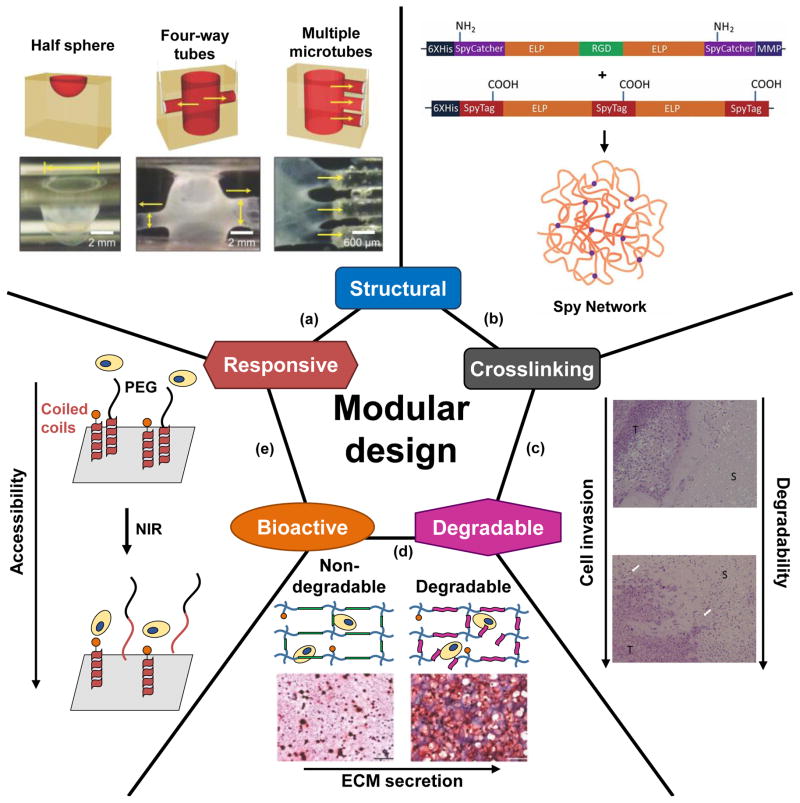
Modular protein domains confer functionality. Five commonly-used functional domains are given as examples. (a) A multilayer structure composed of elastin-like polypeptides (ELPs) and peptide amphiphiles (PAs) can respond to contact with surfaces by changing its geometry. With this responsiveness, complex structures such as interconnected tubes can be fabricated. Reprinted by permission from Macmillan Publishers Ltd: Nature Chemistry (Inostroza-Brito KE, Collin E, Siton-Mendelson O, Smith KH, Monge-Marcet A, Ferreira DS, Rodríguez RP, Alonso M, Rodríguez-Cabello JC, Reis RL et al.: Co-assembly, spatiotemporal control and morphogenesis of a hybrid protein–peptide system. Nat Chem 2015, 7:897–904.), copyright (2015). (b) The crosslinking domains SpyTag and SpyCatcher were incorporated with ELP domains to form a hydrogel. SpyTag and SpyCatcher can form an isopeptide bond between each other and can therefore form a crosslinked network. Reproduced with permission from Sun F, Zhang WB, Mahdavi A, Arnold FH, Tirrell DA: Synthesis of bioactive protein hydrogels by genetically encoded SpyTag-SpyCatcher chemistry. Proc Natl Acad Sci U S A 2014, 111:11269–11274. © National Academy of Sciences. (c) Matrix metalloproteinase (MMP)-sensitive sequences were incorporated into recombinant protein-based hydrogels. When the hydrogels were implanted into tumor-bearing mice, a higher cell invasion rate was observed with MMP-sensitive hydrogels compared to MMP-insensitive hydrogels as shown by the histology results. S: protein hydrogel, T: tumor tissue. White arrows indicate vascular infiltration into the hydrogel. Reprinted from J Control Release, 213, Price R, Poursaid A, Cappello J, Ghandehari H, In vivo evaluation of matrix metalloproteinase responsive silk-elastinlike protein polymers for cancer gene therapy, 96–102, copyright (2015), with permission from Elsevier. (d) MMP-sensitive peptides were incorporated into poly(ethylene glycol) (PEG) hydrogels to introduce degradability into the system. When human mesenchymal stem cells (hMSCs) and chondrocytes were co-cultured in these PEG hydrogels, higher levels of extracellular matrix (ECM) secretion were observed with the degradable hydrogels as shown in the histology results where glycosaminoglycans (GAGs) are stained in red and nuclei are stained in black. Adapted with permission from Sridhar BV, Brock JL, Silver JS, Leight JL, Randolph MA, Anseth KS: Development of a cellularly degradable PEG hydrogel to promote articular cartilage extracellular matrix deposition. Adv Healthc Mater 2015, 4:702–713. © John Wiley and Sons. (e) Temperature-sensitive coiled coils served as responsive domains to change the accessibility of the RGD cell-binding domain. The RGD sequence was attached to one of the coils, and a PEG chain was conjugated to the other coil. At low temperatures, the coiled coils remained in the native structure, and the bioactive domains were inaccessible to the cells because of the PEG chains. When the temperature was raised by near infrared (NIR) radiation of gold nanorods, the coiled coils denatured, and the coils with PEG were released from the RGD sequence, which became accessible to cells. Adapted from Yang J, Yao M-H, Du M-S, Jin R-M, Zhao D-H, Ma J, Ma Z-Y, Zhao Y-D, Liu B: A near-infrared light-controlled system for reversible presentation of bioactive ligands using polypeptide-engineered functionalized gold nanorods. Chem. Commun. 2015, 51:2569–2572 with permission of The Royal Society of Chemistry (RSC) on behalf of the Centre National de la Recherche Scientifique (CNRS) and the RSC.

References

    1. Kyburz KA, Anseth KS. Synthetic mimics of the extracellular matrix: How simple is complex enough? Ann Biomed Eng. 2015;43:489–500. - PMC - PubMed
    1. Walters NJ, Gentleman E. Evolving insights in cell–matrix interactions: Elucidating how non-soluble properties of the extracellular niche direct stem cell fate. Acta Biomater. 2015;11:3–16. - PMC - PubMed
    1. Gentile P, Chiono V, Carmagnola I, Hatton PV. An overview of poly (lactic-co-glycolic) acid (PLGA)-based biomaterials for bone tissue engineering. Int J Mol Sci. 2014;15:3640–3659. - PMC - PubMed
    1. Bakaic E, Smeets NM, Hoare T. Injectable hydrogels based on poly (ethylene glycol) and derivatives as functional biomaterials. RSC Adv. 2015;5:35469–35486.
    1. Shelke NB, James R, Laurencin CT, Kumbar SG. Polysaccharide biomaterials for drug delivery and regenerative engineering. Polymer Adv Tech. 2014;25:448–460.