


Ten-year survival of hepatocellular carcinoma patients undergoing radiofrequency ablation as a first-line treatment
- PMID: 26973395
- PMCID: PMC4779922
- DOI: 10.3748/wjg.v22.i10.2993
Ten-year survival of hepatocellular carcinoma patients undergoing radiofrequency ablation as a first-line treatment
Abstract
Aim: To investigate the long-term survival and prognostic factors in hepatocellular carcinoma (HCC) patients undergoing radiofrequency ablation (RFA) as a first-line treatment.
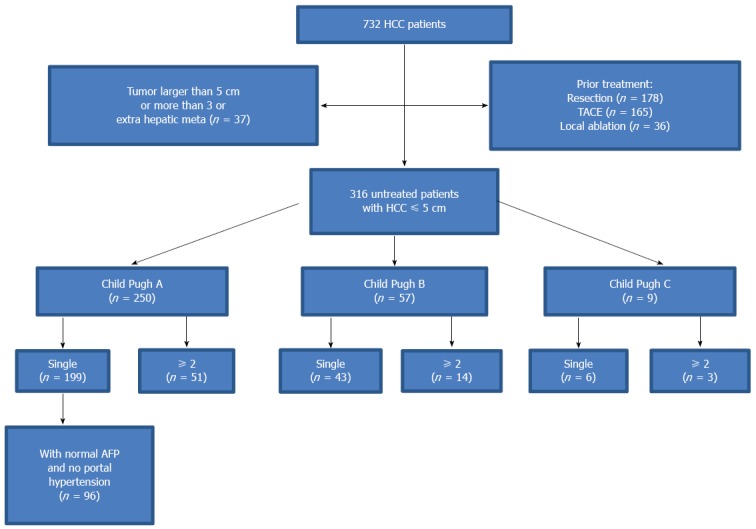
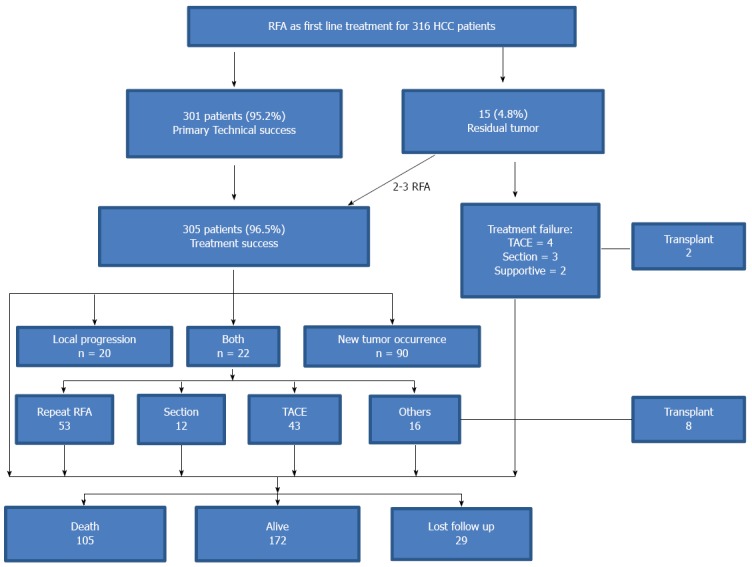
Methods: From 2000 to 2013, 316 consecutive patients with 404 HCC (1.0-5.0 cm; mean: 3.2 ± 1.1 cm) underwent ultrasonography-guided percutaneous RFA as a first-line treatment. There were 250 males and 66 females with an average age of 60.1 ± 10.8 years (24-87 years). Patients were followed for 1 year to > 10 years after RFA (234, 181, 136, and 71 for 3, 5, 7, and 10 years, respectively). Overall local response rates and long-term survival rates were assessed. Survival results were generated using Kaplan-Meier estimates, and multivariate analysis was performed using the Cox regression model.
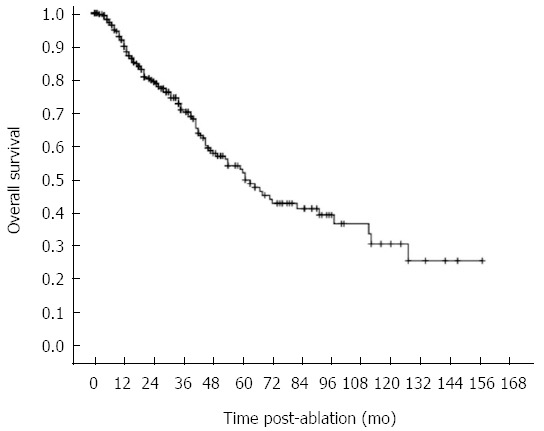
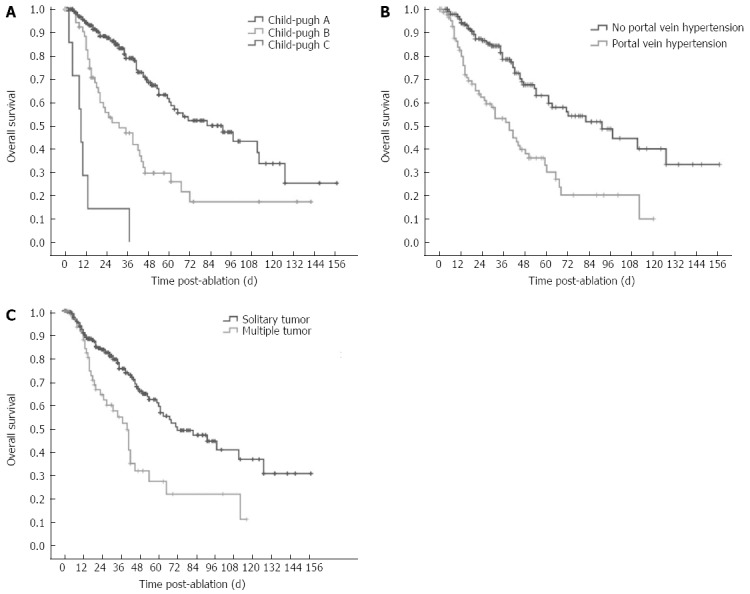
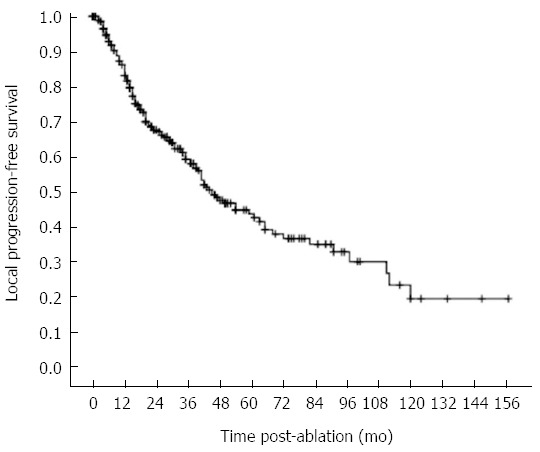
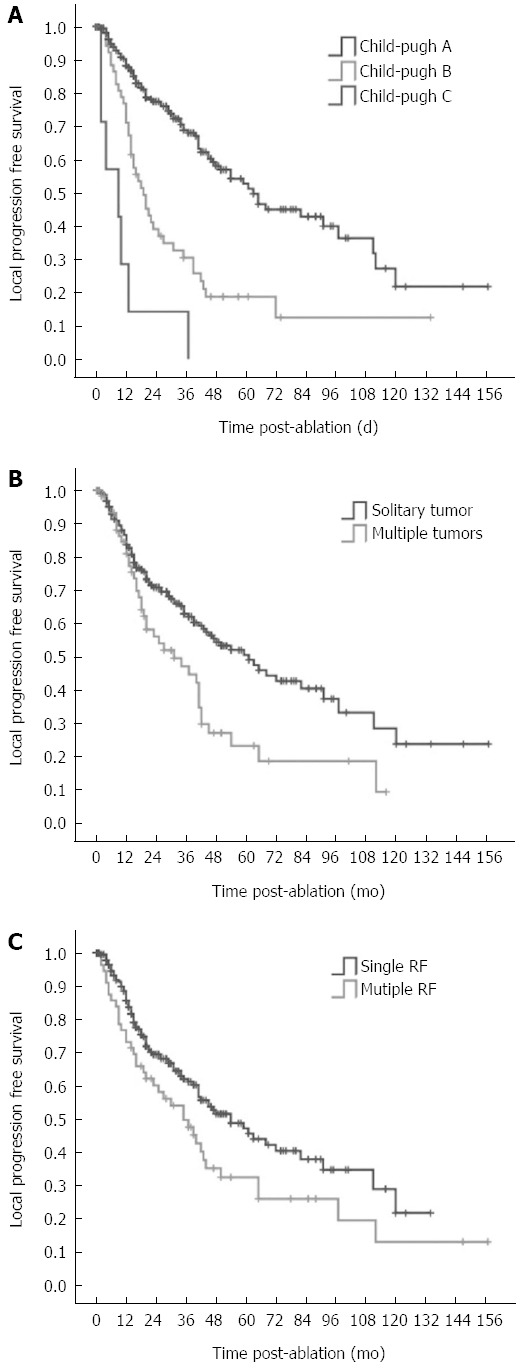
Results: In total, 548 RFA sessions were performed and major complications occurred in 10 sessions (1.8%). Local tumor progression and/or new tumor development were observed in 43.3% (132/305) of the patients during the follow-up period. Overall 5- and 10-year survival rates were 49.7% and 28.4%, respectively. Based on multivariate analysis, three factors were identified as independent prognostic factors for overall survival: Child-Pugh classification (HR = 4.054, P < 0.001), portal vein hypertension (HR = 2.743, P = 0.002), and tumor number (HR = 2.693, P = 0.003). The local progression-free 5- and 10-year survival rates were 42.7% and 19.5%. In addition to the Child-Pugh classification and the number of tumors, the number of RFA sessions (HR = 1.550, P = 0.002) was associated with local progression-free survival.
Conclusion: RFA can achieve acceptable outcomes for HCC patients as a first-line treatment, especially for patients with Child-Pugh class A, patients with a single tumor and patients without portal vein hypertension.
Keywords: Hepatocellular carcinoma; Long term survival; Percutaneous; Radiofrequency ablation; Ultrasonography-guided.
Figures
References
-
- Llovet JM, Burroughs A, Bruix J. Hepatocellular carcinoma. Lancet. 2003;362:1907–1917. - PubMed
-
- Song TJ, Ip EW, Fong Y. Hepatocellular carcinoma: current surgical management. Gastroenterology. 2004;127:S248–S260. - PubMed
-
- N’Kontchou G, Mahamoudi A, Aout M, Ganne-Carrié N, Grando V, Coderc E, Vicaut E, Trinchet JC, Sellier N, Beaugrand M, et al. Radiofrequency ablation of hepatocellular carcinoma: long-term results and prognostic factors in 235 Western patients with cirrhosis. Hepatology. 2009;50:1475–1483. - PubMed
-
- Tateishi R, Shiina S, Teratani T, Obi S, Sato S, Koike Y, Fujishima T, Yoshida H, Kawabe T, Omata M. Percutaneous radiofrequency ablation for hepatocellular carcinoma. An analysis of 1000 cases. Cancer. 2005;103:1201–1209. - PubMed
-
- Lencioni R, Cioni D, Crocetti L, Franchini C, Pina CD, Lera J, Bartolozzi C. Early-stage hepatocellular carcinoma in patients with cirrhosis: long-term results of percutaneous image-guided radiofrequency ablation. Radiology. 2005;234:961–967. - PubMed
Publication types
MeSH terms
LinkOut - more resources
Full Text Sources
Other Literature Sources
Medical
