


The South African dysphagia screening tool (SADS): A screening tool for a developing context
- PMID: 26974244
- PMCID: PMC5843204
- DOI: 10.4102/sajcd.v63i1.117
The South African dysphagia screening tool (SADS): A screening tool for a developing context
Abstract
Background: Notwithstanding its value, there are challenges and limitations to implementing a dysphagia screening tool from a developed contexts in a developing context. The need for a reliable and valid screening tool for dysphagia that considers context, systemic rules and resources was identified to prevent further medical compromise, optimise dysphagia prognosis and ultimately hasten patients' return to home or work.
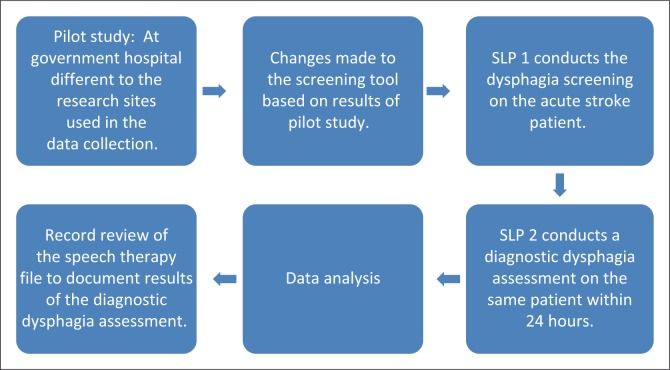
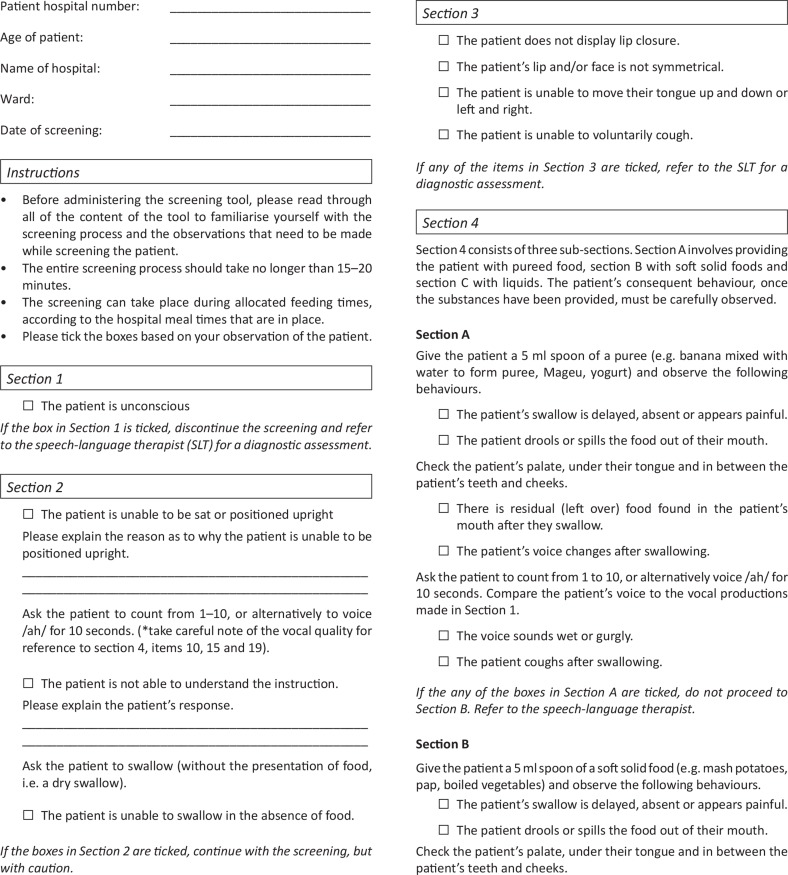
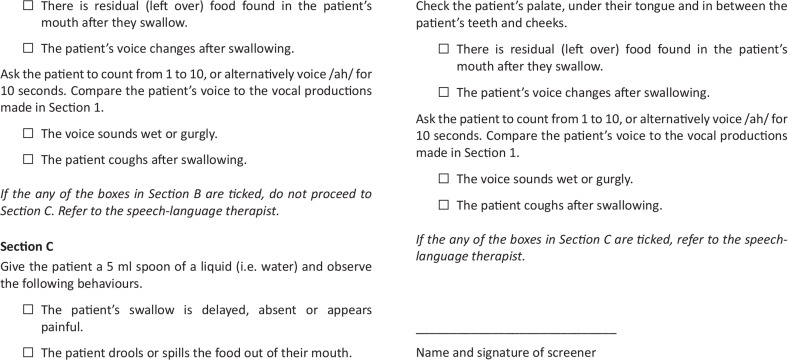
Methodology: To establish the validity and reliability of the South African dysphagia screening tool (SADS) for acute stroke patients accessing government hospital services. The study was a quantitative, non-experimental, correlational cross-sectional design with a retrospective component. Convenient sampling was used to recruit 18 speech-language therapists and 63 acute stroke patients from three South African government hospitals. The SADS consists of 20 test items and was administered by speech-language therapists. Screening was followed by a diagnostic dysphagia assessment. The administrator of the tool was not involved in completing the diagnostic assessment, to eliminate bias and prevent contamination of results from screener to diagnostic assessment. Sensitivity, validity and efficacy of the screening tool were evaluated against the results of the diagnostic dysphagia assessment. Cohen's kappa measures determined inter-rater agreement between the results of the SADS and the diagnostic assessment.
Results and conclusion: The SADS was proven to be valid and reliable. Cohen's kappa indicated a high inter-rater reliability and showed high sensitivity and adequate specificity in detecting dysphagia amongst acute stroke patients who were at risk for dysphagia. The SADS was characterised by concurrent, content and face validity. As a first step in establishing contextual appropriateness, the SADS is a valid and reliable screening tool that is sensitive in identifying stroke patients at risk for dysphagia within government hospitals in South Africa.
Conflict of interest statement
The authors declare that they have no financial or personal relationships that may have inappropriately influenced them in writing this article.
Figures
References
-
- Abramson J.H., & Abramson Z.H. (2008). Research methods in community medicine: Surveys, epidemiological research, programme evaluation, clinical trials. (6th edn). Chichester, UK: John Wiley & Sons Ltd; http://dx.doi.org/10.1002/9780470987230 - DOI
-
- American Speech-Language and Hearing Association (ASHA) (2013). Definitions of professions. Retrieved December 2013, from http://www.asha.org/div40/definitions.htm
-
- Blackwell Z., & Littlejohns P. (2010). A review of the management of dysphagia: A South African perspective. The Journal of Neuroscience Nursing, 42, 1–9. http://dx.doi.org/10.1097/JNN.0b013e3181ce5c86 - DOI - PubMed
-
- Brainin M., Teuschl Y., & Kalra L. (2007). Acute treatment and long-term management of stroke in developing countries. The Lancet Neurology, 6(6), 553–561. http://dx.doi.org/10.1016/S1474-4422(07)70005-4 - DOI - PubMed
-
- Cichero J.A., & Murdoch B.E. (2006). Dysphagia: Foundation, theory and practice. New York, NY: Wiley.
Publication types
MeSH terms
LinkOut - more resources
Full Text Sources
Other Literature Sources
Medical
Research Materials