


Income Inequities and Medicaid Expansion are Related to Racial and Ethnic Disparities in Delayed or Forgone Care Due to Cost
- PMID: 26974677
- PMCID: PMC5830941
- DOI: 10.1097/MLR.0000000000000525
Income Inequities and Medicaid Expansion are Related to Racial and Ethnic Disparities in Delayed or Forgone Care Due to Cost
Abstract
Background: Monitoring political and social determinants of delayed or forgone care due to cost is necessary to evaluate efforts to reduce racial and ethnic disparities in access to care. Our objective was to examine the extent to which state Medicaid expansion decisions and personal household income may be associated with individual-level racial and ethnic disparities in delayed or forgone care due to cost, at baseline, before the implementation of the Affordable Care Act.
Methods: We used 2012 Behavioral Risk Factor Surveillance System survey data to examine racial and ethnic differences in delayed or forgone care due to cost in states that do and do not plan Medicaid expansion. We examined personal household income as a social factor that could contribute to racial and ethnic disparities in delayed or forgone care.
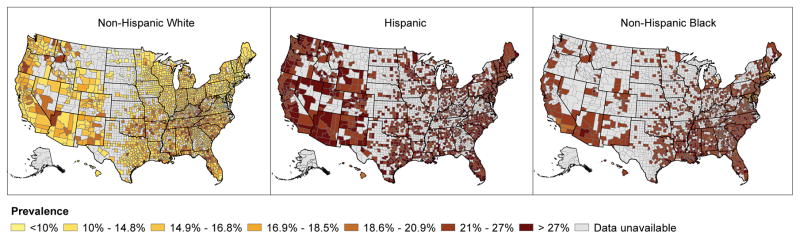
Results: We found that personal income differences were strongly related to disparities in delayed or forgone care in places with and without plans to expand Medicaid. In addition, while delayed or forgone care disparities between non-Hispanic whites and non-Hispanic blacks were lowest in places with plans to expand Medicaid access, disparities between non-Hispanic whites and Hispanics did not differ by state Medicaid expansion plans.
Conclusions: As access to insurance improves for diverse groups, health systems must develop innovative strategies to overcome social determinants of health, including income inequities, as barriers to accessing care for Hispanic and non-Hispanic blacks. Additional efforts may be needed to ensure Hispanic groups achieve the benefits of investments in health care access.
Figures
References
-
- The Kaiser Commission on Medicaid and the Uninsured. Key Facts about the Uninsured Population. Kaiser Family Foundation; 2014. [Last accessed: 8-28-2015].
-
- Kaiser Commission on Medicaid and the Uninsured. [Last accessed: 8-28-2015];Impact of the Medicaid Expansion for Low-Income Communities of Color Across States. 2013 http://www.kff.org/minorityhealth/upload/8435.pdf.
-
- Stephens J, Artiga S, Lyons B, Jankiewicz A, Rousseau D. Understanding the Effect of Medicaid Expansion Decisions in the South. JAMA. 2014;311:2471.
-
- Braveman P, Egerter S, Williams DR. The social determinants of health: coming of age. Annual review of public health. 2011;32:381–398. - PubMed
MeSH terms
Grants and funding
LinkOut - more resources
Full Text Sources
Other Literature Sources
Medical
Research Materials
