. 2016 Feb 1;66(2):156-163.
doi: 10.1093/biosci/biv171. Epub 2015 Dec 16.

Upgrading Marine Ecosystem Restoration Using Ecological-Social Concepts

Affiliations

Upgrading Marine Ecosystem Restoration Using Ecological-Social Concepts

Avigdor Abelson et al. Bioscience. .

Abstract

Conservation and environmental management are principal countermeasures to the degradation of marine ecosystems and their services. However, in many cases, current practices are insufficient to reverse ecosystem declines. We suggest that restoration ecology, the science underlying the concepts and tools needed to restore ecosystems, must be recognized as an integral element for marine conservation and environmental management. Marine restoration ecology is a young scientific discipline, often with gaps between its application and the supporting science. Bridging these gaps is essential to using restoration as an effective management tool and reversing the decline of marine ecosystems and their services. Ecological restoration should address objectives that include improved ecosystem services, and it therefore should encompass social-ecological elements rather than focusing solely on ecological parameters. We recommend using existing management frameworks to identify clear restoration targets, to apply quantitative tools for assessment, and to make the re-establishment of ecosystem services a criterion for success.

Keywords: Ocean Health Index (OHI); conservation; marine ecosystems; marine spatial planning (MSP); social–ecological restoration.


Figures
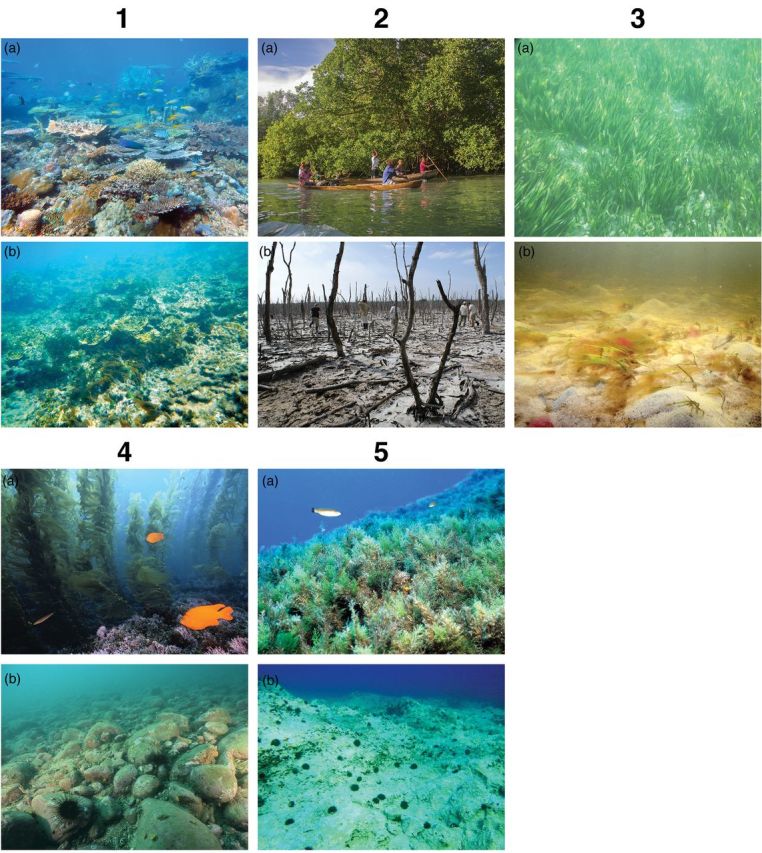
Figure 1.
Figure 1.
Examples of healthy (rich ecosystem services; e.g., food supply, nursery grounds, coastal protection) versus degraded (poor ecosystem services) marine ecosystem sites. (1) Tropical coral reefs: (a) a high-structural-complexity reef, dominated by reef-building corals (Kota Kinabalu, Malaysia), (b) a degraded reef (Ulithi, Yap, Federated States of Micronesia); (2) Mangrove forests: (a) a fully developed forest (Mangal; Solomon Islands), (b) a degraded mangrove site (Rookery Bay, Florida); (3) Seagrass meadows: (a) a Posidonia australis meadow (King George Sound, Australia), (b) a stressed Zostera muelleri meadow (Tasmania, Australia); (4) Kelp forests: (a) a highly productive giant kelp forest (California), (b) a deforested kelp reef with low productivity and diversity (California); (5) Canopy-forming algal forests: (a) a Cystoseira balearica forest (Scandola, Corsica), (b) urchin barrens (Porto Cesareo, Italy). Photographs: 1a C. Storlazzi; 1b A. Abelson; 2a E. Brokovich, 2b C.J. Sapp; 3a G. Kendrick, 3b G. Edgar; 4a,b R. McPeak; 5a E. Ballesteros, 5b P Guidetti.
Figure 2.
Figure 2.
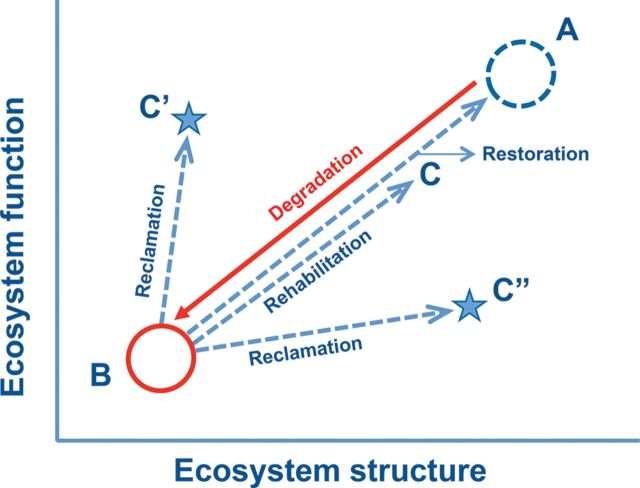
A schematic illustration of the effects of restoration interventions (e.g., restoration, rehabilitation, and reclamation) on ecosystem structure (e.g., species diversity and structural complexity) and ecosystem function (e.g., nutrient content and cycling as well as productivity), illustrating changes that occur as a degraded ecosystem (State B) recovers toward its original state (A). Practices which lead to partial recovery are termed rehabilitation (C), in which practices that improve either or both the ecosystem structure or function—but not toward the original state (A)—are termed reclamation (C’ and C”; after Dobson et al. 1997).
Figure 3.
Figure 3.
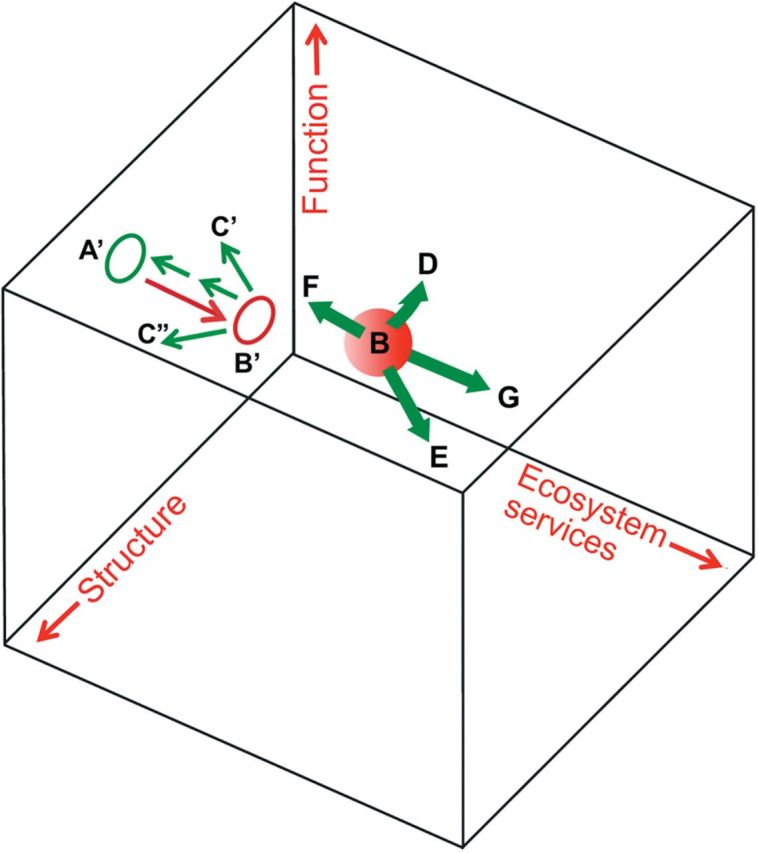
A schematic illustration of the effects of restoration interventions on ecosystem structure, ecosystem function, and ecosystem services, illustrating the hypothetical scenarios that may occur as degraded ecosystems either recover toward their original state or shift toward other improved directions (C–F). Arrays A’ to C’, correspond to figure 2; B,B’ to the degraded ecosystem; D to improved function, structure, and services (e.g., the removal of stressors, which enables the partial or complete recovery of the ecosystems); E to the declined function and slight improvement of structure and services (e.g., the transplantation of a single habitat-engineering species); F to improved function and structure but no significant change in services (e.g., the restoration of a reef-table community with species that cannot improve coastal protection); G to no improvement of the structure and function of a given ecosystem site but improved locally needed services (e.g., enhanced food supply related to the creation of alternative habitat sites, such as artificial reefs).
Figure 4.
Figure 4.
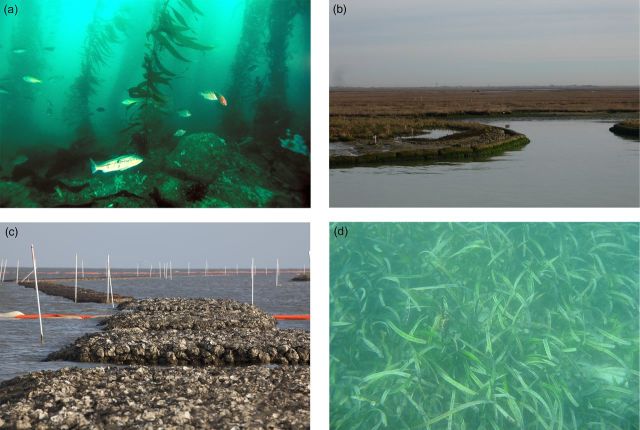
Case studies of marine ecosystem restoration projects designed to restore or mitigate for lost ecosystem services, notably coastal protection, seabed stabilization, food supply, nursery habitats, carbon sequestration (“blue carbon”), and tourism attractions. (a) A replaced kelp forest, established on an artificial reef (i.e., deployed rocks) on a sandy seabed, in an alternative site to mitigate for the loss of a kelp forest damaged by a power plant, the San Onofre Nuclear Generating Station (California; a project by UCSB). (b) Restored salt marshes, which are part of the coastal defense strategy to protect the city of Venice and the Venetian Lagoon from flooding (Italy; the MOSE project by Consorzio Venezia Nuova). (c) A constructed oyster reef in the Gulf of Mexico as part of the living shoreline efforts (Alabama; a project by The Nature Conservancy). (d) A seagrass meadow of Posidonia australis restored three decades after having been heavily affected by eutrophication (Cockburn Sound, Perth, Western Australia; a project by Murdoch University). Photographs: (a) Richard Herrmann, (b) Laura Airoldi, (c) Jeff DeQuattro, and (d) Jennifer Verduin.

References

    1. Adger WN, Hughes TP, Folke C, Carpenter SR, Rockstrom J. Social–ecological resilience to coastal disasters. Science. 2005;309:1036–1039. - PubMed
    1. Barbier EB. Progress and challenges in valuing coastal and marine ecosystem services. Review of Environmental Economics and Policy. 2012;6:1–19.
    1. Beck MW, et al. Oyster reefs at risk and recommendations for conservation, restoration, and management. BioScience. 2011;61:107–116.
    1. Béné C. When fishery rhymes with poverty: A first step beyond the old paradigm on poverty in small-scale fisheries. World Development. 2003;31:949–975.
    1. Béné C. Are fishers poor or vulnerable? Assessing economic vulnerability in small-scale fishing communities. The Journal of Development Studies. 2009;45:911–933.