Type 1 diabetes prevalence increasing globally and regionally: the role of natural selection and life expectancy at birth
- PMID: 26977306
- PMCID: PMC4780042
- DOI: 10.1136/bmjdrc-2015-000161
Type 1 diabetes prevalence increasing globally and regionally: the role of natural selection and life expectancy at birth
Abstract
Objective: Prevalence of type 1 diabetes (T1D) disease is increasing worldwide. We aim to test correlation of T1D prevalence to the reduced natural selection measured by Biological State Index (Ibs).
Research design and methods: Country-specific estimates of T1D prevalence, life expectancy, obesity prevalence rate, urbanization rates, per capita sugars consumption and per capita gross domestic product (GDP) were obtained. Ibs and country-specific longevity (e50) increase for each country were self-calculated. These data were then matched to T1D prevalence by country for our ecological study among 118 countries. Countries were also grouped to study the associations in different regions. SPSS V.22 was used for correlation analysis.
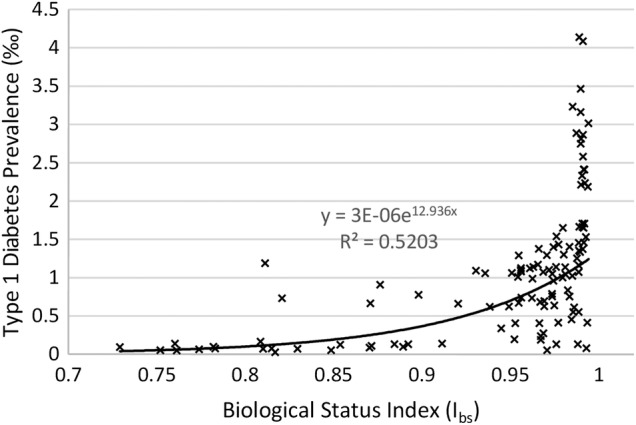
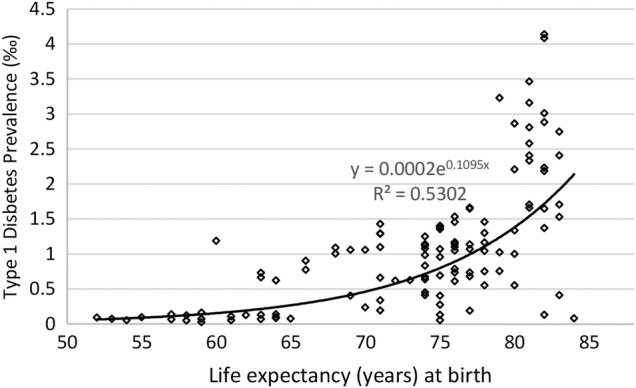
Results: Worldwide, both Ibs and life expectancy at birth (Ibs proxy) were significantly correlated to T1D prevalence in Pearson r (r=0.713, p<0.001 and r=0.722, p<0.001, respectively) and Spearman's r (r=0.724, p<0.001 and r=0.689, p<0.001, respectively). T1D prevalence was not correlated to longevity increase measured as life expectancy at 50 years old. T1D prevalence was significantly associated with I bs (r=0.307, p<0.001) and newborn life expectancy (r=0.349, p<0.001) independent of per capita total sugar consumption, per capita GDP, urbanization and obesity prevalence in partial correlation. Globally, both life expectancy at birth and Ibs exponentially correlated to T1D prevalence. Pearson correlations generally existed in different country categorizations by geographic region, culture background and economic status.
Conclusions: Reduced natural selection may have contributed to the increasing T1D prevalence worldwide. T1D epidemiology study in total population may be the practical solution to identify the causes of increasing T1D prevalence.
Keywords: Epidemiology; Insulin; Life and Health Expectancy; Type 1.
Figures
References
-
- Frese T, Sandholzer H. The epidemiology of type 1 diabetes mellitus. In: Escher S, Li A, eds. type 1 diabetes. InTech, 2013:1–22.
-
- International Diabetes Federation. Key findings 2014. http://www.idf.org/diabetesatlas/update-2014
LinkOut - more resources
Full Text Sources
Other Literature Sources