


Patterns of regional cerebellar atrophy in genetic frontotemporal dementia
- PMID: 26977398
- PMCID: PMC4781923
- DOI: 10.1016/j.nicl.2016.02.008
Patterns of regional cerebellar atrophy in genetic frontotemporal dementia
Abstract
Background: Frontotemporal dementia (FTD) is a heterogeneous neurodegenerative disorder with a strong genetic component. The cerebellum has not traditionally been felt to be involved in FTD but recent research has suggested a potential role.
Methods: We investigated the volumetry of the cerebellum and its subregions in a cohort of 44 patients with genetic FTD (20 MAPT, 7 GRN, and 17 C9orf72 mutation carriers) compared with 18 cognitively normal controls. All groups were matched for age and gender. On volumetric T1-weighted magnetic resonance brain images we used an atlas propagation and label fusion strategy of the Diedrichsen cerebellar atlas to automatically extract subregions including the cerebellar lobules, the vermis and the deep nuclei.
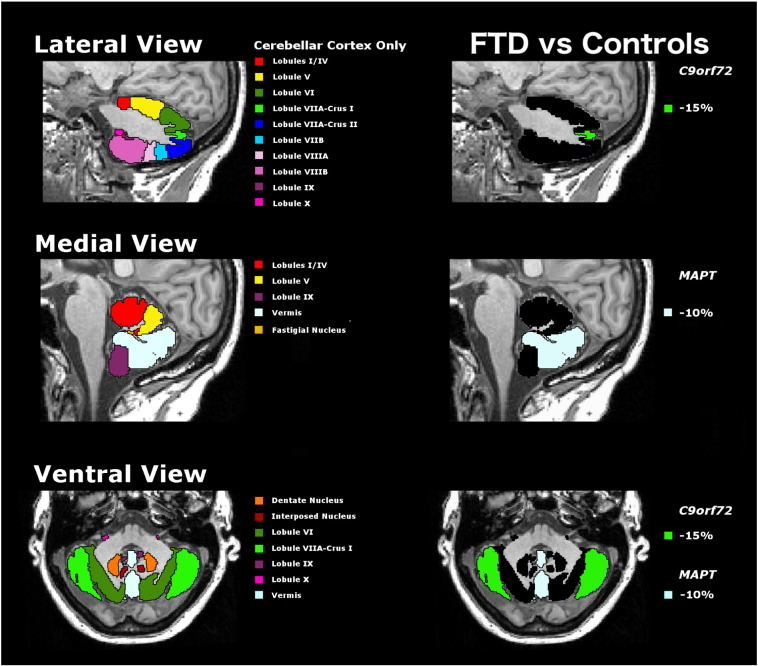
Results: The global cerebellar volume was significantly smaller in C9orf72 carriers (mean (SD): 99989 (8939) mm(3)) compared with controls (108136 (7407) mm(3)). However, no significant differences were seen in the MAPT and GRN carriers compared with controls (104191 (6491) mm(3) and 107883 (6205) mm(3) respectively). Investigating the individual subregions, C9orf72 carriers had a significantly lower volume than controls in lobule VIIa-Crus I (15% smaller, p < 0.0005), whilst MAPT mutation carriers had a significantly lower vermal volume (10% smaller, p = 0.001) than controls. All cerebellar subregion volumes were preserved in GRN carriers compared with controls.
Conclusion: There appears to be a differential pattern of cerebellar atrophy in the major genetic forms of FTD, being relatively spared in GRN, localized to the lobule VIIa-Crus I in the superior-posterior region of the cerebellum in C9orf72, the area connected via the thalamus to the prefrontal cortex and involved in cognitive function, and localized to the vermis in MAPT, the 'limbic cerebellum' involved in emotional processing.
Keywords: C9orf72; Cerebellum; Genetic frontotemporal dementia.
Figures
Comment in
-
Dementia: Cerebellar atrophy has disease-specific patterns.Nat Rev Neurol. 2016 Apr;12(4):188. doi: 10.1038/nrneurol.2016.28. Epub 2016 Mar 11. Nat Rev Neurol. 2016. PMID: 26965672 No abstract available.
References
-
- Arrigo A., Mormina E., Anastasi G.P., Gaeta M., Calamuneri A., Quartarone A., De Salvo S., Bruschetta D., Rizzo G., Trimarchi F., Milardi D. Constrained spherical deconvolution analysis of the limbic network in human, with emphasis on a direct cerebello-limbic pathway. Front. Hum. Neurosci. 2014;8:987. - PMC - PubMed
-
- Behrens T.E., Johansen-Berg H., Woolrich M.W., Smith S.M., Wheeler-Kingshott C.A., Boulby P.A., Barker G.J., Sillery E.L., Sheehan K., Ciccarelli O., Thompson A.J., Brady J.M., Matthews P.M. Non-invasive mapping of connections between human thalamus and cortex using diffusion imaging. Nat. Neurosci. 2003;6(7):750–757. - PubMed
-
- Boyes R.G., Gunter J.L., Frost C., Janke A.L., Yeatman T., Hill D.L., Bernstein M.A., Thompson P.M., Weiner M.W., Schuff N., Alexander G.E., Killiany R.J., DeCarli C., Jack C.R., Fox N.C., ADNI Study Intensity non-uniformity correction using N3 on 3-T scanners with multichannel phased array coils. NeuroImage. 2008;39(4):1752–1762. - PMC - PubMed
Publication types
MeSH terms
Substances
Grants and funding
LinkOut - more resources
Full Text Sources
Other Literature Sources
Miscellaneous
