. 2016 Mar 10;14(3):55.
doi: 10.3390/md14030055.

Pseudopterosin A: Protection of Synaptic Function and Potential as a Neuromodulatory Agent

Affiliations

Pseudopterosin A: Protection of Synaptic Function and Potential as a Neuromodulatory Agent

Stacee Lee Caplan et al. Mar Drugs. .

Abstract

Natural products have provided an invaluable source of inspiration in the drug discovery pipeline. The oceans are a vast source of biological and chemical diversity. Recently, this untapped resource has been gaining attention in the search for novel structures and development of new classes of therapeutic agents. Pseudopterosins are group of marine diterpene glycosides that possess an array of potent biological activities in several therapeutic areas. Few studies have examined pseudopterosin effects during cellular stress and, to our knowledge, no studies have explored their ability to protect synaptic function. The present study probes pseudopterosin A (PsA) for its neuromodulatory properties during oxidative stress using the fruit fly, Drosophila melanogaster. We demonstrate that oxidative stress rapidly reduces neuronal activity, resulting in the loss of neurotransmission at a well-characterized invertebrate synapse. PsA mitigates this effect and promotes functional tolerance during oxidative stress by prolonging synaptic transmission in a mechanism that differs from scavenging activity. Furthermore, the distribution of PsA within mammalian biological tissues following single intravenous injection was investigated using a validated bioanalytical method. Comparable exposure of PsA in the mouse brain and plasma indicated good distribution of PsA in the brain, suggesting its potential as a novel neuromodulatory agent.

Keywords: Drosophila melanogaster; Pseudopterogorgia elisabethae; blood-brain barrier; neuromodulatory agent; octocoral; oxidative stress; pseudopterosins.


Figures
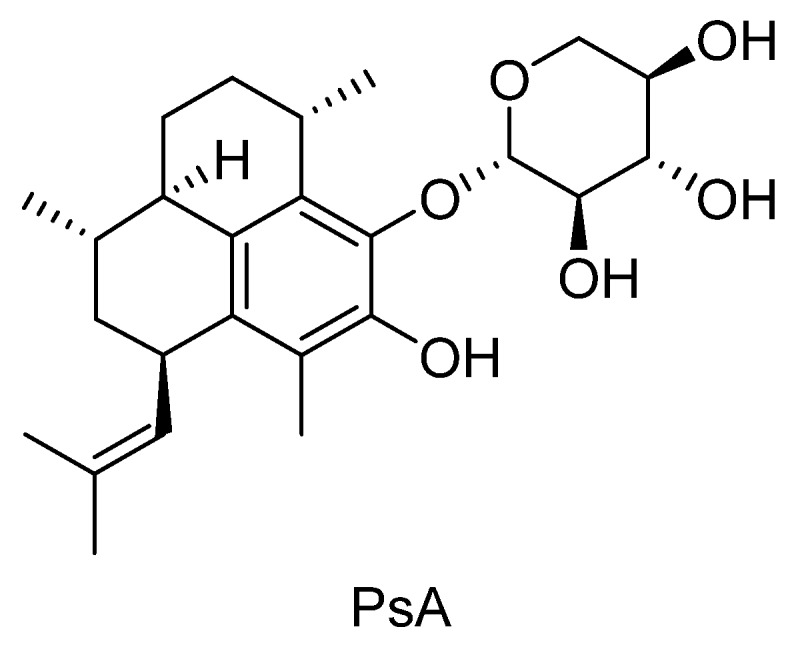
Figure 1
Figure 1
Chemical structure of pseudopterosin A (PsA).
Figure 2
Figure 2
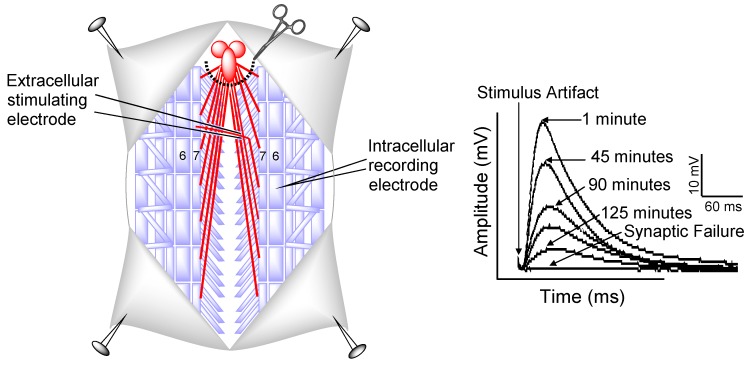
The Drosophila larval NMJ preparation and electrophysiological recording of the postsynaptic response. (Left) A diagram of the body wall muscles and innervating nerves in 3rd instar Drosophila larvae. The larval NMJ dissection technique removes the central nervous system. A presynaptic nerve is suctioned into an extracellular stimulating electrode and the postsynaptic excitatory junction potential (EJP) is recorded from muscle 6/7 with an intracellular electrode. (Right) An example of the postsynaptic EJP and its decline over time until synaptic failure (amplitude < 1 mV).
Figure 3
Figure 3
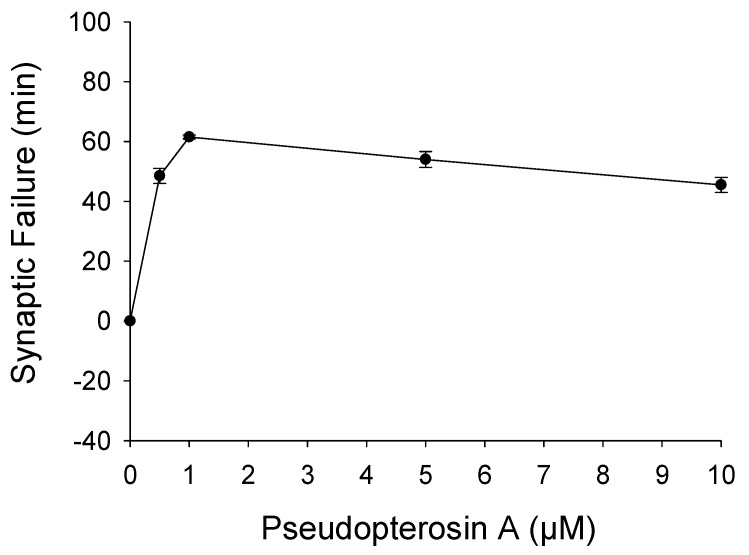
Dose–response curve of pseudopterosin A (0.5–10 µM) during oxidative stress induced by H2O2 (1 mM) in wild-type Canton-S Drosophila larvae.
Figure 4
Figure 4
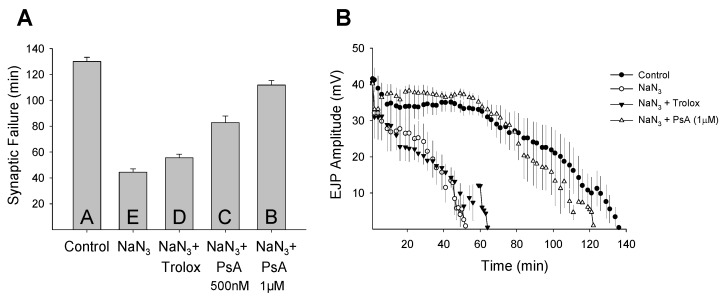
Pseudopterosin A protects synaptic function during NaN3 exposure. (A) Synaptic transmission at the Drosophila larval NMJ failed rapidly during NaN3 exposure (75 µM; N = 5) compared to control preparations (N = 4). Pseudopterosin A (PsA; 500 nM (N = 5) or 1 µM (N = 4)) and Trolox (5 µM; N = 4) showed extension of neurotransmission during the insult (one-way ANOVA, F(4,17) = 92.985, p < 0.001). Letters in histogram bars represent statistical rankings using a pair-wise multiple comparison procedure, where different letters are statistically significant (Holm-Šidák, p < 0.05). All vertical bar charts are shown as means ± SE. (B) Amplitude of evoked EJPs reduced over time at different rates in control preparations (saline only) and those exposed to NaN3 (75 µM). The addition of either Trolox (5 µM) or PsA (1 µM) to the saline/NaN3 bath solution extended the time that synaptic transmission continued.
Figure 5
Figure 5
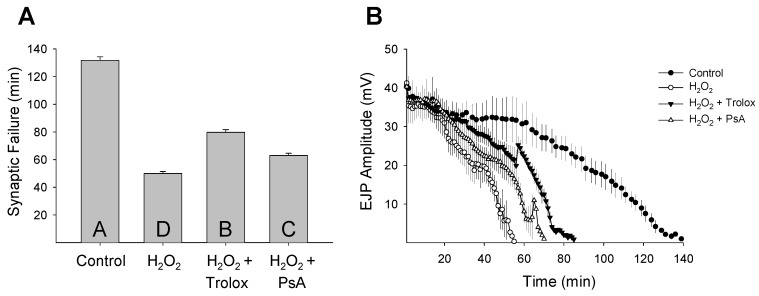
Pseudopterosin A protects synaptic function during H2O2 exposure. (A) Synaptic transmission at the Drosophila larval NMJ failed rapidly during H2O2 exposure (1 mM; N = 4) compared to control preparations (N = 4). Pseudopterosin A (PsA; 1 µM (N = 5)) and Trolox (5 µM; N = 4) showed significant extension of neurotransmission during the insult (one-way ANOVA, F(3,13) = 349.27, p < 0.001). Letters in histogram bars represent statistical rankings using a pair-wise multiple comparison procedure, where different letters are statistically significant (Holm-Šidák, p < 0.05). All vertical bar charts are shown as means ± SE. (B) Amplitude of evoked EJPs reduced over time at different rates in control preparations (saline only) and those exposed to H2O2 (1 mM). The addition of either Trolox (5 µM) or PsA (1 µM) to the saline/H2O2 bath solution extended the time that synaptic transmission continued.
Figure 6
Figure 6
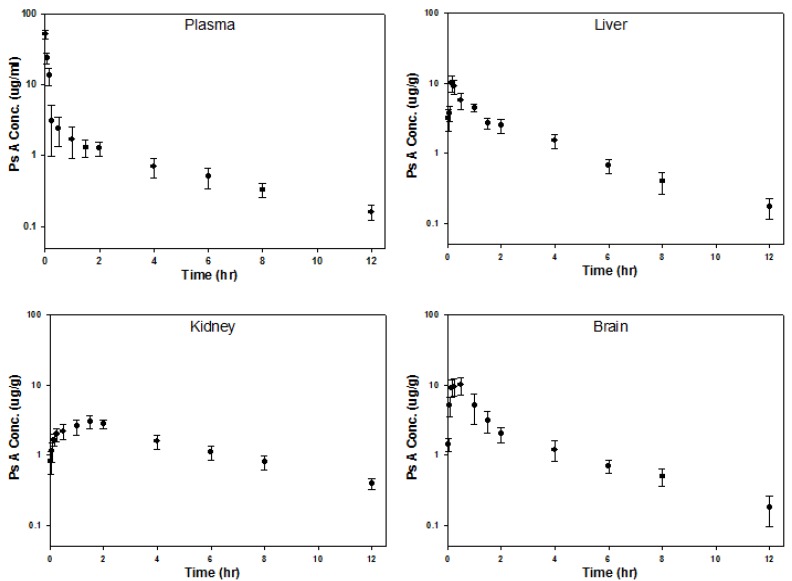
Concentration vs. time profiles of PsA in the plasma, liver, brain, and kidney after 50 mg/mL iv bolus doses of PsA via the tail vein in male NIH Swiss mice (25–30 g). The mice were fasted for 12 h before receiving PsA and fed 4 h after drug administration. The mice (N = 3 per time point) were sacrificed under anesthesia and blood and tissue samples were collected at each time point (2, 5, 10, 15, 30, 60, 90, 120, 180, 240, 360, 480, 720 min) into heparinized microcentrifuge tubes.

References

    1. Inoue M., Sato E.F., Nishikawa M., Park A.M., Kira Y., Imada I., Utsumi K. Mitochondrial generation of reactive oxygen species and its role in aerobic life. Curr. Med. Chem. 2003;10:2495–2505. doi: 10.2174/0929867033456477. - DOI - PubMed
    1. Kohen R., Nyska A. Oxidation of biological systems: Oxidative stress phenomena, antioxidants, redox reactions, and methods for their quantification. Toxicol. Pathol. 2002;30:620–650. doi: 10.1080/01926230290166724. - DOI - PubMed
    1. Auerbach J.M., Segal M. Peroxide modulation of slow onset potentiation in rat hippocampus. J. Neurosci. 1997;17:8695–8701. - PMC - PubMed
    1. Vanden-Hoek T.L., Becker L.B., Shao Z., Li C., Schumacker P.T. Reactive oxygen species released from mitochondria during brief hypoxia induce preconditioning in cardiomyocytes. J. Biol. Chem. 1998;273:18092–18098. doi: 10.1074/jbc.273.29.18092. - DOI - PubMed
    1. Fraga C.G., Shigenaga M.K., Park J.W., Degan P., Ames B.N. Oxidative damage to DNA during aging: 8-Hydroxy-2′-deoxyguanosine in rat organ DNA and urine. Proc. Natl. Acad. Sci. USA. 1990;87:4533–4537. doi: 10.1073/pnas.87.12.4533. - DOI - PMC - PubMed

Publication types

MeSH terms

LinkOut - more resources